
Maths
Stop doing 20 identical questions. Start choosing the method.
Why a perfect page of identical A-Level Maths questions can mislead you, and how to move from blocked practice to mixed sets that train you to choose between differentiating, integrating and solving.
By Finesse Tuition · · 8 min read
The most reassuring page of work can be the least informative
Here is an uncomfortable idea: twenty correct differentiation questions in a row may tell you surprisingly little about how you will perform in an A-Level Maths paper. The exercise heading has already told you the method. Each question looks like the one before it. By question five you are often repeating a pattern rather than deciding what to do.
That is not useless. Repetition is how a new technique becomes fluent. The problem comes when it is the only kind of practice you do. In the exam, nobody writes “differentiate” at the top of the page. A question about a curve might want a gradient, a stationary point, an area, an equation of a tangent or the coordinates where the curve meets the axis. Part of the mark comes from recognising which of those you have been asked for.
So the aim of this guide is not to make revision feel harder for its own sake. It is to separate two skills that are easy to blur together: carrying out a method, and choosing it. Students who struggle with the second skill often describe it as “I knew how to do it once I saw the mark scheme.” That sentence is a useful diagnosis. It usually means the execution is there and the selection is not.
Blocked practice first, then mixed practice
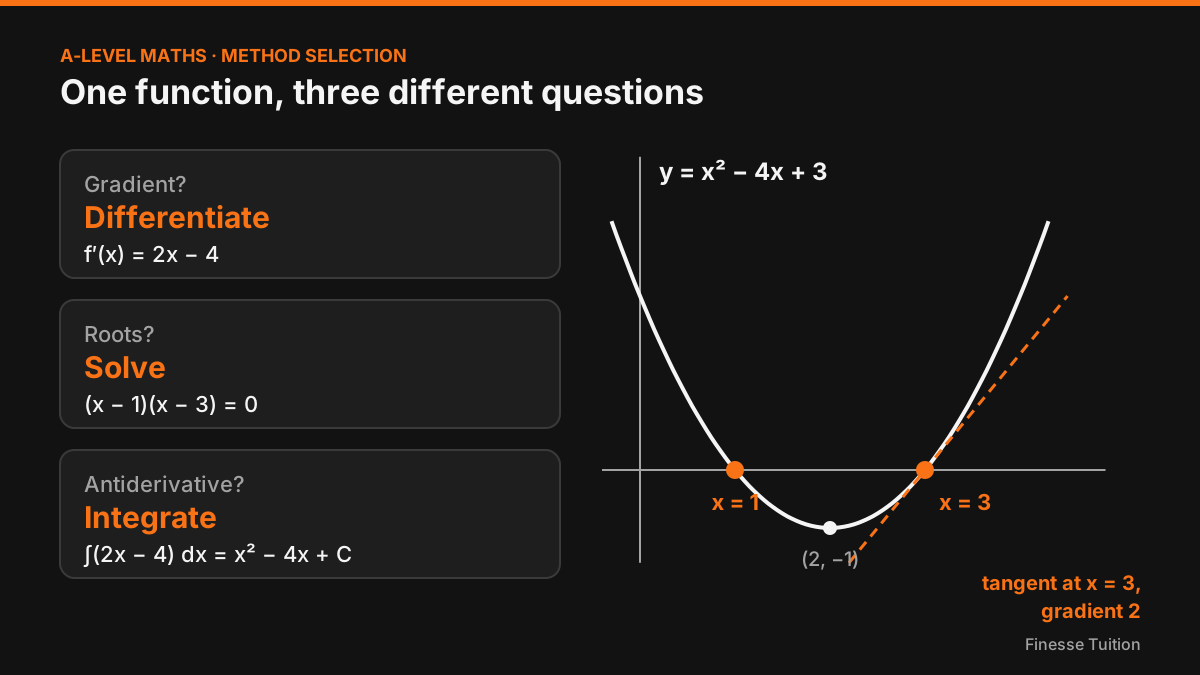
Researchers use the term blocked practice for a set of problems that all use the same method, and interleaved practice for a set that mixes problem types so consecutive questions need different strategies. In a frequently cited experiment, Rohrer and Taylor (2007) found that students who practised a mix of related maths problem types performed better on a later test than students who practised them in blocks, even though the blocked group often looked better during practice itself.
Later classroom work points in the same direction. Rohrer and colleagues (2020) ran a cluster-randomised trial in which whole maths classes received either mostly interleaved or mostly blocked assignments, and the interleaved group scored higher on a delayed, unannounced test. That trial was with seventh-grade students in the United States, not A-Level students, and it measured a specific test rather than final qualification grades. It supports a principle; it does not guarantee a particular A-Level outcome.
The practical sequence we recommend is simple. When a method is genuinely new to you, start with a short blocked set so you can concentrate on the steps. As soon as you can complete those steps without notes, stop adding more identical questions. Move the method into a mixed set alongside the methods it is most often confused with. For calculus, that means placing differentiation, integration and equation-solving questions side by side.
A worked example: one function, three questions
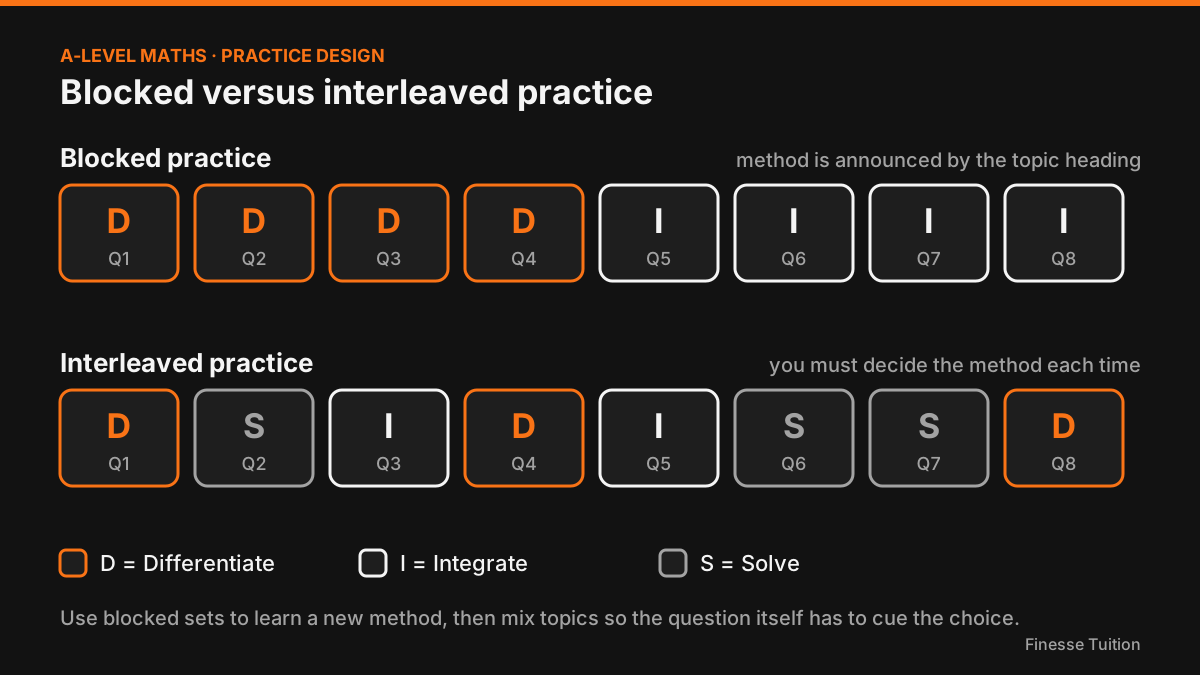
Take f(x) = x² − 4x + 3. We will ask three short questions about it and notice how the wording, not the function, determines the method.
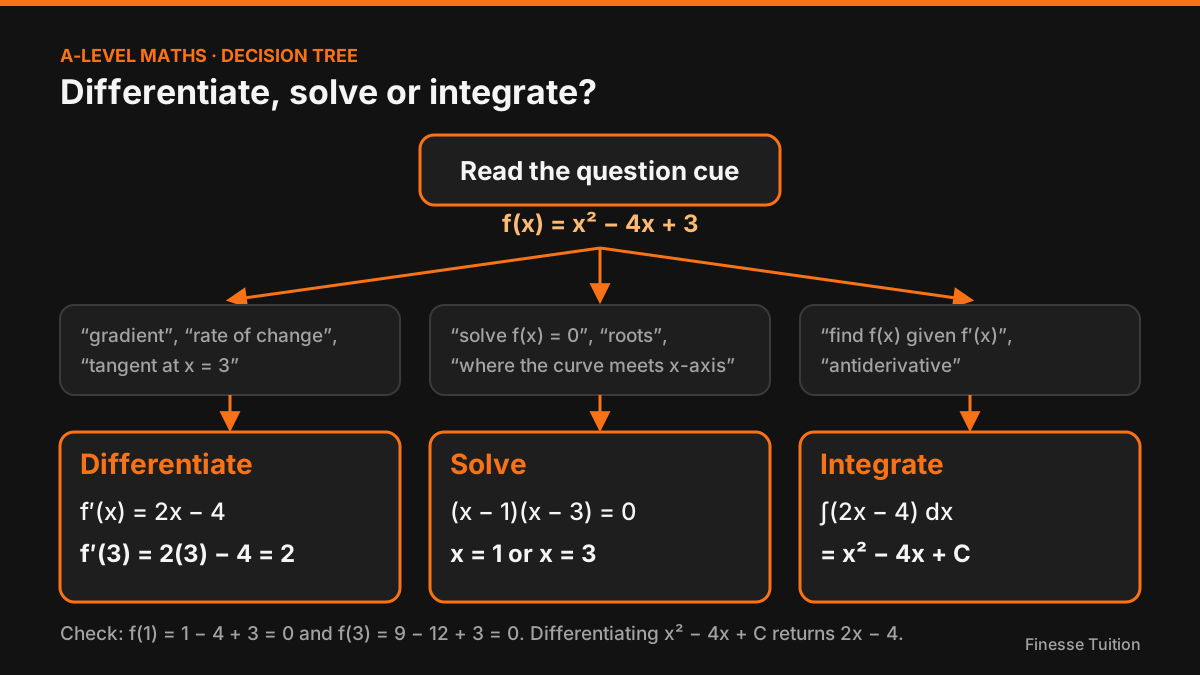
Question 1: find the gradient of the curve at x = 3. The cue is “gradient”. Differentiate: f′(x) = 2x − 4. Substitute x = 3: f′(3) = 2(3) − 4 = 2. The gradient of the tangent at x = 3 is 2.
Question 2: solve f(x) = 0. The cue is an equation set equal to zero, so this is solving, not calculus. Factorise: x² − 4x + 3 = (x − 1)(x − 3). Setting each factor to zero gives x = 1 or x = 3. Check by substitution: f(1) = 1 − 4 + 3 = 0 and f(3) = 9 − 12 + 3 = 0. These are where the curve crosses the x-axis.
Question 3: given that the gradient function is 2x − 4, find an expression for the original function. The cue is going backwards from a derivative, so integrate: ∫(2x − 4) dx = x² − 4x + C. Without further information the constant cannot be found. If you are told the curve passes through (0, 3), then C = 3 and you recover f(x) = x² − 4x + 3. Differentiating x² − 4x + C returns 2x − 4, which is a quick check that the integration was correct.
Notice that the slowest part of each question is not the arithmetic. It is the first ten seconds, when you decide what kind of answer is wanted. That is precisely the decision that blocked practice removes, and that mixed practice forces you to rehearse.
- “Gradient”, “rate of change”, “tangent” or “stationary point” usually points to differentiating.
- “Solve”, “roots”, “intersects the x-axis” or “= 0” points to solving an equation.
- “Find f(x) given f′(x)”, “area under the curve” or “antiderivative” points to integrating.
- Before writing algebra, state in one line what you need, for example “need f′(3)”.
Correct the cause, not just the answer
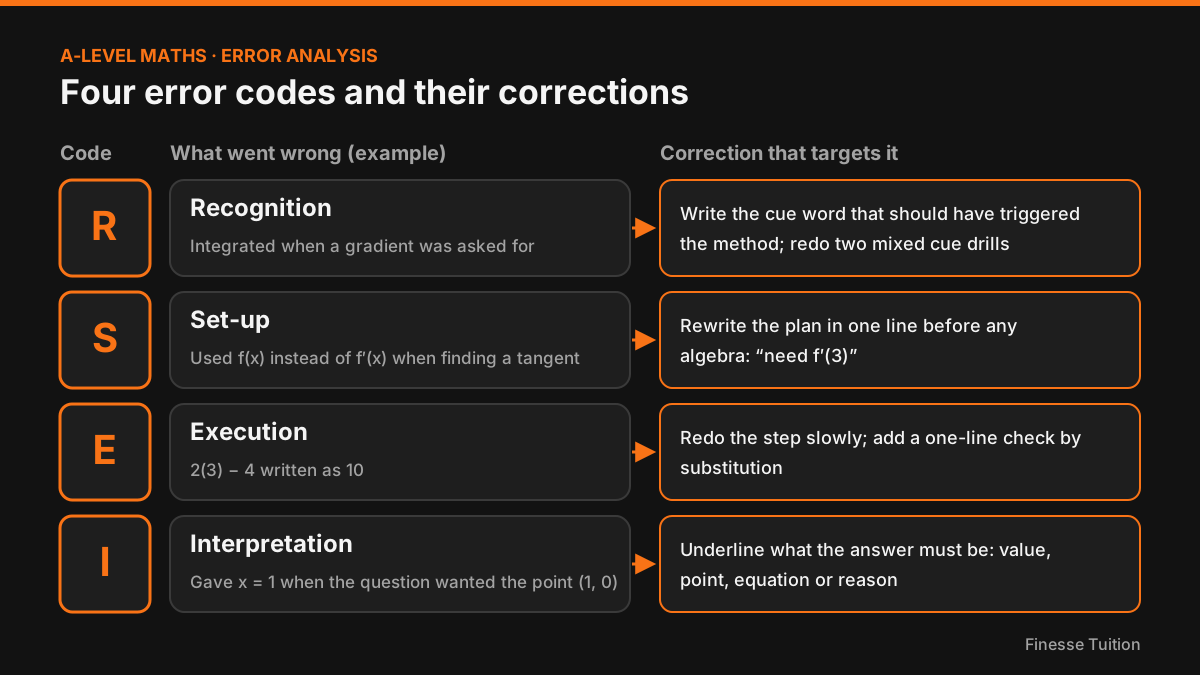
Mixed practice will produce more mistakes than blocked practice, at least at first. That is useful only if you look at the mistakes carefully. Copying out the correct solution is not enough, because it does not tell you why the error happened. We ask students to tag each lost mark with one of four codes.
R for recognition: you chose the wrong method, for example integrating when the question asked for a gradient. The repair is to write down the cue you missed, then do two or three short “which method?” drills where you only identify the method without solving.
S for set-up: you chose the right area of maths but started from the wrong expression, for example substituting into f(x) instead of f′(x) when finding the gradient of a tangent. The repair is to write a one-line plan before any calculation.
E for execution: the plan was right and the algebra or arithmetic slipped, for instance writing 2(3) − 4 = 10. The repair is to redo the step slowly and build a habit of checking, such as substituting your roots back into the original equation.
I for interpretation: the working was correct but the final answer did not answer the question, such as giving x = 1 when the question asked for the coordinates of a point, which are (1, 0). The repair is to underline what form the answer must take before you begin.
This approach reflects what the Education Endowment Foundation describes in its guidance on metacognition (second edition, 2025): learners benefit from planning, monitoring and evaluating their own approach to a task, rather than only checking whether the final answer was right. Coding errors is a concrete way of evaluating.
What the evidence does and does not tell us
Dunlosky and colleagues (2013) reviewed ten common study techniques. They rated practice testing and distributed (spaced) practice as having high utility, and interleaved practice as moderate, partly because the evidence base was smaller and more concentrated in particular kinds of tasks, including maths. They rated rereading and highlighting as low utility when used on their own. These are ratings from a review of studies, not absolute rules, and they do not say that any technique always works for every learner or every topic.
Interleaving is most clearly useful when the problem types are similar enough to be confused. Mixing a calculus question with a probability question may not help much, because the difference is obvious. Mixing differentiation with integration, or the sine rule with the cosine rule, makes you discriminate between methods that genuinely look alike. Mixed practice can also feel slower and less satisfying, which can make it seem less effective than it is.
Finally, no study we cite measured A-Level grades directly. Use the findings as a sensible guide to how you structure practice, monitor whether your own mixed-set scores improve over several weeks, and adjust if they do not.
Context from the 2026 results
In its overview of summer 2026 results, published on 13 August 2026, Ofqual reported that maths remained the most commonly taken A-Level subject. The proportion of maths entries awarded A* or A rose slightly, from 41.6% in 2025 to 42.1% in 2026. Ofqual stated that the standard of work required for each grade in maths was the same as in previous years, and attributed the rise to a slightly stronger cohort. It is therefore not evidence that the exams have become easier.
Overall, Ofqual’s statistics record 835,950 A-Level results awarded to 320,505 students in England in summer 2026. Further maths also continued to grow. For a student, the practical takeaway is modest: a large, capable cohort sits these papers, and the questions continue to reward precise method selection, not just familiarity with a chapter.
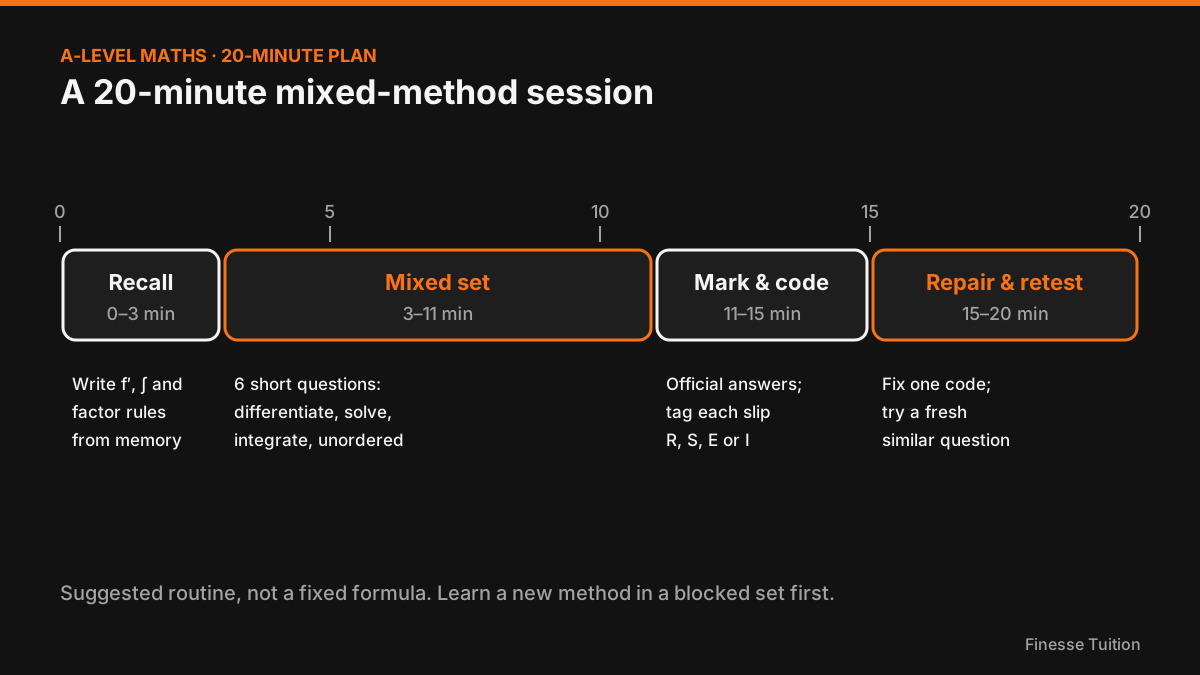
A 20-minute mixed-method routine
Use this routine once you can perform each method on its own. It fits into a short evening slot and leaves you with a clear target for next time.
Keep a simple log with the date, the question source, your error codes and the repair you chose. Over two or three weeks the codes will show you whether your main problem is choosing the method, setting it up, executing it or reading what the answer should be. That pattern is far more useful than a single percentage score.
- Minutes 0–3: from memory, write the rules for differentiating and integrating xⁿ and one factorising method.
- Minutes 3–11: attempt six short, unordered questions that mix differentiating, integrating and solving.
- Minutes 11–15: mark against the official answers or mark scheme and tag each lost mark R, S, E or I.
- Minutes 15–20: repair the most frequent code, then attempt one fresh question that tests the same decision.
- Two or three days later, start with a new mixed set rather than repeating the same six questions.
Sources & further reading
- Dunlosky et al. (2013), Improving Students’ Learning With Effective Learning Techniques, Psychological Science in the Public Interest
- Rohrer & Taylor (2007), The shuffling of mathematics problems improves learning, Instructional Science
- Rohrer, Dedrick, Hartwig & Cheung (2020), A randomized controlled trial of interleaved mathematics practice, Journal of Educational Psychology
- Education Endowment Foundation (2025), Metacognition and Self-Regulated Learning — guidance report, 2nd edition
- Ofqual blog, 13 August 2026: A level and level 3 results 2026 at a glance
- GOV.UK (Ofqual), Qualification results in England: summer 2026
Sources checked on 12 October 2026. Check linked guidance for subsequent changes.