
Chemistry
Stop revising. Start retargeting: turn every lost mark into a permanent upgrade.
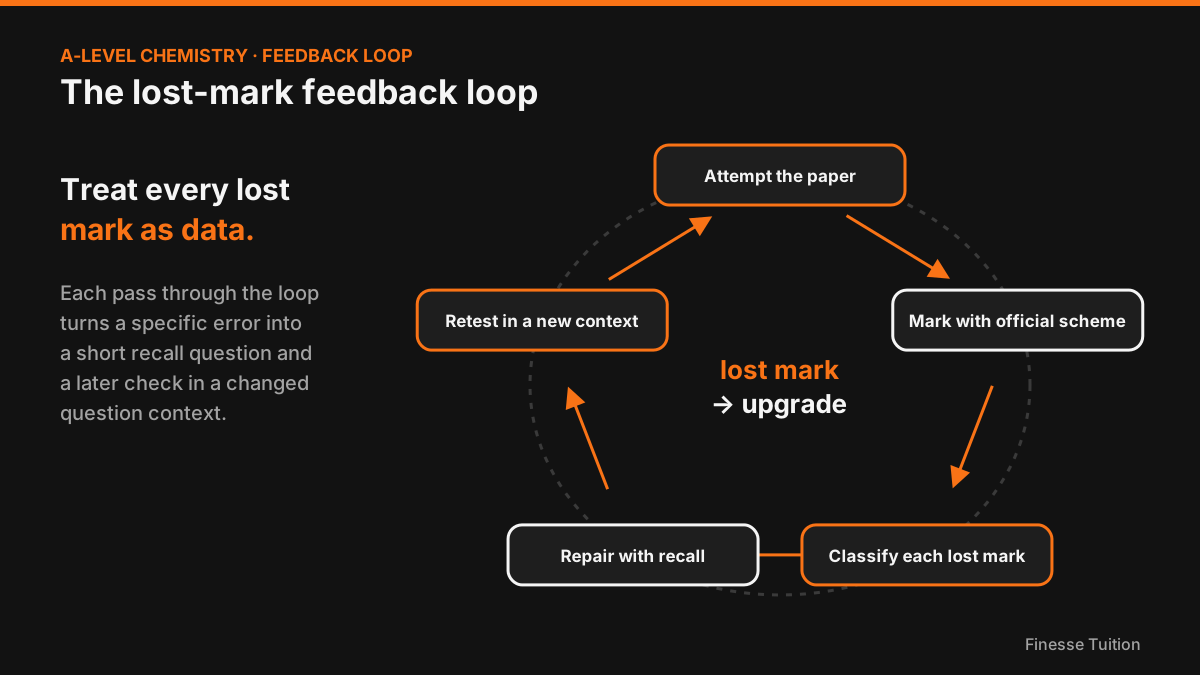
A feedback-led system for A-Level Chemistry: mark real AQA or OCR papers with the official scheme, classify every lost mark into one of six categories, then repair it with recall and a spaced, changed-context retest.
By Finesse Tuition · · 7 min read
Your next past paper is worth less than your last one
Most students treat a past paper as a test: sit it, see the score, move on to the next one. Yet the score is the least useful thing a paper produces. The valuable part is the list of marks you dropped, because each one is a precise description of what is not yet secure. If you start the next paper before you have dealt with that list, you are likely to lose many of the same marks again, just on different questions.
So instead of “revising Chemistry” in general, we suggest retargeting: aiming each study session at the specific marks you have already shown you can lose. This guide sets out a complete system for doing that with genuine AQA or OCR papers and their official mark schemes. It works whether you are aiming to move from a C to a B or to secure an A*. It is not a shortcut, and it will not by itself guarantee a grade, but it makes every hour of practice far more specific.
Step 1: mark with the official scheme, honestly
Use papers and mark schemes published by your own exam board for your specification. Sit at least a section under timed conditions, without notes, then mark it yourself before looking at any worked solutions. When you compare your answer with the mark scheme, read the guidance notes as well as the main answer column. Schemes often list alternative acceptable answers and say what is not accepted for that particular question.
Be careful how you generalise from a mark scheme. A phrase that is required for one question does not automatically apply to every question on the same topic. If several papers and examiner reports point in the same direction, that is stronger evidence. If you only have one example, note it as specific to that question.
The Education Endowment Foundation’s guidance on teacher feedback (2021) recommends that feedback focuses on moving learning forward and that learners have opportunities to act on it. Self-marking against an official scheme gives you feedback; this system is about making sure you act on it.
Step 2: classify every lost mark
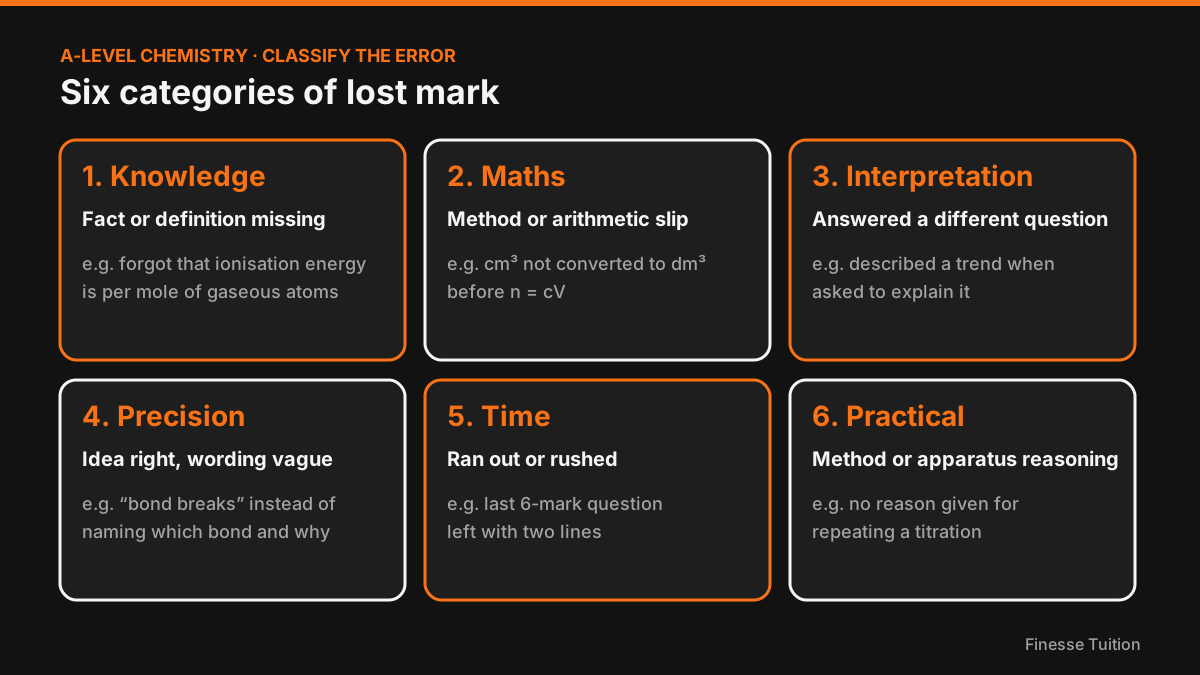
Write each lost mark on a single line and give it one category. The category decides the repair, so be specific.
Over a few papers, a pattern usually appears. A student who loses mostly knowledge marks needs more recall practice. A student who loses mostly precision marks often understands the chemistry but needs to practise writing explanations that name the particles, bonds or forces involved. Time errors may need a change to how you order a paper, not more content.
- Knowledge: a fact or definition was missing or wrong.
- Maths: a calculation method, unit conversion, rounding or significant-figure slip.
- Interpretation: you answered a different question, such as describing when asked to explain.
- Mark-scheme precision: the idea was right but too vague to earn the mark.
- Time: the question was rushed or not reached.
- Practical: reasoning about apparatus, method, variables or reliability was missing.
Step 3: repair with a worked example you can explain
Suppose you lost a maths mark on a reacting-quantities question. A useful repair is a short worked example you can reproduce and explain from memory. Here is an original one.
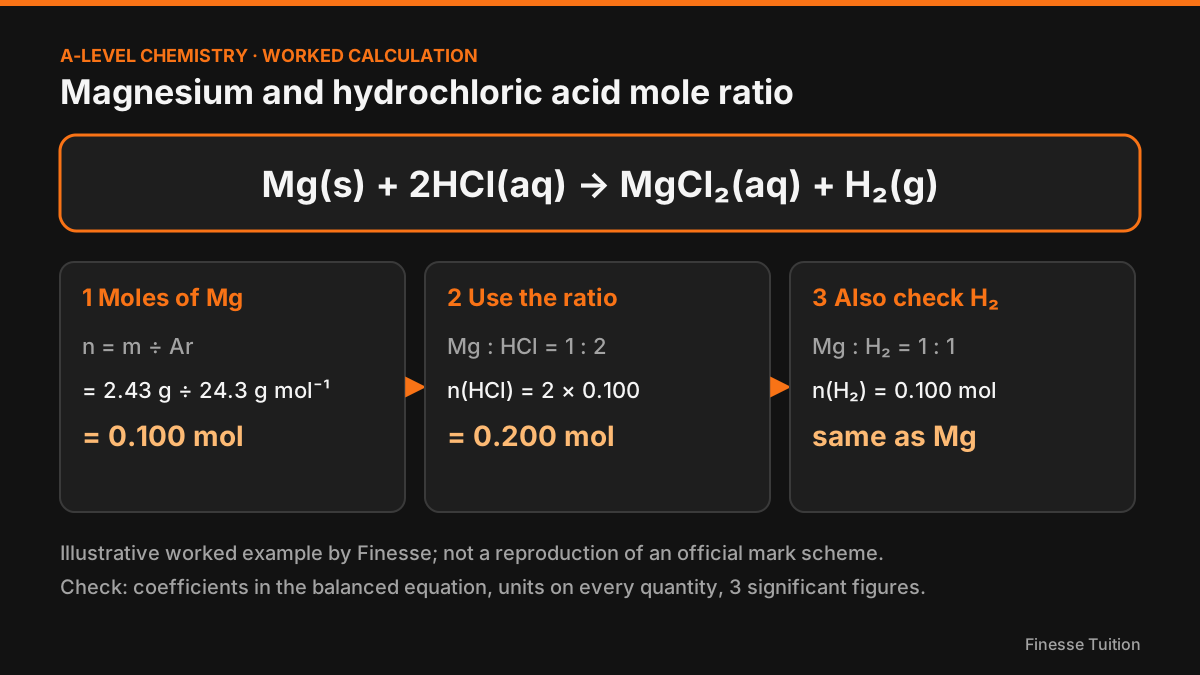
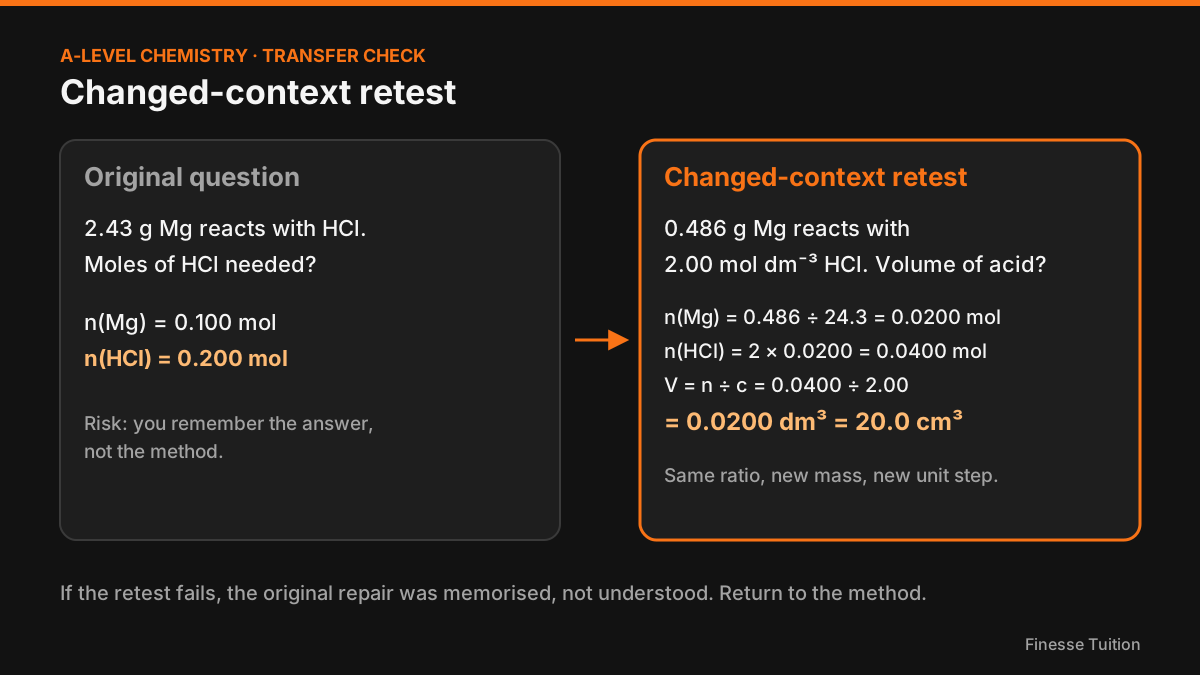
Magnesium reacts with hydrochloric acid: Mg(s) + 2HCl(aq) → MgCl₂(aq) + H₂(g). How many moles of HCl react with 2.43 g of magnesium? First find the amount of magnesium: n = m ÷ Ar = 2.43 g ÷ 24.3 g mol⁻¹ = 0.100 mol. The balanced equation shows that 1 mol of Mg reacts with 2 mol of HCl, so n(HCl) = 2 × 0.100 = 0.200 mol. As a check, the same equation shows 1 mol of Mg produces 1 mol of H₂, so 0.100 mol of hydrogen forms.
The repair is not finished when you can copy those lines. Write down why each step is there: the mass is converted to moles because the equation compares amounts in moles, the coefficients give the ratio, and the answer is quoted to three significant figures to match the data. Then turn the repair into a recall question for later, such as “What is the mole ratio of Mg to HCl, and why?”
Step 4: retest on day 1, day 3 and day 7
Testing yourself after a delay is one of the better-supported study habits. Dunlosky and colleagues (2013) rated practice testing and distributed practice as high-utility techniques in their review, while rereading and highlighting on their own were rated low. Karpicke and Roediger (2008) showed that repeated retrieval greatly improved later recall; their study used foreign-language vocabulary pairs, so it supports the principle of retrieval rather than proving a specific effect on chemistry exams.
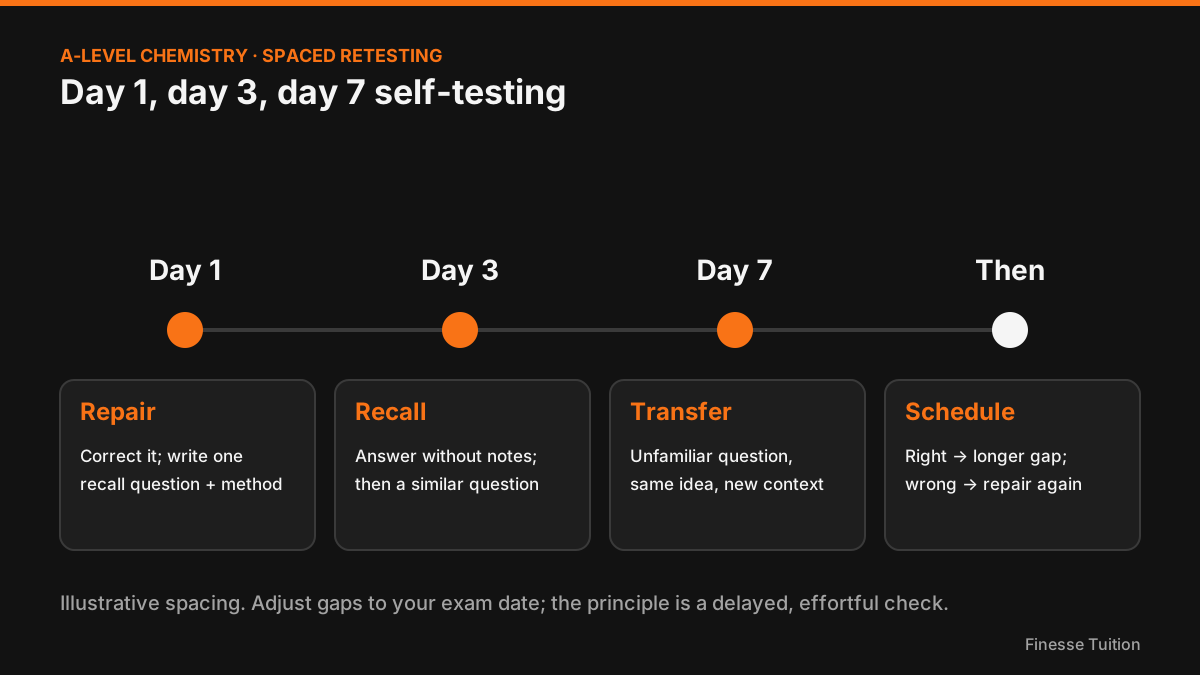
A simple schedule is enough. On day 1, make the repair and write one recall question plus one model method. On day 3, answer the recall question without notes and try a similar calculation. On day 7, attempt an unfamiliar question that uses the same idea in a different context. If you get it right, lengthen the gap; if not, go back to the repair. The days are illustrative; the principle is a delayed, effortful check.
Step 5: check that the understanding transfers
Repeating the original question tests memory of that answer. A changed-context question tests the method. For the magnesium example, try: what volume of 2.00 mol dm⁻³ hydrochloric acid reacts exactly with 0.486 g of magnesium?
n(Mg) = 0.486 ÷ 24.3 = 0.0200 mol. Using the 1:2 ratio, n(HCl) = 0.0400 mol. Volume = n ÷ c = 0.0400 ÷ 2.00 = 0.0200 dm³, which is 20.0 cm³. The question adds a concentration step and a unit conversion, so it checks whether you understood the ratio rather than remembering 0.200.
A one-page error log and seven-day plan
Keep everything on a single page per paper so you can review it in two minutes. Columns: question number, marks lost, category, a one-line cause, the repair, the recall question, and three small boxes for day 1, day 3 and day 7. Tick each box only when you answer correctly without notes.
A seven-day plan around one paper might look like this: day 1 sit and mark the paper and make repairs; days 2 and 3 retest the day-1 items and start new content; day 4 a short mixed set from older papers; days 5 and 6 normal study plus any failed retests; day 7 the changed-context checks, then choose the next paper.
- Q number · marks lost · category · cause in one line.
- Repair: the corrected method or explanation, in your own words.
- Recall question you can answer without notes.
- Day 1 / Day 3 / Day 7 boxes, ticked only on unaided success.
Limits of the evidence, and 2026 context
The studies behind this system were not run on A-Level Chemistry students, and none measured A-Level grades directly. The categories are a practical tool, not a research classification, and some lost marks fit more than one category. If a schedule is not producing better unaided answers after a few weeks, change it.
On 13 August 2026 Ofqual reported that chemistry was among the five most commonly taken A-Level subjects, alongside maths, psychology, biology and economics, and described the overall national picture for results as one of stability. We do not speculate about future grade boundaries; they are set each year after papers are marked. What you can control is how thoroughly each paper you sit is turned into specific, retested improvements.
A 20-minute retargeting routine
When you do not have time for a full paper, run one short loop.
- Minutes 0–4: answer three recall questions from your error log without notes.
- Minutes 4–12: attempt one past-paper question you have not seen.
- Minutes 12–16: mark it with the official scheme and classify any lost mark.
- Minutes 16–20: write the repair and a recall question, and schedule its day 3 and day 7 checks.
Sources & further reading
- Dunlosky et al. (2013), Improving Students’ Learning With Effective Learning Techniques, Psychological Science in the Public Interest
- Karpicke & Roediger (2008), The critical importance of retrieval for learning, Science
- Education Endowment Foundation (2021), Teacher Feedback to Improve Pupil Learning — guidance report
- Education Endowment Foundation (2025), Metacognition and Self-Regulated Learning — guidance report, 2nd edition
- Ofqual blog, 13 August 2026: A level and level 3 results 2026 at a glance
- GOV.UK (Ofqual), Qualification results in England: summer 2026
Sources checked on 12 October 2026. Check linked guidance for subsequent changes.