
Follow 2-chloro-2-methylpropane through its preparation and work-up, explain what each purification step removes, and calculate a defensible isolated yield.
A tertiary alcohol gives a tertiary chloroalkane
Core Practical 6 reacts 2-methylpropan-2-ol with concentrated hydrochloric acid to prepare 2-chloro-2-methylpropane. The OH group is replaced by Cl, leaving the four-carbon skeleton unchanged. Water is the other product. This is substitution, even though the practical title uses the word chlorination.
The tertiary alcohol reacts readily because the pathway can involve a relatively stable tertiary carbocation after acid assists departure of water. This explanation connects to carbocation stability, but detailed alcohol-substitution mechanisms are not required by 6.38. The practical priority is preparing, separating, drying and testing the intended product.
Work in a fume cupboard with eye protection and suitable gloves: concentrated HCl is corrosive and gives harmful fumes, and the organic reactant and product are flammable. Use the laboratory’s supervised quantities and risk assessment. The following account explains the purpose and order of the operations.
Mix, allow reaction and release pressure
The Pearson worksheet combines the alcohol and concentrated HCl in a conical flask, gently mixes over the specified reaction time and repeatedly releases pressure. Two liquid layers form; in this particular preparation the crude organic product is the upper layer. Do not heat a sealed vessel or allow pressure to accumulate.
After about 20 minutes of controlled mixing, the worksheet adds calcium chloride before transfer to the separating funnel to help retain unreacted alcohol in the lower aqueous phase. This is distinct from the later addition of anhydrous sodium sulfate to the isolated organic phase for drying. Simply calling every salt addition “drying” misses what it is doing at that stage.
Alcohol can hydrogen-bond with water; the chloroalkane cannot make equivalent strong hydrogen bonds and has much lower water solubility. The product also lacks the O–H intermolecular hydrogen bonding of the alcohol, helping explain its lower boiling temperature. Use the known density/layer information for this preparation; an organic layer is not always the upper layer in every extraction.
Use partition between two immiscible phases
Transfer to a separating funnel, allow the phases to settle and remove the lower aqueous layer. A separating funnel separates immiscible liquid phases; it does not separate two liquids that dissolve completely in one another. Where layer identity is uncertain, use reliable density information or a small water-addition test: the aqueous layer increases in volume.
For washing, gently mix the organic product with the chosen aqueous solution so water-soluble impurities can transfer into the aqueous phase. Vent as directed, pointing the outlet away from people. Let the phases separate again. Remove the stopper when draining through the tap so air can enter; otherwise flow may be irregular or stop.
Drain the lower phase into a labelled container and retain both fractions until the product-containing layer has been identified confidently. Avoid carrying an aqueous droplet trapped in the tap into the organic collection. Dry glassware for the subsequent organic stage prevents adding back the water you are trying to remove.
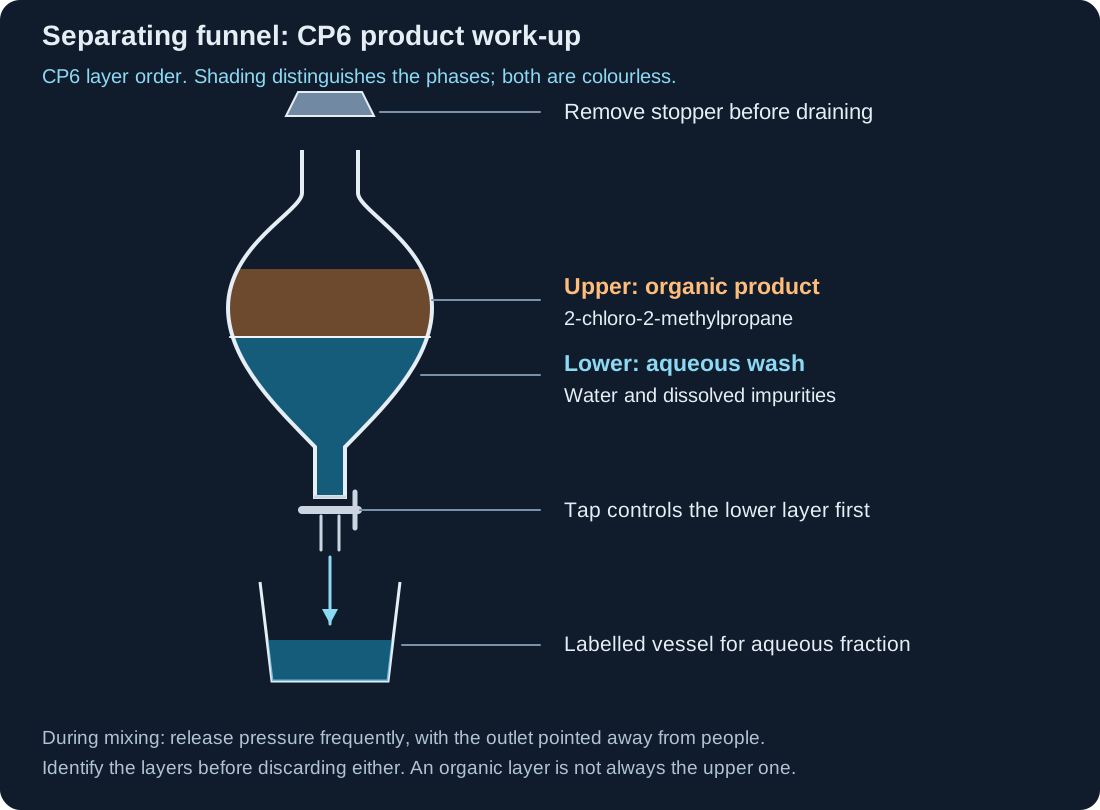
Swipe horizontally to view the whole diagram.
Neutralisation and drying remove different impurities
Wash the retained organic layer with aqueous sodium hydrogencarbonate to remove residual HCl. Acid–hydrogencarbonate reaction produces CO₂, explaining the effervescence and pressure build-up. Add and mix in controlled portions, vent frequently and repeat the wash as directed. A drying agent is not a replacement for neutralising residual acid.
After separating off the wash water, transfer the organic product into a clean dry flask and add anhydrous sodium sulfate. It binds residual water as hydrated salt. Swirl and allow enough time; the liquid becomes clear and fresh drying agent remains free-moving when sufficient water has been removed. Decant the liquid away from the solid, or filter appropriately, before distillation.
A suitable drying agent must remove water without reacting with the wanted product, and it must be separable. Adding water to dissolve the drying agent defeats the drying step. Excessive solid can also retain some product, contributing to a lower isolated yield.
Collect a boiling range, not every liquid that arrives
Assemble distillation apparatus with anti-bumping granules added before heating. Use an appropriate water bath or controlled electric heat for the volatile, flammable product. Keep an open path to the receiver and place the thermometer bulb in the vapour at the entrance to the condenser sidearm; this measures the temperature of vapour being collected, not the flask liquid or cooling water.
Water enters the lower end of the condenser jacket and leaves at the upper end. Vapour condenses and runs into the receiver. Pearson’s CP6 sheet specifies collection of the fraction boiling between 50 and 52 °C; a centre method may specify a slightly broader range. Record the actual range and use the pressure/reference information supplied, rather than treating a memorised value as universal.
A narrow boiling range close to a reliable value supports purity, but does not prove identity by itself. Atmospheric pressure affects boiling temperature; some different substances have similar values and mixtures can behave unexpectedly. Combine the boiling range with a suitable chemical test and/or spectroscopy. Keep the sample stoppered appropriately once cool to reduce evaporation losses.
| Technique | Purpose | What it cannot establish alone |
|---|---|---|
| Reflux | Keep volatile material in the reaction while heating | Does not isolate a product into a separate receiver |
| Solvent extraction/washing | Move components between immiscible phases | Does not by itself remove every trace of water |
| Drying with an anhydrous salt | Remove residual water from organic liquid | Does not replace an acid-neutralising wash |
| Distillation | Separate and collect a volatile fraction | Does not guarantee a unique identity |
| Boiling-temperature measurement | Compare a physical property and assess a range | A matching value alone does not prove complete purity |
Show that chlorine is covalently bonded
To test a chloroalkane chemically, a separate small sample can be hydrolysed with aqueous hydroxide, then acidified with dilute nitric acid before silver nitrate is added. Hydrolysis releases Cl⁻; Ag⁺ gives white AgCl. The acid removes excess hydroxide that could otherwise produce a silver-containing precipitate. Nitric acid avoids introducing chloride from HCl.
Residual hydrochloric acid would itself give chloride, causing a misleading positive result. That is why correct washing and use of a separate sample matter. The test, suitable boiling range and absence of an alcohol O–H absorption together provide stronger evidence than any one observation.
Worked limiting-reagent calculation and atom economy
Illustrative data: 7.40 g of pure 2-methylpropan-2-ol, M = 74.0 g mol⁻¹, reacts with excess HCl. n(alcohol) = 7.40/74.0 = 0.100 mol. The 1:1 equation gives 0.100 mol 2-chloro-2-methylpropane. With M = 92.5 g mol⁻¹, theoretical product mass = 0.100 × 92.5 = 9.25 g.
If the dry purified product mass is 6.66 g, percentage isolated yield = 6.66/9.25 × 100 = 72.0%. Use the starting alcohol amount only because HCl was stated to be in excess; if both amounts are supplied, compare moles divided by their equation coefficients to find the limiting reagent.
Atom economy for the intended equation = 92.5/(74.0 + 36.5) × 100 = 83.7%. The remaining atoms form water. This theoretical value is independent of the measured 72.0% yield, and does not count extra solvent, washing agents or excess HCl. Full resource use needs additional process measures.
When obtaining a transferred mass by weighing before and after, there are two balance readings. For ±0.01 g per reading, a conservative absolute uncertainty of ±0.02 g gives 0.02/7.40 × 100 = 0.270% in the starting mass. This is a measurement contribution, separate from chemical or transfer losses. Do not describe a low yield as “within uncertainty” without comparing its magnitude.
Explain how an error changes the result
Incomplete conversion and competing reactions lower chemical yield. Product left on glassware, retained by drying agent, dissolved in a discarded wash, lost by evaporation or excluded by an overly narrow collection range lowers isolated yield. Reduce unnecessary transfers, use appropriate closed storage after collection and optimise collection consistently with purity.
Residual water, HCl or unreacted alcohol can increase the apparent product mass, even producing an apparent yield above 100%. A wide collection range may increase collected mass while lowering purity. More material collected is not automatically a better preparation: explain the trade-off between recovery and contamination.
Reading the method and answering written questions establish practical understanding, not observed competence for the A-Level practical endorsement. Actual safe assembly, manipulation, recording and evaluation must be demonstrated in supervised practical work.
Quick checks
Original Finesse questions. Reveal the indicative worked solutions after attempting each question; these are not official Edexcel mark allocations.
Q1. Why does sodium hydrogencarbonate washing require repeated pressure release?Show answer
It neutralises residual HCl and generates CO₂: HCl + NaHCO₃ → NaCl + CO₂ + H₂O. Accumulated gas raises pressure in a closed funnel, so controlled mixing and venting are necessary.
Q2. What is the difference between washing with hydrogencarbonate and adding anhydrous sodium sulfate?Show answer
The aqueous wash removes/neutralises acidic impurities. Anhydrous sodium sulfate removes remaining water from the isolated organic phase by hydration. Neither step substitutes for the other.
Q3. Why must the thermometer bulb be at the entrance to the distillation sidearm?Show answer
It should measure the temperature of vapour entering the condenser and becoming the collected fraction. A bulb in the liquid or above the vapour stream can give a different, unrepresentative temperature.
Q4. 4.44 g alcohol (M = 74.0) gives 4.16 g chloroalkane (M = 92.5), with HCl in excess. Calculate yield.Show answer
n(alcohol) = 4.44/74.0 = 0.0600 mol. Theoretical product mass = 0.0600 × 92.5 = 5.55 g. Yield = 4.16/5.55 × 100 = 75.0% to three significant figures.
Q5. An apparent yield is 108% and the product has a broad boiling range. Give a linked explanation.Show answer
The collected material likely contains impurities such as water or unreacted alcohol, increasing mass beyond the theoretical pure-product mass. A broad boiling range supports a mixture. Rewashing/drying and suitable fraction collection may improve purity even if the final measured mass decreases.
Sources
Sources and examiner guidance (reviewed 9 October 2026)
- Pearson Edexcel 9CH0 specification — Issue 3 — Topic 6, 6.39(ii–v) and Core Practical 6; printed pages 17–20. Reviewed 9 October 2026.
- Pearson Edexcel 8CH0 specification — Issue 3 — Topic 6, printed pages 15–18; AS scope checked against the A-Level outcomes.
- Chemrevise — Edexcel Organic Chemistry I — Pages 27–28; explanatory coverage reference. Teaching and practice here are original.
- Pearson Core Practical 6 — teacher and student sheets — Teacher printed pages 1–2; official reaction, CaCl₂ stage, hydrogencarbonate wash, sodium sulfate drying and 50–52 °C collection range. This source takes precedence over variant quantities in secondary guides.
- Pearson 8CH0/02 — June 2023 mark scheme — Q4(d)(i), PDF page 21; specific causes of low organic yield, used for general transfer evaluation rather than claimed as a CP6 question.
- Pearson 8CH0/02 — June 2023 examiner report — Q4(d)(i), PDF page 5; handling losses. No CP6-specific examiner claim is made.
Finesse Tuition is not endorsed by AQA or Chemrevise. All explanations and examples here are our own.