
Translate an alkene into a polymer repeat unit, reverse the process, and judge disposal choices using energy and material flows across the product life cycle.
Polymerisation joins molecules into long chains
A monomer is a small molecule that can join with many others to form a polymer. In addition polymerisation of an alkene, the π bond is used to make new bonds to neighbouring monomer units. The two carbons formerly in C=C become adjacent atoms in the saturated polymer backbone. All monomer atoms are retained; no water or other small molecule is eliminated.
Draw the monomer with its double bond horizontal and all substituents attached to the correct carbon. Change C=C to C–C, extend a bond from each backbone carbon through the brackets, and put n outside. Those open bonds show that the chain continues. A closed structure with no bonds through the brackets can imply a small molecule rather than a repeat unit.
Keep side groups out of the backbone
Propene has three carbon atoms but only the two C=C carbons enter the simplest repeat-unit backbone. Its CH₃ group remains a side group. The repeat unit of poly(propene) is –CH₂–CH(CH₃)–, not a three-carbon unbranched chain. Every backbone carbon must still have four bonds after addition.
Worked example: CH₂=C(CH₃)₂ gives –CH₂–C(CH₃)₂–. The substituted backbone carbon has two backbone bonds and two methyl branches, so it carries no H. Count four carbons and eight hydrogens in both the monomer and repeat unit. Leaving C=C in the repeat unit would give an invalid five-bond carbon if both chain links were also present.
If asked for two repeat units of poly(propene), write –CH₂–CH(CH₃)–CH₂–CH(CH₃)– and show continuing bonds. If asked for the repeat unit, the smallest repeating segment is normally enough. Read the requested representation: drawing a monomer when the question asks for two units does not address the task.
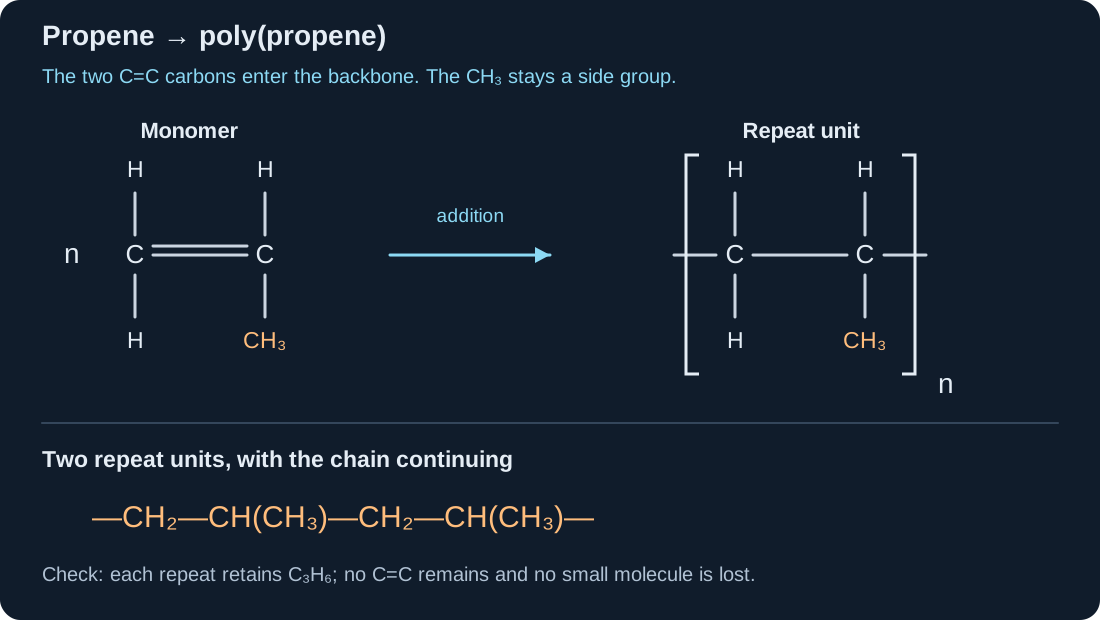
Swipe horizontally to view the whole diagram.
Reverse a repeat unit into its alkene
Find a two-carbon stretch of the backbone and retain every attached group. Remove the two external chain connections and place a double bond between the backbone carbons. For –CH₂–CH(C₆H₅)– the monomer is CH₂=CHC₆H₅; the aromatic group remains a side group. You do not need to know its later aromatic chemistry to preserve its connectivity.
For –CH(CH₃)–CH(CH₃)–, the monomer is CH₃CH=CHCH₃, but-2-ene. Both backbone carbons have one H and one methyl group. Simply replacing every single bond in a repeat unit with a double bond would alter the side groups and create incorrect valencies.
Worked amount: an illustrative poly(propene) chain with relative molecular mass approximately 84 000 contains about 84 000/42.0 = 2000 propene units, neglecting end groups. The repeat-unit mass equals the monomer mass because addition polymerisation loses no small molecule. Real polymer samples contain chains of different lengths, so one relative mass often represents an average.
Separation comes before effective recycling
Sorting separates polymers with different chemical compositions and processing behaviour. Contaminants, mixed polymers, pigments and additives can lower the quality of recycled material; collection, washing and remelting also consume energy. Thermoplastics can often be softened and remoulded, whereas extensively cross-linked thermosets do not simply melt into a reusable liquid. This explains why an instruction to recycle all plastics is not a complete chemical solution.
| Route | Benefit | Limitation to evaluate |
|---|---|---|
| Mechanical recycling | Preserves much of the material; can reduce demand for new monomer | Needs suitable sorted material; processing and contamination can reduce quality |
| Incineration with energy recovery | Releases energy and reduces waste volume | Consumes polymer material; releases CO₂; acidic/toxic gases require treatment |
| Feedstock recycling by cracking | Converts polymers into smaller molecules for fuels or chemical feedstocks | Requires energy; product mixtures need separation; using products as fuels still releases carbon |
| Biodegradable materials | Can break down biologically under suitable conditions | Breakdown depends on conditions and time; may require industrial composting and careful collection |
Name the chemistry that removes an acidic waste gas
Burning chlorine-containing polymers such as poly(chloroethene) can produce HCl. Passing the waste gas through an alkaline solution or over a basic solid neutralises it. For example calcium oxide reacts with HCl to make calcium chloride and water. Merely saying “scrub the gas” omits the substance and reaction that make the process work.
In the June 2023 AS Q3(h)(i) context, Pearson credited a specified alkali or base for removing HCl. The useful transfer principle is to connect the acidic pollutant to a suitable neutralisation method; it is not a universal instruction that one substance removes every pollutant. Particulates and other gases require appropriate additional controls.
Make a conclusion using a stated comparison
A life-cycle comparison follows extraction or growth of feedstock, monomer and polymer manufacture, transport, use, collection and final treatment. Durability can reduce the frequency of replacement; low mass can reduce transport energy; reuse can reduce demand for new items. These benefits must be weighed against manufacture, washing, recovery and waste impacts.
Biodegradable is not synonymous with plant-derived or instantly harmless in the environment. A bio-based polymer can be persistent, and a biodegradable polymer may require specific temperature, moisture and microbial conditions. Chemists can design degradable links, improve catalysts and solvent recovery, reduce material use, and develop sorting or recovery methods. The best option depends on the function and local disposal system.
Worked comparison: suppose producing a reusable item requires 12 MJ, each cleaning 0.20 MJ, and an equivalent single-use item requires 1.0 MJ. For N uses, compare 12 + 0.20N with 1.0N. Reuse has lower energy demand when 12 < 0.80N, so N > 15; from 16 uses in this simplified model. That result says nothing yet about water use, transport or toxicity. State the model’s boundary instead of turning one energy calculation into an overall environmental verdict.
Quick checks
Original Finesse questions. Reveal the indicative worked solutions after attempting each question; these are not official Edexcel mark allocations.
Q1. Write the repeat unit from CH₂=CHBr.Show answer
[–CH₂–CH(Br)–]ₙ, with bonds through both bracket sides. Br stays on the carbon to which it was attached; the C=C becomes C–C.
Q2. Which monomer produces –CH₂–C(CH₃)(Cl)–?Show answer
CH₂=C(CH₃)Cl. Restore C=C between the two backbone carbons while retaining methyl and chlorine on the same carbon.
Q3. A poly(ethene) chain has relative mass 56 000. Estimate the number of monomer units, ignoring end groups.Show answer
Mᵣ(ethene) = 2(12.0) + 4(1.0) = 28.0. Number of units = 56 000/28.0 = 2000. This is an estimate if the stated mass is an average.
Q4. Why does incinerating a polymer not count as recycling its material?Show answer
Its chemical structure is destroyed and its carbon usually becomes CO₂. Energy is recovered, but the same material is not returned to a polymer product; fresh feedstock is still needed.
Q5. Explain why “biodegradable” alone is insufficient to justify dropping packaging into ordinary landfill.Show answer
The required microbes, oxygen, moisture and temperature may not exist there, so degradation may be slow or follow different pathways. Suitable collection and processing conditions, along with the full life cycle, must be considered.
Sources
Sources and examiner guidance (reviewed 9 October 2026)
- Pearson Edexcel 9CH0 specification — Issue 3 — Topic 6, 6.26–6.29; printed pages 17–20. Reviewed 9 October 2026.
- Pearson Edexcel 8CH0 specification — Issue 3 — Topic 6, printed pages 15–18; AS scope checked against the A-Level outcomes.
- Chemrevise — Edexcel Organic Chemistry I — Pages 17–18; explanatory coverage reference. Teaching and practice here are original.
- Pearson 8CH0/02 — June 2023 mark scheme — Q3(f) and Q3(h), PDF pages 14 and 16; two repeat units and HCl removal.
- Pearson 8CH0/02 — June 2023 examiner report — Q3(f) and Q3(h), PDF page 4; polymer drawings and the meaning of scrubbing.
Finesse Tuition is not endorsed by AQA or Chemrevise. All explanations and examples here are our own.