
Read carbon structures accurately, name the compounds you will meet and distinguish a different connectivity from a different arrangement in space.
Start with atoms, bonds and functional groups
A hydrocarbon contains carbon and hydrogen only. Ethanol contains carbon and hydrogen but also oxygen, so it is not a hydrocarbon. Carbon normally forms four covalent bonds: count a double bond twice when checking its valency. Oxygen normally forms two bonds, neutral nitrogen three and a halogen one. These checks catch missing hydrogens before a name or equation is attempted.
A functional group is an atom or group of atoms responsible for characteristic chemical reactions. A homologous series is a family with the same functional group and general formula, similar chemical properties, a gradual trend in physical properties, and successive members differing by CH₂. Similar does not mean identical: chain length changes intermolecular forces and therefore boiling temperature and solubility.
An alkane has only single carbon–carbon bonds and is saturated. An alkene contains C=C and is unsaturated. Cycloalkanes are saturated despite having fewer hydrogens than an open-chain alkane with the same carbon count; a ring and a double bond each reduce that count by two.
Six formula types answer different questions
The molecular formula tells you the actual numbers of atoms, but does not locate the functional group. A structural formula must make the connectivity clear. Parentheses show branches attached to the preceding atom: CH₃CH(CH₃)CH₂OH has four carbon atoms, and its OH is at the end of the three-carbon parent chain.
In a skeletal formula, each unlabelled line end and vertex is carbon. Hydrogens attached to carbon are omitted and are supplied mentally to complete four bonds; heteroatoms and their attached hydrogens are shown. A hexagon is six carbons, not five, and a line drawn inside one side adds a second bond there. A displayed formula must show every atom and every bond, including C–H and O–H bonds.
| Representation | Meaning | Example or drawing instruction |
|---|---|---|
| Empirical | Simplest whole-number atom ratio | CH₂ |
| Molecular | Actual atom counts in one molecule | C₄H₈ |
| General | Algebraic relationship for a stated series | CₙH₂ₙ for an acyclic alkene with one C=C |
| Structural | Shows which groups are connected | CH₃CH=CHCH₃ |
| Displayed | Every atom and bond | Four-carbon chain; C2=C3; 3, 1, 1, 3 hydrogens on C1–C4 |
| Skeletal | Carbon framework and heteroatoms | Four carbon positions with a double bond between the middle two |
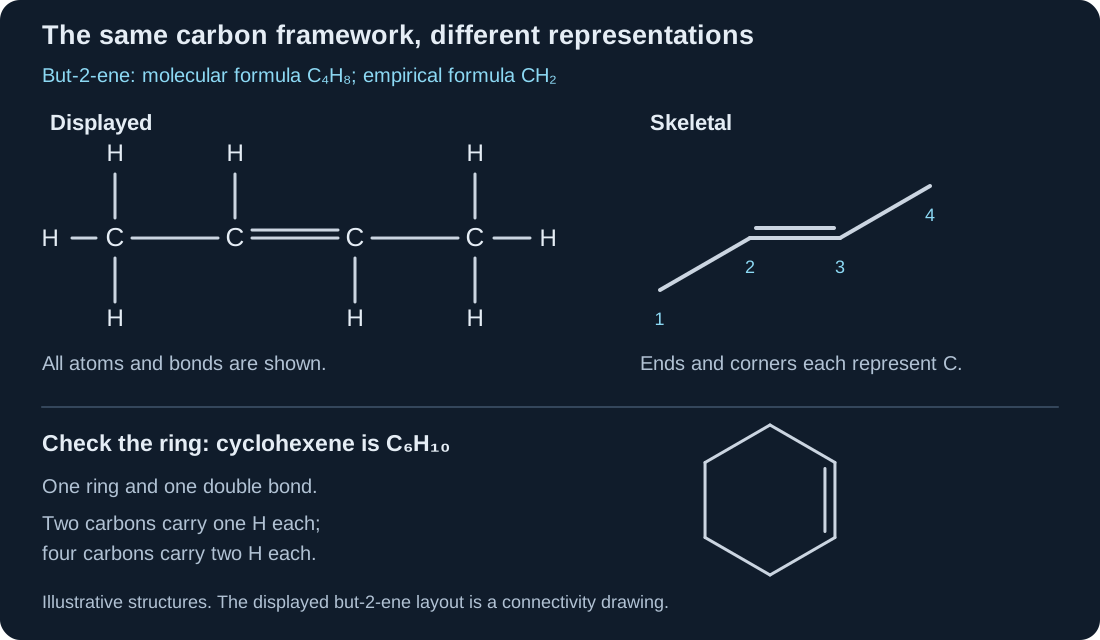
Swipe horizontally to view the whole diagram.
Build an unambiguous IUPAC name
Learn the one-to-ten carbon stems: meth-, eth-, prop-, but-, pent-, hex-, hept-, oct-, non- and dec-. Select a parent chain containing the main functional group; number it to give that group its lowest possible position. The longest line in the way a structure happens to be drawn is not necessarily the longest continuous chain.
Use -ane for alkanes, -ene for an alkene and -ol for an alcohol. Use fluoro-, chloro-, bromo- and iodo- for halogen substituents and methyl- or ethyl- for branches. Name a terminal CHO group with -al, an internal C=O with -one, COOH with -oic acid, C≡N with -nitrile and NH₂ with -amine. The carbon of CHO, COOH or C≡N is part of the parent chain. These names allow you to describe Topic 6 products even where their later reactions belong to Year 13.
For the combinations used here, an alcohol takes numbering priority over an alkene or halogen; a carboxylic acid, aldehyde or ketone takes priority over an alcohol. Indicate repeated substituents using di- or tri-, give every required locant and alphabetise different substituents while ignoring di-/tri-. Separate numbers with commas and numbers from words with hyphens.
Worked example: CH₃CH(CH₃)CH(Br)CH₂OH has a four-carbon chain including the OH-bearing carbon. Number from CH₂OH: OH at 1, Br at 2, methyl at 3. The name is 2-bromo-3-methylbutan-1-ol. The branch gives a fifth carbon overall; a five-carbon molecular formula does not force a pentane parent. CH₃CH₂C≡N is propanenitrile because the nitrile carbon is the third carbon.
Classify the change by comparing reactant and product
Identify what is added, removed or exchanged before naming the reaction. One transformation can fit more than one description: adding H₂ to an alkene is both addition and reduction; replacing a halogen using water is both substitution and hydrolysis.
| Type | What changes | Example |
|---|---|---|
| Addition | Groups add across a multiple bond; two reactants form one product | Ethene + HBr → bromoethane |
| Elimination | A small molecule is removed and a multiple bond forms | Ethanol → ethene + water |
| Substitution | One atom/group replaces another | Bromoethane + OH⁻ → ethanol + Br⁻ |
| Oxidation | Here, increase in bonds to oxygen or loss of hydrogen | Ethanol → ethanal |
| Reduction | Here, gain of hydrogen or loss of oxygen | Ethene + H₂ → ethane |
| Hydrolysis | Bond breaking through reaction with water | RBr + H₂O → ROH + H⁺ + Br⁻ |
| Addition polymerisation | Many alkene monomers join with no small by-product | Ethene → poly(ethene) |
Find structures systematically rather than by redrawing
Structural isomers have the same molecular formula but different structural formulae: their atoms have different connections. Changes can involve the carbon skeleton, the position of a functional group or the functional group itself. Rotating a drawing or writing the same chain backwards does not create an isomer.
Worked example: find all alcohols with formula C₄H₁₀O. Use the straight four-carbon skeleton first. OH at carbon 1 gives butan-1-ol; OH at carbon 2 gives butan-2-ol. Positions 3 and 4 duplicate those structures by renumbering. Next use the branched skeleton: 2-methylpropan-1-ol and 2-methylpropan-2-ol. These four exhaust the alcohol possibilities. The formula also permits ethers, so “all alcohols” and “all structural isomers” are different instructions.
For C₃H₈O, CH₃CH₂CH₂OH and CH₃CH(OH)CH₃ are alcohols, whereas CH₃OCH₂CH₃ is an ether. Check each proposed structure has three carbons, eight hydrogens and one oxygen; an elegant drawing is insufficient if its atom count is wrong.
Restricted rotation produces E/Z stereoisomerism
Stereoisomers have the same structural formula but a different spatial arrangement of atoms. Rotation about C=C would disrupt the sideways overlap forming its π bond. E/Z isomerism therefore requires restricted rotation and two different substituents on each double-bond carbon. Propene fails the second condition because its terminal carbon has two H atoms.
Assign priority independently at each end of the double bond using the atomic number of the directly attached atom: Br > Cl > O > N > C > H. If tied, compare the atoms attached to those atoms in descending atomic-number order until the first difference. For example ethyl outranks methyl: both begin with C, but the next comparison is C,H,H against H,H,H. Higher-priority groups on the same side give Z; opposite sides give E.
In but-2-ene, CH₃ outranks H at both ends. CH₃ groups on the same side give Z-but-2-ene, also called cis-but-2-ene; opposite sides give E/trans. Cis–trans terminology is useful when an identical substituent occurs at both ends. E and trans are not universal synonyms: apply priorities rather than the visual size of a group.
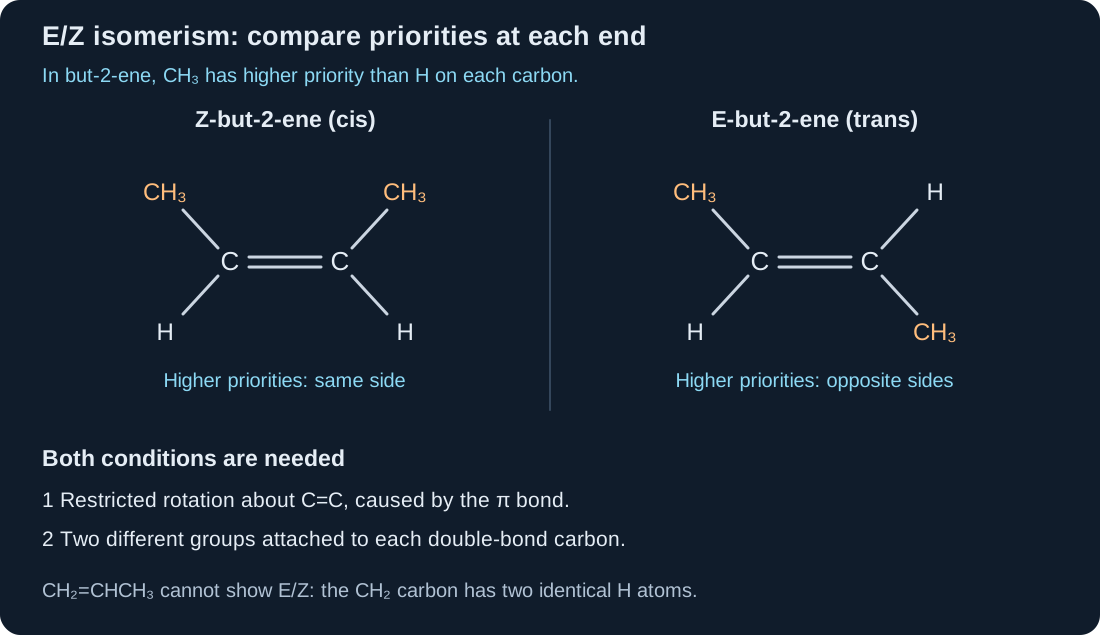
Swipe horizontally to view the whole diagram.
Quick checks
Original Finesse questions. Reveal the indicative worked solutions after attempting each question; these are not official Edexcel mark allocations.
Q1. A hydrocarbon has formula C₆H₁₂. Does this alone prove it is an alkene?Show answer
No. An acyclic alkene with one double bond and a saturated cycloalkane with one ring both fit CₙH₂ₙ. Evidence for a C=C bond is needed.
Q2. Name CH₃CH₂CH(OH)CH₃ and give its empirical formula.Show answer
The four-carbon chain is numbered from the end nearest OH: butan-2-ol. Its molecular formula is C₄H₁₀O. The counts have no common divisor, so C₄H₁₀O is also its empirical formula; the single oxygen prevents halving.
Q3. Give the three structural isomers of C₅H₁₂. Explain why 3-methylbutane is not a fourth.Show answer
Pentane, 2-methylbutane and 2,2-dimethylpropane. A drawing labelled 3-methylbutane is the same connectivity as 2-methylbutane when numbered from the opposite end.
Q4. Which show E/Z isomerism: CH₂=CHCH₂CH₃, CH₃CH=CHCH₃ and (CH₃)₂C=CHCH₃?Show answer
Only CH₃CH=CHCH₃: both double-bond carbons have two different groups. The first has two H on one carbon; the third has two CH₃ on one carbon. Restricted rotation alone is insufficient.
Q5. Explain why converting bromoethane to ethanol with water is both substitution and hydrolysis.Show answer
OH replaces Br on the same carbon, so the reaction is substitution. Water participates in breaking the C–Br bond and supplying the OH group, so it is hydrolysis. The carbon skeleton remains two carbons.
Sources
Sources and examiner guidance (reviewed 9 October 2026)
- Pearson Edexcel 9CH0 specification — Issue 3 — Topic 6, 6.1–6.7; printed pages 17–20. Reviewed 9 October 2026.
- Pearson Edexcel 8CH0 specification — Issue 3 — Topic 6, printed pages 15–18; AS scope checked against the A-Level outcomes.
- Chemrevise — Edexcel Organic Chemistry I — Pages 1–7; explanatory coverage reference. Teaching and practice here are original.
- Pearson 8CH0/02 — June 2023 mark scheme — Q3(a–d), PDF pages 11–13; formula representation and bonding requirements.
- Pearson 8CH0/02 — June 2023 examiner report — Q3(b), PDF pages 3–4; confusion between cyclohexane and cyclohexene. Read with Q3, question paper printed pages 7–8.
Finesse Tuition is not endorsed by AQA or Chemrevise. All explanations and examples here are our own.