
Build a cycle whose alternative routes have identical endpoints, then combine measured changes with the correct directions, coefficients, states and units.
Same initial and final states give the same enthalpy change
Hess's law states that the enthalpy change of a chemical reaction is independent of route, provided the initial and final conditions are the same. Enthalpy is a state function, so different intermediate steps cannot create an extra energy supply. A cycle is bookkeeping for equal start and finish states; it need not describe the actual reaction mechanism.
Write the target equation first. Reverse a supporting equation if necessary and reverse its ΔH sign; multiply an equation and its ΔH by the same factor; add equations and cancel identical species in identical states. Check that the surviving equation is exactly the target before adding the numbers. This method works when a familiar triangle formula does not.
For A → B with ΔH₁, and B → C with ΔH₂, A → C has ΔH₁ + ΔH₂. If the supplied second arrow is C → B, going from B to C requires −ΔH₂. Arrow direction, not the position of a box on the page, determines the sign.
Formation data: products minus reactants
Both sides can be constructed from the same elements in their standard states. The path elements → reactants → products must equal elements → products. Therefore ΔrH = ΣνΔfH(products) − ΣνΔfH(reactants), including coefficients. An element in its standard state has ΔfH° = 0 by definition; this does not mean its combustion or atomisation enthalpy is zero.
Original worked example using supplied illustrative data: CH₄(g) + 2O₂(g) → CO₂(g) + 2H₂O(l), with ΔfH values −75, 0, −394 and −286 kJ mol⁻¹ respectively. Product sum = −394 + 2(−286) = −966. Reactant sum = −75 + 2(0) = −75. ΔrH = −966 − (−75) = −891 kJ mol⁻¹. Missing the water coefficient or subtracting 75 instead of −75 gives a different result.
Combustion data: reactants minus products
For combustion cycles both sides burn to the same final combustion products, including the same water state. The path reactants → target products → combustion products equals direct combustion of reactants. Hence ΔrH = ΣνΔcH(reactants) − ΣνΔcH(products). This is the opposite order to formation data because the supporting arrows now point towards a common final state.
For C₂H₄(g) + H₂(g) → C₂H₆(g), use illustrative combustion values −1411, −286 and −1560 kJ mol⁻¹. Reactant total = −1697; product total = −1560. ΔrH = −1697 − (−1560) = −137 kJ mol⁻¹. It is the hydrogenation equation's enthalpy, not a new combustion enthalpy.
The same reasoning works with dissolution: if an anhydrous salt and its hydrate dissolve to the same final solution, hydration enthalpy equals ΔHsolution(anhydrous) − ΔHsolution(hydrate), with enough water included to make the endpoints match. Different final concentrations can add dilution effects, so a real experiment should make the routes comparable.
Do not add kJ g⁻¹ directly to kJ mol⁻¹
Suppose H₂(g) + ½O₂(g) → H₂O(l) has illustrative ΔH = −286 kJ mol⁻¹ and liquid water vaporisation needs +2.40 kJ g⁻¹. Convert the latter to a one-mole basis: +2.40 × 18.0 = +43.2 kJ mol⁻¹. Adding the vaporisation step gives H₂(g) + ½O₂(g) → H₂O(g), ΔH = −286 + 43.2 = −243 kJ mol⁻¹ to 3 s.f.
Making steam is less exothermic because some energy remains in the gaseous final state rather than being released during condensation. Write the state change explicitly; it is not a small correction that can be ignored just because the molecular formula is unchanged.
Core Practical 8: an indirect decomposition enthalpy
Pearson's implementation measures separate reactions of anhydrous K₂CO₃ and KHCO₃ with excess hydrochloric acid in an insulated cup. Carbonate gives a temperature rise, while hydrogencarbonate gives a fall under the stated conditions. Weigh the solid actually transferred, measure the acid volume, stir and record temperature changes. Use separate clean preparations and appropriate initial temperature readings for each run.
Directly heating hydrogencarbonate is unsuitable for this simple calorimetric measurement because supplied heat also warms the apparatus and materials; the observed temperature change is not solely the decomposition's heat. The two acid reactions reach a common set of products, allowing the target change to be obtained by Hess's law. The target below deliberately ends with liquid water; a high-temperature decomposition producing steam has a different enthalpy.
Use goggles, avoid contact with irritant acid and carbonate, and add solid with control because CO₂ evolution can cause splashing. A loose lid limits heat exchange while allowing gas to escape. Support the cup, stir without puncturing it and use a thermometer/probe appropriate to the temperature range. Reading this method does not replace supervised practical performance.
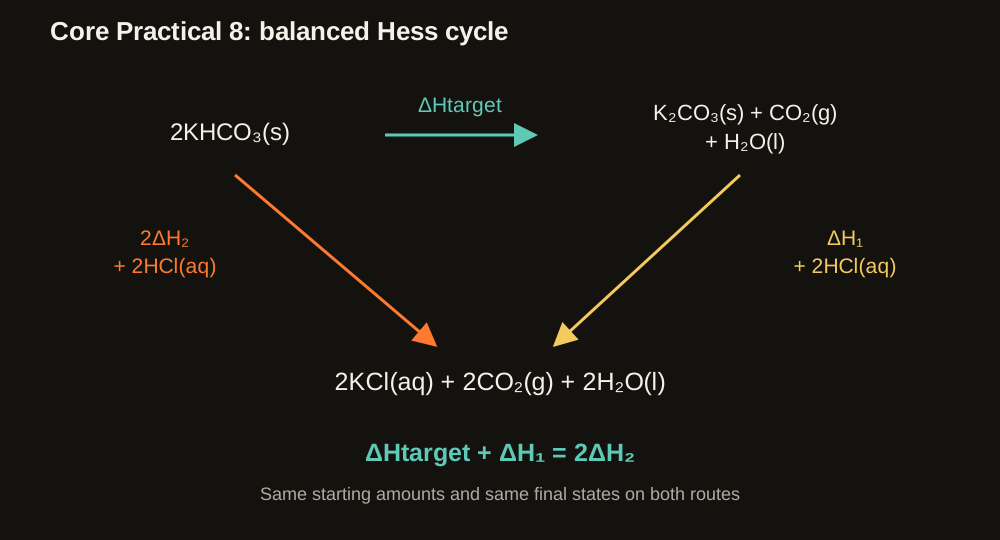
Swipe horizontally to view the whole diagram.
Original worked CP8 calculation
For each illustrative run use 50.0 cm³ of 1.00 mol dm⁻³ HCl and, for this simplified calculation, approximate the heated/cooled solution as 50.0 g with c = 4.18 J g⁻¹ K⁻¹. Run 1 uses 2.764 g K₂CO₃ (M = 138.2), giving 0.02000 mol; corrected ΔT = +4.00 K. Qsolution = 50.0 × 4.18 × 4.00 = +836 J, so ΔH₁ = −836/(1000 × 0.02000) = −41.8 kJ mol⁻¹.
Run 2 uses 2.002 g KHCO₃ (M = 100.1), also 0.02000 mol; corrected ΔT = −1.30 K. Qsolution = 50.0 × 4.18 × (−1.30) = −271.7 J, so ΔH₂ = +271.7/(1000 × 0.02000) = +13.585 kJ mol⁻¹. The solution loses heat; the endothermic reaction gains it.
Acid available is 0.0500 mol in each run. Run 1 needs 2 × 0.02000 = 0.04000 mol HCl and run 2 needs 0.02000 mol, so acid is in excess in both. Now combine the molar results: ΔHtarget = 2(+13.585) − (−41.8) = +68.97 ≈ +69.0 kJ mol⁻¹ of the target reaction. Per mole of KHCO₃ decomposed this is +34.5 kJ mol⁻¹. State which basis is intended.
Evaluate both measurements before combining them
Heat leaving the exothermic run makes ΔH₁ insufficiently negative; heat entering the endothermic run makes ΔH₂ insufficiently positive. Both effects reduce the calculated positive 2ΔH₂ − ΔH₁ in this particular cycle. A lid, insulation and an appropriate extrapolation address heat exchange, while repeats assess scatter.
Hydrated or impure potassium carbonate changes both the reacting amount and dissolution contribution; use appropriately dried anhydrous material of known composition. Incomplete reaction, splashing, probe lag and assuming water's heat capacity all require separate evaluation. The 50.0 g approximation ignores the added solid and evolved gas; a more refined model must use consistent final solution mass and heat capacity rather than altering one term arbitrarily.
A small cooling change can have large percentage uncertainty. When ΔHtarget = 2ΔH₂ − ΔH₁, the maximum absolute uncertainty contribution from ΔH₂ is doubled too. If uncertainties are ±0.6 and ±0.4 kJ mol⁻¹ respectively, target uncertainty = 2(0.6) + 0.4 = ±1.6 kJ mol⁻¹ using a worst-case estimate. Subtraction of measured values does not subtract their uncertainties.
Quick checks
Original Finesse questions. Reveal the indicative worked solutions after attempting each question; these are not official Edexcel mark allocations.
Q1. A → B has ΔH = −30 kJ mol⁻¹; C → B has ΔH = −85 kJ mol⁻¹. Find ΔH for A → C.Show answer
Go A → B (−30), then reverse C → B to B → C (+85). Sum = +55 kJ mol⁻¹. The negative supplied arrow must be reversed as well as the equation.
Q2. For a reaction, summed formation enthalpies are −720 for products and −180 kJ mol⁻¹ for reactants. Find ΔrH.Show answer
ΔrH = −720 − (−180) = −540 kJ mol⁻¹. Formation data use products minus reactants after stoichiometric weighting.
Q3. What extra enthalpy step is required to change a target that forms H₂O(l) into one that forms H₂O(g)?Show answer
Add H₂O(l) → H₂O(g), multiplied by the water coefficient. Its positive vaporisation enthalpy makes an exothermic target less negative. All values must use the same molar basis.
Q4. CP8 gives ΔH₁ = −45.0 and ΔH₂ = +12.0 kJ mol⁻¹. Find ΔH for decomposition of 2 mol KHCO₃ as in the stated target.Show answer
ΔHtarget = 2ΔH₂ − ΔH₁ = 24.0 − (−45.0) = +69.0 kJ per target stoichiometric change. Per mole KHCO₃ it is +34.5 kJ mol⁻¹.
Q5. Why is it wrong to combine the two measured cup heat values directly if the solid amounts differ?Show answer
Each cup heat belongs to its own sample size. Convert each to the enthalpy for its balanced reaction basis, then apply the target coefficients and signs. Otherwise the cycle combines different amounts and its endpoints do not match.
Sources
Sources and examiner guidance (reviewed 9 October 2026)
- Pearson Edexcel 9CH0 specification, Issue 3 — Topic 8, printed pp. 22–23; AS boundary checked against 8CH0 pp. 20–21. Reviewed 9 October 2026.
- Chemrevise — Energetics I — Pages 1–10 reviewed. Original explanations and calculations; level/profile diagrams and state-dependent values distinguished.
- Pearson Core Practical 8 worksheets — Teacher and student sheets: potassium carbonate / hydrogencarbonate reactions and Hess's law. Reviewed 9 October 2026.
- Pearson 8CH0/02 June 2023 mark scheme — Q5(a–b), PDF pp. 23–25; Q7(b), p. 28; Q8(b), pp. 35–36. Read with question context.
- Pearson 8CH0/02 June 2023 examiner report — PDF pp. 3, 5–6: sign versus magnitude, theoretical/practical limitations and mixed Hess-cycle units. Reviewed 9 October 2026.
- Pearson 8CH0/02 June 2023 question paper — Q5, printed pp. 18–20; Q7(b), p. 23; Q8, pp. 26–27: context for the linked assessment observations.
Finesse Tuition is not endorsed by AQA or Chemrevise. All explanations and examples here are our own.