
Convert a temperature change into heat for the sample, then into a signed enthalpy change per mole of the relevant reaction or product.
Q = mcΔT measures the material being warmed or cooled
For a measured mass m and specific heat capacity c, Q = mcΔT. With m in g and c in J g⁻¹ K⁻¹, Q is in J. A change of 1 °C is the same size as a change of 1 K, so either can express a temperature difference. Use final minus initial temperature and keep track of whose heat change you are calculating.
For dilute aqueous solutions a calculation may assume density 1.00 g cm⁻³ and c = 4.18 J g⁻¹ K⁻¹. The total liquid volume then provides the approximate mass. These are assumptions, not exact facts for every solution. If a question specifies a different heat capacity, mass convention or calorimeter heat capacity, use it. When a solid is added, do not silently choose between solvent mass and total final solution mass; state and follow the model supplied.
In the simplest model, Qreaction = −Qsolution. To obtain ΔH in kJ mol⁻¹, divide reaction heat by the amount of reaction and by 1000. For a general equation, the amount of reaction is n(species)/its coefficient. For neutralisation it is often clearer to divide by moles of water formed, in line with that definition.
Worked example with a limiting reactant
Mix 25.0 cm³ of 2.00 mol dm⁻³ HCl with 40.0 cm³ of 1.00 mol dm⁻³ NaOH, initially at the same temperature. The corrected rise is 8.00 K. Assume solution density 1.00 g cm⁻³ and c = 4.18 J g⁻¹ K⁻¹. Total solution mass = 65.0 g, so Qsolution = 65.0 × 4.18 × 8.00 = 2173.6 J. Both liquids absorb the released energy, so using only 25.0 g is wrong.
n(HCl) = 2.00 × 0.0250 = 0.0500 mol; n(NaOH) = 1.00 × 0.0400 = 0.0400 mol. The 1:1 reaction makes 0.0400 mol H₂O and leaves acid in excess. ΔHneutralisation = −2173.6/(1000 × 0.0400) = −54.3 kJ mol⁻¹. Dividing by all the acid would incorrectly assume 0.0500 mol water formed.
The result is negative because the solution warmed. It is an experimental estimate, not automatically a standard value: check concentrations, temperature, heat exchange and the model used. A correct calculation cannot remove limitations of the data.
Design the insulated-container experiment
Support a polystyrene cup in a beaker and use a loose insulating lid with openings for a thermometer or probe and stirrer. Measure reagent quantities, bring them to a common starting temperature where practical, record initial temperatures, then mix and stir. The probe must remain immersed without being forced through the cup. If gas is evolved, the vessel must not be sealed against pressure buildup.
Stirring reduces temperature gradients so the reading represents the bulk liquid. A lid and insulation reduce heat exchange with air and the apparatus. Accurate masses and volumes determine the amount reacting; a probe with smaller reading uncertainty helps especially when ΔT is small. Record temperatures before and after mixing at regular intervals instead of writing only one initial and one final number.
If two liquids start at different temperatures, their no-reaction mixture temperature depends on both masses and heat capacities. A simple arithmetic mean is justified only when their heat capacities and masses are equal. A common starting temperature avoids this complication.
Extrapolate to estimate temperature change at mixing
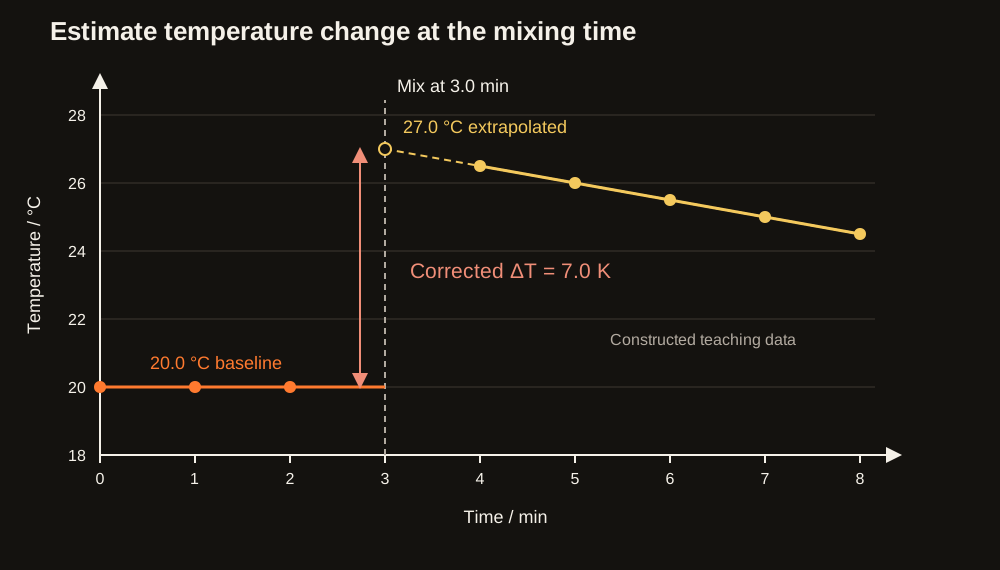
Heat exchange occurs while the reaction and thermometer response are still taking place. Plot temperature against time, mark the mixing time and extend the post-reaction cooling trend backwards to that time. Compare this extrapolated temperature with the initial baseline at the same time. Do not use a single late reading as if no cooling had occurred.
In the illustrative graph, the pre-mixing temperature is 20.0 °C and the post-reaction line extrapolates to 27.0 °C at 3.0 min. Corrected ΔT = 7.0 K, even though the first completed post-mixing reading is 26.5 °C. For an endothermic experiment, extrapolate the subsequent warming trend backwards to estimate the lower temperature at mixing.
The correction assumes that the fitted post-reaction heat-exchange behaviour can reasonably describe the unobserved interval. It becomes less dependable for a slow reaction whose heat generation overlaps much of the cooling trace. It also does not correct incomplete reaction, a wrong specific heat capacity or evaporation automatically.
Swipe horizontally to view the whole diagram.
Spirit-burner calorimetry: water mass and fuel mass have different roles
Weigh the burner and fuel before and after heating a known water mass. The difference is the mass lost by the burner, used as an estimate of fuel burned. Use the water mass in mcΔT, and the fuel mass divided by fuel molar mass for n. Keep burner distance, water quantity and apparatus arrangement controlled when comparing alcohols.
Original example: 0.920 g ethanol heats 200.0 g water by 22.0 K. Qwater = 200.0 × 4.18 × 22.0 = 18392 J. n(ethanol) = 0.920/46.0 = 0.0200 mol. Estimated ΔcH = −18392/(1000 × 0.0200) = −920 kJ mol⁻¹ to 3 s.f. The energy transferred per gram is −18.392/0.920 = −20.0 kJ g⁻¹; this is a different unit and quantity from kJ mol⁻¹.
Heat escaping around the vessel, heating the container and incomplete combustion all make the measured heat per mole less negative than the ideal complete-combustion value. Evaporation increases measured burner mass loss without heating the water, so it also reduces the calculated magnitude. A draught shield and lid reduce some heat loss; a suitable metal calorimeter improves heat transfer, but its heat capacity should then be considered. An oxygen bomb calorimeter is a different, more controlled method, not a simple correction to an open flame reading.
Cap a spirit burner to extinguish it, keep spare flammable liquid away from flames and do not refill a hot burner. A soot deposit is evidence of incomplete combustion, not proof that all discrepancy came from that one cause.
Link an experimental fault to the calculated answer
In an exothermic cup reaction, loss of heat to the surroundings reduces measured ΔT and makes the estimated negative ΔH less negative. In an endothermic reaction, heat entering from surroundings reduces the magnitude of cooling and underestimates the positive ΔH. 'Heat loss' is therefore not the correct universal phrase for both cases.
A temperature difference uses two readings: if each uncertainty is ±0.1 °C, a maximum ΔT uncertainty is ±0.2 °C. For ΔT = 2.0 °C this is 10%; for 10.0 °C it is 2%. Larger temperature changes can reduce relative reading uncertainty but may increase heat exchange, so choose a balanced design rather than maximising ΔT without limit.
Quick checks
Original Finesse questions. Reveal the indicative worked solutions after attempting each question; these are not official Edexcel mark allocations.
Q1. 100.0 g solution warms by 3.50 K; c = 4.18 J g⁻¹ K⁻¹. Calculate its heat gain.Show answer
Qsolution = 100.0 × 4.18 × 3.50 = 1463 J = 1.46 kJ to 3 s.f. The reaction's heat is −1463 J in the simple insulated model.
Q2. The reaction in the previous question formed 0.0250 mol water. Find the enthalpy of neutralisation.Show answer
ΔH = −1.463/0.0250 = −58.5 kJ mol⁻¹ to 3 s.f. Keep the reaction sign and divide by moles of water formed.
Q3. Why does using only the acid mass in a two-solution neutralisation usually underestimate the enthalpy magnitude?Show answer
Both acid and alkali solutions are heated. Using only part of the liquid mass underestimates mcΔT, so the inferred heat released and magnitude of molar enthalpy are too small.
Q4. A spirit burner loses fuel by evaporation as well as burning. Predict the error in calculated ΔcH.Show answer
The inferred fuel moles are too high, because evaporated fuel is included in mass loss without providing corresponding heat to the water. The calculated negative value is less negative than it should be.
Q5. Two thermometer readings each have uncertainty ±0.2 °C. Find the maximum percentage uncertainty of a 5.0 °C change and give one targeted improvement.Show answer
Maximum absolute uncertainty = ±0.4 °C, so percentage = 0.4/5.0 × 100 = 8%. A calibrated probe with smaller uncertainty reduces this contribution. Repetition alone does not remove a fixed calibration or heat-exchange error.
Sources
Sources and examiner guidance (reviewed 9 October 2026)
- Pearson Edexcel 9CH0 specification, Issue 3 — Topic 8, printed pp. 22–23; AS boundary checked against 8CH0 pp. 20–21. Reviewed 9 October 2026.
- Chemrevise — Energetics I — Pages 1–10 reviewed. Original explanations and calculations; level/profile diagrams and state-dependent values distinguished.
- Pearson 8CH0/02 June 2023 mark scheme — Q5(a–b), PDF pp. 23–25; Q7(b), p. 28; Q8(b), pp. 35–36. Read with question context.
- Pearson 8CH0/02 June 2023 examiner report — PDF pp. 3, 5–6: sign versus magnitude, theoretical/practical limitations and mixed Hess-cycle units. Reviewed 9 October 2026.
- Pearson 8CH0/02 June 2023 question paper — Q5, printed pp. 18–20; Q7(b), p. 23; Q8, pp. 26–27: context for the linked assessment observations.
Finesse Tuition is not endorsed by AQA or Chemrevise. All explanations and examples here are our own.