
Identify the reacting system, explain why a temperature rise corresponds to negative reaction enthalpy, and write definitions with the correct one-mole basis.
Enthalpy change describes heat transfer at constant pressure
Enthalpy change, ΔH, is the heat energy change measured at constant pressure. For a reaction, ΔH = H(products) − H(reactants). It is a difference between specified initial and final states; we do not need an absolute enthalpy value for either. State symbols and amounts are part of the definition of the change.
In an exothermic reaction the reacting system transfers energy to the surroundings. Its products have lower enthalpy than its reactants, so ΔH is negative. In an endothermic reaction energy is taken in from the surroundings and products have higher enthalpy, giving positive ΔH. If the surrounding solution warms, the solution's energy has increased but the reacting system has released that energy; the two descriptions have opposite signs.
Temperature change is not itself an energy or a molar enthalpy change. Raising 200 g of water by 5 K requires more energy than raising 20 g by 5 K. Doubling the amount reacting can double the heat while leaving the enthalpy change per mole unchanged. Part 2 connects these quantities using Q = mcΔT.
Standard conditions are a comparison convention
Standard pressure is 100 kPa, with a specified temperature, usually 298 K. A substance is in its standard state at that pressure and temperature; for solutions the school-level standard concentration is 1 mol dm⁻³. The standard symbol does not mean that temperature is always fixed at 298 K or that every reaction takes place in a room-temperature laboratory.
O₂(g), not isolated O atoms, is oxygen's standard state at 298 K; graphite is the reference standard state of carbon. Liquid water and steam have different enthalpies. An equation forming H₂O(g) describes a different final state from one forming H₂O(l), even though the atoms are identical. Read data labels before combining values.
Four definitions with four different bases
Standard enthalpy change of reaction is the enthalpy change when reactants in the amounts specified by a balanced equation react under standard conditions, all substances in their standard states. It belongs to the equation as written. If an equation is doubled, its reaction enthalpy doubles; reversing it changes the sign.
Standard enthalpy of formation is the enthalpy change when one mole of a compound forms from its elements in their standard states. Standard enthalpy of combustion is the enthalpy change when one mole of a substance burns completely in oxygen under standard conditions, with substances in their standard states. Standard enthalpy of neutralisation is the enthalpy change when acid and alkali react to form one mole of water under standard conditions.
| Quantity | Example equation | One-mole basis |
|---|---|---|
| Formation of Al₂O₃(s) | 2Al(s) + 1½O₂(g) → Al₂O₃(s) | One mole Al₂O₃; fractional coefficients are allowed. |
| Combustion of ethanol | C₂H₅OH(l) + 3O₂(g) → 2CO₂(g) + 3H₂O(l) | One mole ethanol, not one mole CO₂ or H₂O. |
| Strong acid/alkali neutralisation | H⁺(aq) + OH⁻(aq) → H₂O(l) | One mole water formed. |
| Reaction as written | 2H₂(g) + O₂(g) → 2H₂O(l) | Two moles water per mole of reaction. |
Enthalpy level diagrams show endpoints
Draw a vertical enthalpy axis and horizontal levels labelled with reactants and products. Products below reactants describe an exothermic reaction, with a downward ΔH arrow joining the levels. Products above reactants describe an endothermic reaction, with an upward arrow. The arrow represents final minus initial enthalpy, not the distance from the page's baseline.
Edexcel distinguishes an enthalpy level diagram from a reaction profile. A level diagram does not show activation energy. A profile adds the barrier along a reaction pathway and is taught in Kinetics I. Do not confuse the barrier to starting a reaction with the net energy difference between its endpoints.
For illustrative levels of 120 kJ mol⁻¹ for reactants and 45 kJ mol⁻¹ for products, ΔH = 45 − 120 = −75 kJ mol⁻¹. The reverse reaction has ΔH = +75 kJ mol⁻¹. If both equations are doubled, their values become −150 and +150 kJ for the doubled stoichiometric changes.
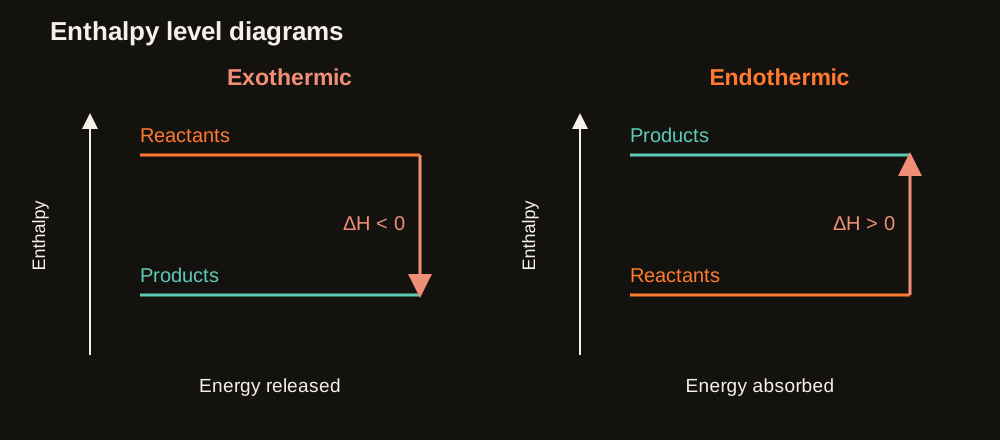
Swipe horizontally to view the whole diagram.
Breaking bonds consumes energy
Energy is required to separate bonded atoms; bond formation releases energy as a lower-energy arrangement forms. An exothermic reaction releases more energy when product bonds form than it requires to break reactant bonds. Saying 'breaking fuel bonds releases energy' reverses the causal explanation.
Strong acid–strong alkali neutralisations have similar values because their main net change is H⁺(aq) + OH⁻(aq) → H₂O(l). A weak acid also needs to ionise as H⁺ is consumed, so its overall enthalpy includes that additional process. This explains why the actual acid/base system matters rather than making neutralisation a fixed number for every possible pair.
Quick checks
Original Finesse questions. Reveal the indicative worked solutions after attempting each question; these are not official Edexcel mark allocations.
Q1. A reaction makes an insulated solution cooler. State the sign of reaction ΔH and explain.Show answer
ΔH is positive: the reacting system absorbs energy from the surroundings, including the solution, which cools. A falling solution temperature does not mean a negative reaction enthalpy.
Q2. Write the standard formation equation for liquid ethanol.Show answer
2C(graphite) + 3H₂(g) + ½O₂(g) → C₂H₅OH(l). It forms exactly one mole from elements in their standard states; forming ethanol from ethene and water would not be a formation definition.
Q3. For H₂(g) + ½O₂(g) → H₂O(l), ΔH = −286 kJ mol⁻¹. Give ΔH for 2H₂O(l) → 2H₂(g) + O₂(g).Show answer
Reverse to change the sign, then double the stoichiometry: +572 kJ for the equation as written, or +572 kJ mol⁻¹ of that stated reaction.
Q4. Why is the standard formation enthalpy of O₂(g) zero, but that of O(g) is not?Show answer
O₂(g) is the element's standard reference state at 298 K. Producing O(g) requires breaking oxygen–oxygen bonds, so it is a different, energy-requiring change.
Q5. What belongs on an enthalpy level diagram but distinguishes it from a reaction profile?Show answer
Labelled reactant/product enthalpy levels and a ΔH arrow are needed. An enthalpy level diagram omits the activation barrier; a reaction profile shows the pathway and activation energy. A diagram with only an unlabelled hump does not establish the reaction enthalpy.
Sources
Sources and examiner guidance (reviewed 9 October 2026)
- Pearson Edexcel 9CH0 specification, Issue 3 — Topic 8, printed pp. 22–23; AS boundary checked against 8CH0 pp. 20–21. Reviewed 9 October 2026.
- Chemrevise — Energetics I — Pages 1–10 reviewed. Original explanations and calculations; level/profile diagrams and state-dependent values distinguished.
- Pearson 8CH0/02 June 2023 mark scheme — Q5(a–b), PDF pp. 23–25; Q7(b), p. 28; Q8(b), pp. 35–36. Read with question context.
- Pearson 8CH0/02 June 2023 examiner report — PDF pp. 3, 5–6: sign versus magnitude, theoretical/practical limitations and mixed Hess-cycle units. Reviewed 9 October 2026.
- Pearson 8CH0/02 June 2023 question paper — Q5, printed pp. 18–20; Q7(b), p. 23; Q8, pp. 26–27: context for the linked assessment observations.
Finesse Tuition is not endorsed by AQA or Chemrevise. All explanations and examples here are our own.