
Choosing a tutor
Group tuition vs one-to-one: why five students often beat one
Why a competitive group of similar-ability students is often the better and more affordable choice for A-Level Chemistry and Maths, when one-to-one is worth paying for, and how to tell good group tuition from bad.
By Amman Damani · · 5 min read
One-to-one is not automatically better
Many families assume one-to-one tuition is the premium option and group tuition is the compromise. For maths-based subjects such as A-Level Chemistry and Maths, I think the opposite is often true. A well-run group is usually the more effective choice for most families, and often the more sensible one financially.
That does not mean every group works, or that one-to-one is never right. It means the format should be chosen for the job it has to do.
What a good group lesson looks like
The group should be small, around five students, and matched by ability. The tutor teaches a clearly defined piece of content, then the students compete on exam-style questions.
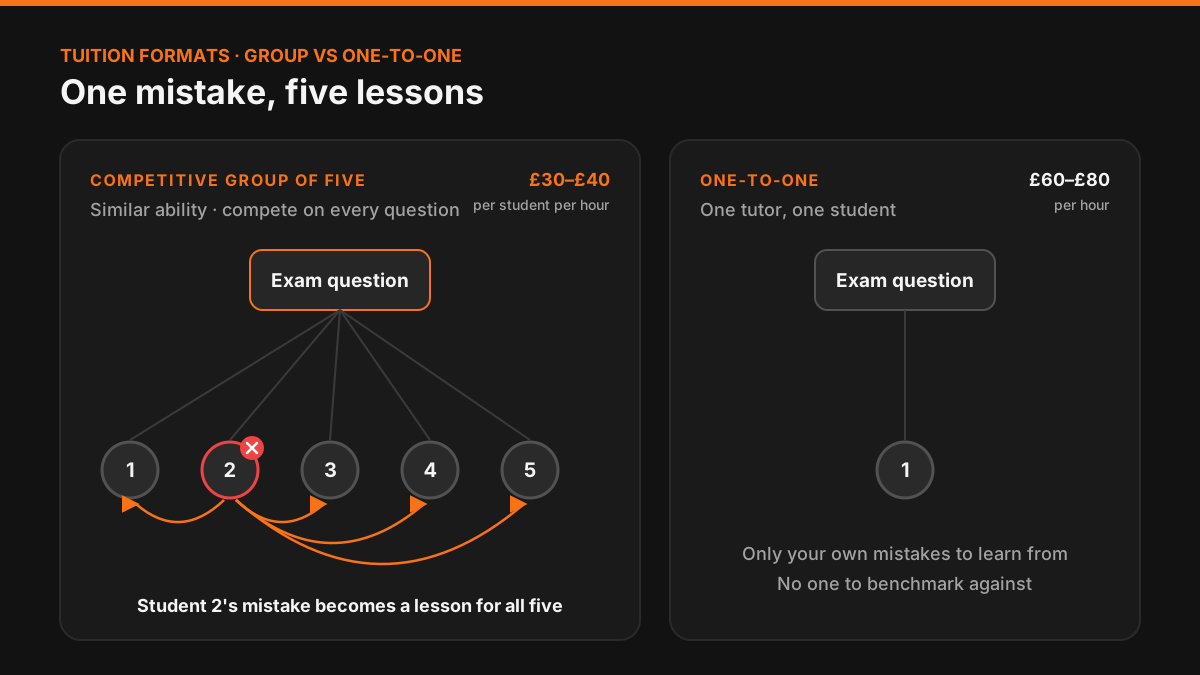
When anyone gets something wrong, the whole group benefits. Everyone sees the specific trap in that exam question and the misunderstanding behind it: the kind of mistake any of them could make months later, as the content starts to fade. In a one-to-one lesson you learn from your own mistakes. In a group of five, you learn from everyone's.
- Teach: the tutor covers one clearly defined piece of content.
- Compete: five students of similar ability attempt the same exam-style questions.
- Unpick: every wrong answer is discussed, so the whole group learns the trap and the misconception behind it.
- Track: each student's results are recorded individually.
Why competition matters at A-Level
A-Level grades are not awarded against a fixed pass mark. Exam boards set grade boundaries after the papers are marked, using statistical predictions based on the prior attainment of everyone taking the subject alongside senior examiners' judgement of real scripts, so that a cohort of similar ability receives broadly similar results from year to year. In practice, your grade depends partly on how well you perform compared with everyone else sitting the same paper.
Competing against students of similar ability every week keeps that comparison in view. You know where you stand, and you feel the pressure to keep up. In my experience, students taught only one-to-one can become softer. With nobody to benchmark against, it is easy to feel further ahead than you are, and the session loses the competitive edge the real exam will have.
When one-to-one is the right choice
One-to-one tuition earns its price in subjects where the quality of your own written work needs close, individual attention, such as English literature or a foreign language. A tutor needs time to read your essay line by line or listen to you speak, and that time does not divide well between five people.
It also suits two kinds of maths and science student: those who have already learned most of the content and only need help with a few carefully chosen parts of certain topics, and those who are seriously behind and need to rebuild their foundations before they can keep pace with a group.
Group and one-to-one tuition side by side
A good group session taught by a well-qualified graduate of Oxford, Cambridge, UCL or Imperial typically costs around £30–£40 per student per hour. One-to-one lessons with a similarly qualified tutor typically cost £60–£80 per hour: almost double, for the same content.
If the hour is being used to learn content, a group gives you the same teaching, plus everyone else's mistakes to learn from, for roughly half the price.
Typical price
- Competitive group tuition
- Around £30–£40 per student per hour
- One-to-one tuition
- Around £60–£80 per hour for a similarly qualified tutor
Best for
- Competitive group tuition
- Learning and practising content in maths-based subjects such as Chemistry and Maths
- One-to-one tuition
- Essay-based subjects and languages, help with a few chosen topics, or catching up when seriously behind
Learning from mistakes
- Competitive group tuition
- Every mistake in the group becomes a lesson for all five students
- One-to-one tuition
- Only your own mistakes
Benchmarking
- Competitive group tuition
- You measure yourself against students of similar ability every lesson
- One-to-one tuition
- Nobody to compare yourself with
Exam pressure
- Competitive group tuition
- Regular competition, like an exam where grades depend partly on the whole cohort
- One-to-one tuition
- Little competitive pressure
Feedback on long written answers
- Competitive group tuition
- Shared feedback on the errors students make most often
- One-to-one tuition
- Detailed, individual feedback on every piece of writing
Individual attention
- Competitive group tuition
- Personal progress tracking for each student, with one-to-one help when someone is stuck
- One-to-one tuition
- The tutor's full attention for the whole hour
| Criterion | Competitive group tuition | One-to-one tuition |
|---|---|---|
| Typical price | Around £30–£40 per student per hour | Around £60–£80 per hour for a similarly qualified tutor |
| Best for | Learning and practising content in maths-based subjects such as Chemistry and Maths | Essay-based subjects and languages, help with a few chosen topics, or catching up when seriously behind |
| Learning from mistakes | Every mistake in the group becomes a lesson for all five students | Only your own mistakes |
| Benchmarking | You measure yourself against students of similar ability every lesson | Nobody to compare yourself with |
| Exam pressure | Regular competition, like an exam where grades depend partly on the whole cohort | Little competitive pressure |
| Feedback on long written answers | Shared feedback on the errors students make most often | Detailed, individual feedback on every piece of writing |
| Individual attention | Personal progress tracking for each student, with one-to-one help when someone is stuck | The tutor's full attention for the whole hour |
Not all group tuition is the same
A large class where students sit and listen is not what I am describing. Before you choose a group, check that it has the features that make the format work.
- Students are matched by ability, so nobody is left behind or held back.
- Lessons include competition on exam-style questions, not just a lecture.
- Every student's work and progress is tracked individually.
- Any student can get one-to-one help when they do not understand something.
- Previous sessions are recorded, so students can go back over anything they need to.
Weekly tuition works best alongside independent study
One hour of tuition a week cannot carry an entire A-Level. Used well, that hour is an accountability, management and doubt-clearing session that supports the independent study a student does for the rest of the week. It is not the place to cover huge chunks of new content for the first time.
If the hour is mostly about checking work, exposing misunderstandings and keeping a student on track, a competitive group does that efficiently, and the money saved goes further.
How we run groups at Finesse Tuition
At Finesse Tuition, students are taught online in competitive groups matched by ability, and every lesson follows a step-by-step plan within our 16-week A-Level Chemistry programme. Every tutor has passed our standardised chemistry exam before interview.
We track each student's work and progress individually and follow up with them one-to-one through our website. If a student needs more help, we offer additional doubt-clearing sessions free of charge. Every session is recorded, so students can rewatch previous lessons whenever they need to. Lessons cost £30–£40 per hour.
A final thought
If one-to-one were genuinely the better way to learn, you would see it everywhere performance matters most. Competitive sports teams would give every single player their own coach instead of training as a squad, and top universities would teach every student one-to-one instead of through lectures, classes and small groups. They do not, because people improve fastest when they are taught well and pushed by others working at their level.