
Chemistry
Stop memorising buffer recipes. Start following the H⁺.
Stop memorising acid–base recipes. Derive buffer pH, follow added H⁺ and OH⁻ with mole tables, and understand precisely why buffer capacity is limited.
By Finesse Tuition · · 9 min read
A recipe will not rescue you in an unfamiliar question
Mix a weak acid with one of its salts. Learn a pH equation. Repeat it five times. That sounds like revision, but it fails the first time the examiner adds an acid, changes the volume or asks what happens after dilution. Buffer questions become much easier when you stop memorising ingredients and track what actually happens to hydrogen ions.
A buffer is not a solution whose pH is magically constant. It resists relatively large pH changes when small quantities of acid or base are added, because a conjugate acid–base pair is present in useful amounts. Eventually the buffer runs out of one component, and its protective effect weakens. Understanding the reaction explains the limitation better than a memorised slogan.
This guide focuses on Year 13 acids and bases for AQA Chemistry 7405, OCR A H432 and Pearson Edexcel Chemistry 9CH0. Check your particular board's specification and marking guidance for expected calculations and terminology. Every numerical question here is an original teaching example, not a reproduction of an exam paper.
See the two chemical reserves in one equilibrium
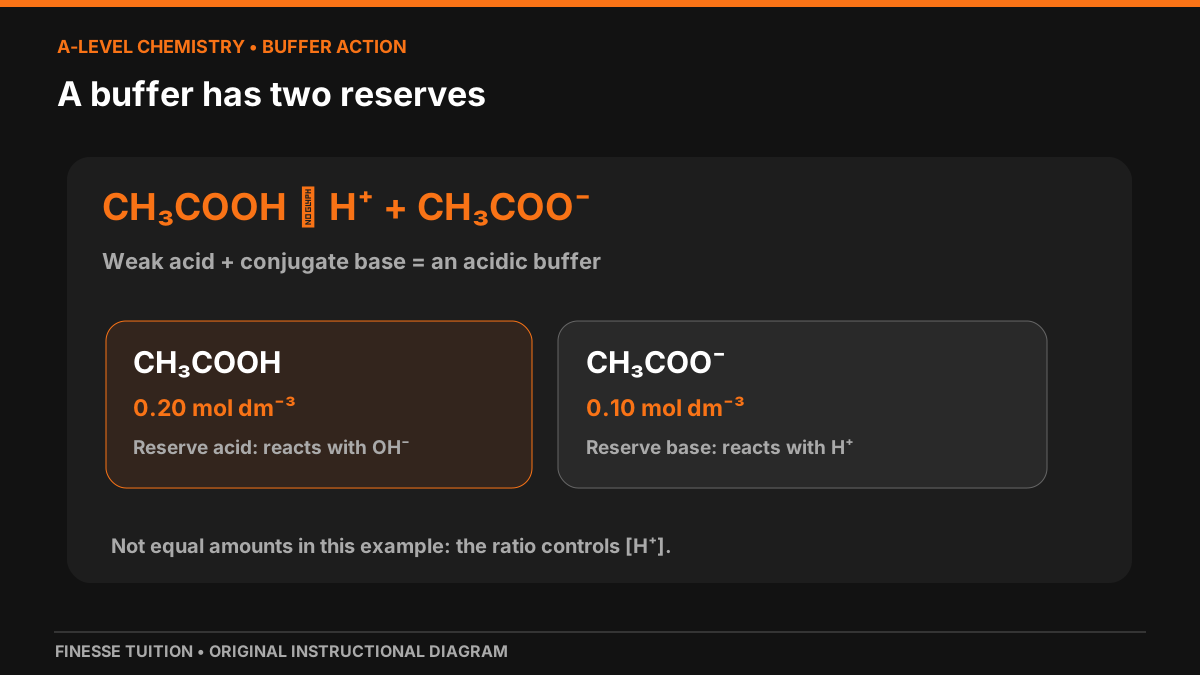
Consider ethanoic acid, CH₃COOH, and its conjugate base, ethanoate, CH₃COO⁻, supplied for example by sodium ethanoate. The acid partially dissociates: CH₃COOH ⇌ H⁺ + CH₃COO⁻. A weak acid alone supplies some ethanoate, but adding a soluble ethanoate salt gives a substantial extra concentration of conjugate base. You now have two different chemical reserves, each able to respond to a different disturbance.
If we add a small amount of strong acid, the ethanoate ions remove much of the added H⁺ by forming CH₃COOH. If we add a small amount of alkali, CH₃COOH can donate H⁺ to neutralise OH⁻, generating water and more ethanoate. This does not mean there is zero pH change; it means that, within capacity, the change is smaller than it would be without an effective buffer.
Think in reactions before remembering a direction of equilibrium shift. That method works for a novel weak acid HA with conjugate base A⁻ just as well as for ethanoic acid. Replace the named species with HA and A⁻ and you can reconstruct each buffer response without guessing.
- Identify the weak acid HA and its conjugate base A⁻.
- For added acid, write A⁻ + H⁺ → HA.
- For added alkali, write HA + OH⁻ → A⁻ + H₂O.
- State that [H⁺] and therefore pH change only slightly within buffer capacity.
Follow H⁺ or OH⁻ all the way to the product
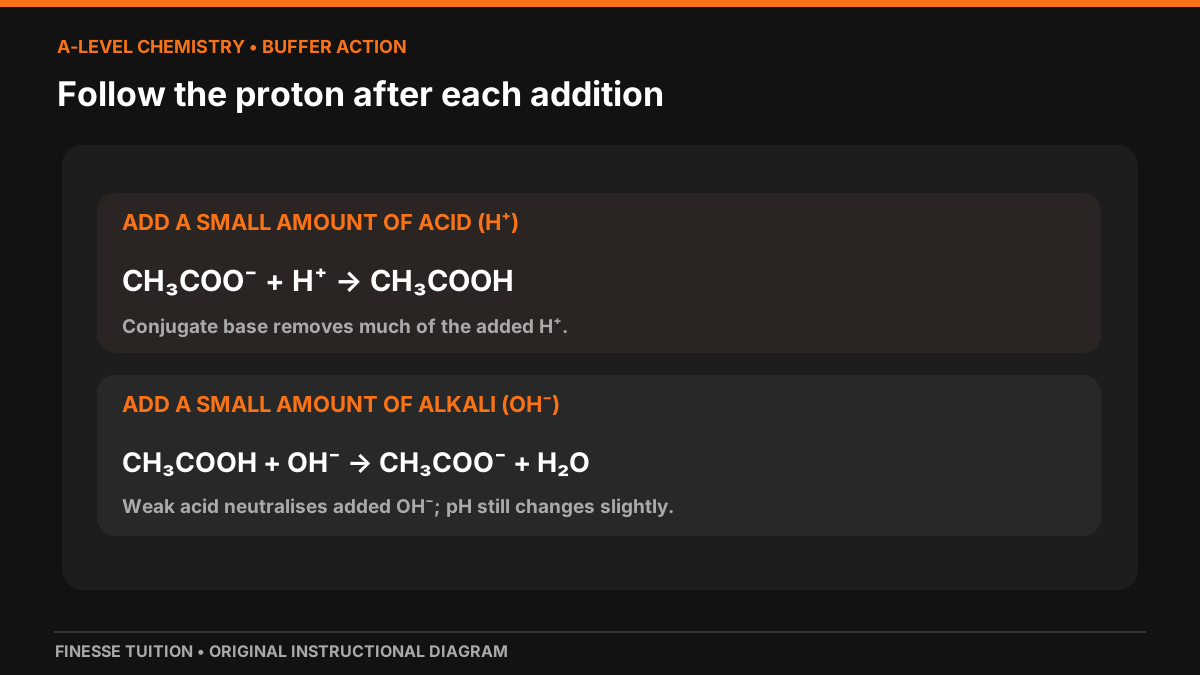
Write two ionic equations on blank paper. For added acid: CH₃COO⁻ + H⁺ → CH₃COOH. For added alkali: CH₃COOH + OH⁻ → CH₃COO⁻ + H₂O. These are different chemical responses. The first uses up some conjugate base; the second uses up some weak acid. A description that says simply 'the buffer neutralises the added ions' does not explain which component is doing the work.
Many A-Level answers need the reason that the hydrogen ion concentration is prevented from changing greatly, rather than a bare statement that the pH stays the same. When explaining an alkali addition, make clear that OH⁻ is removed by the weak acid. When explaining acid addition, make clear that A⁻ reacts with H⁺. The exact wording accepted depends on the question and its marking guidance, but these balanced chemical ideas remain central.
Do not confuse buffer action with strong-acid neutralisation by excess alkali. A buffer has both conjugate components already available, and there is a limit to how much added acid or base it can accommodate.
Derive the pH equation from the acid equilibrium
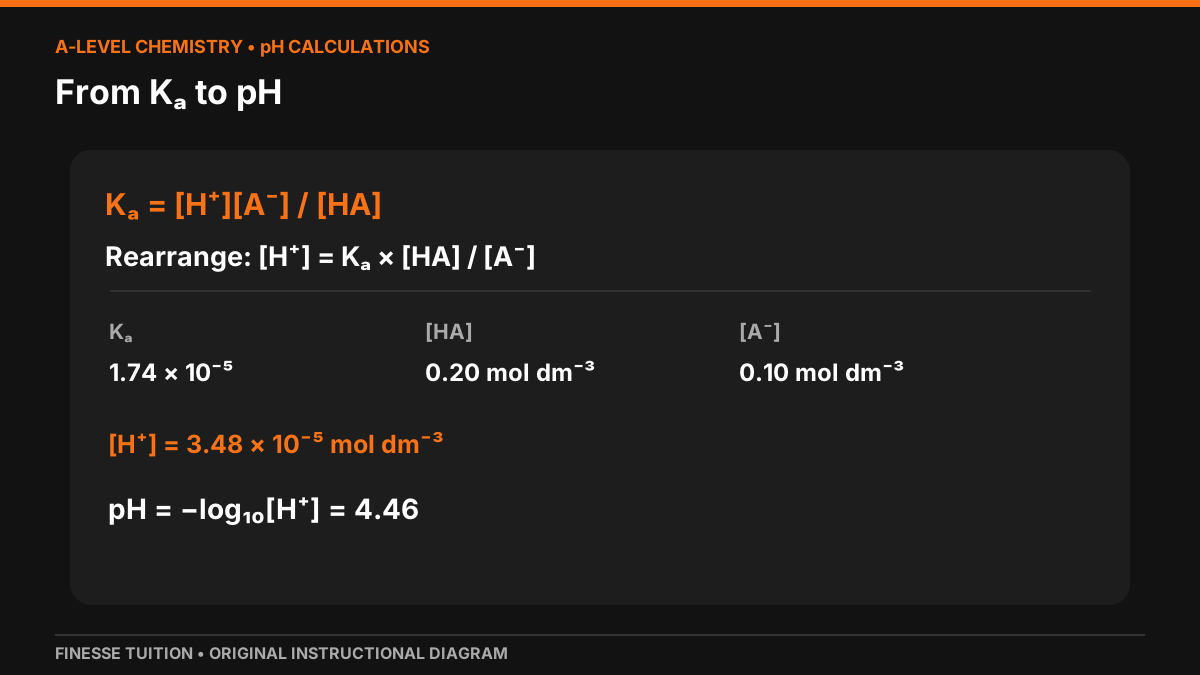
The weak-acid equilibrium constant is Kₐ=[H⁺][A⁻]/[HA]. Rearranging gives [H⁺]=Kₐ×[HA]/[A⁻]. This expression reveals the chemistry: more available conjugate base relative to weak acid means a lower hydrogen-ion concentration and a higher pH, assuming the equilibrium model remains valid. You are not just memorising a log formula; you can predict the direction before using a calculator.
Take a solution with analytical ethanoic acid concentration 0.20 mol dm⁻³ and ethanoate concentration 0.10 mol dm⁻³. Using Kₐ=1.74×10⁻⁵ mol dm⁻³ as an illustrative value at a stated temperature, [H⁺]≈(1.74×10⁻⁵)×0.20/0.10=3.48×10⁻⁵ mol dm⁻³. Thus pH=−log₁₀(3.48×10⁻⁵)=4.46 to two decimal places. State the assumption that the equilibrated HA and A⁻ concentrations are close to the supplied concentrations; it is a good approximation when dissociation is small relative to the buffer amounts.
Do not confuse pKₐ with Kₐ or forget the negative logarithm. A quick sense check helps: the weak acid and its base are not equimolar. Here the acid concentration is twice that of its conjugate base, so pH should be lower than pKₐ (about 4.76). A calculated pH above pKₐ would signal a ratio or logarithm mistake.
When acid is added, do the reaction before the logarithm
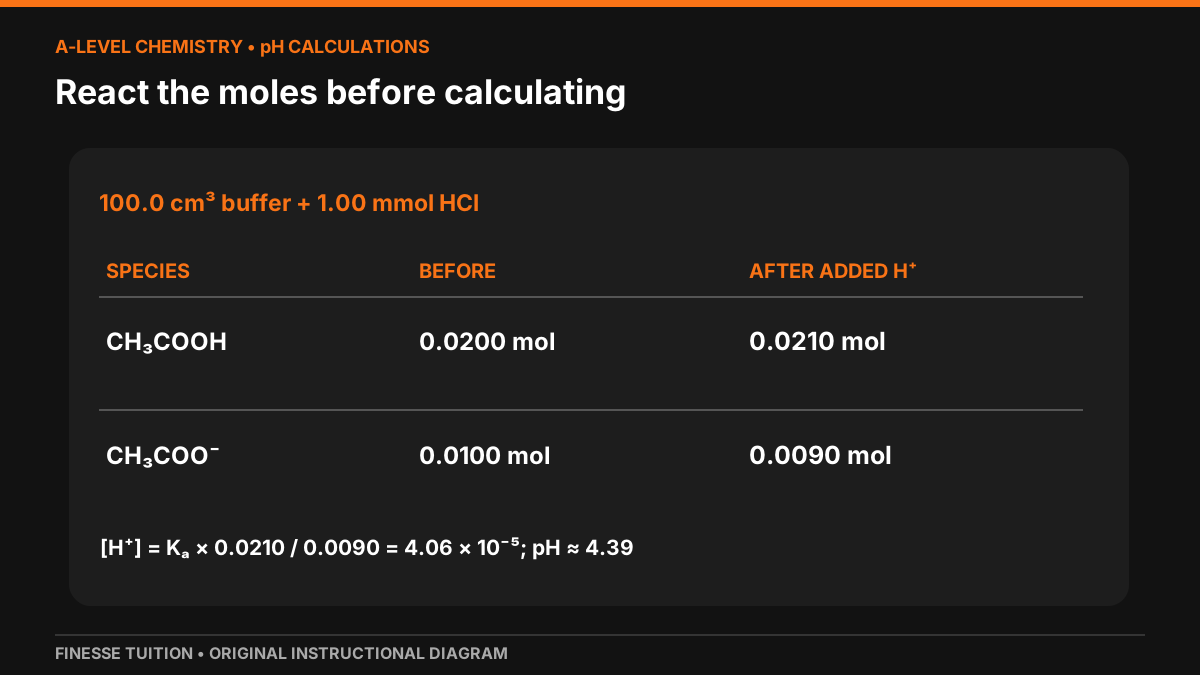
Now take 100.0 cm³ of that original buffer. The initial amount of CH₃COOH is 0.20×0.1000=0.0200 mol, and the initial amount of CH₃COO⁻ is 0.10×0.1000=0.0100 mol. Add 1.00 mmol (0.00100 mol) HCl, assuming complete dissociation and that the amount is small enough for the buffer to remain effective. The hydrogen ions react with CH₃COO⁻ to form CH₃COOH.
Make a mole table. Ethanoate falls to 0.0100−0.00100=0.00900 mol; ethanoic acid rises to 0.0200+0.00100=0.0210 mol. These values, not the starting amounts, belong in the new equilibrium calculation. Because both species share the same final solution volume, their concentration ratio equals their amount ratio. Therefore [H⁺]≈(1.74×10⁻⁵)×0.0210/0.00900=4.06×10⁻⁵ mol dm⁻³; pH≈4.39.
The pH has decreased from approximately 4.46 to 4.39, not remained completely unchanged. The small numerical change is consistent with buffer action, and the larger [HA]/[A⁻] ratio explains its direction. A frequent method mistake is to add 0.00100 to the hydrogen-ion concentration directly, ignoring the rapid neutralisation by available A⁻. Another is to subtract it from both components; always follow the balanced stoichiometric equation.
Dilution, capacity and the assumptions the simple equation hides
Suppose you dilute a buffer substantially with water but do not add acid or base. Both conjugate components are diluted by approximately the same factor, so their ratio—and thus the pH predicted by the simple Henderson–Hasselbalch relationship—changes little. The buffer's capacity, however, becomes lower per unit volume: it now contains fewer moles of reacting species in a given sample volume. Similar pH does not mean similar resistance to future additions.
The approximation is not limitless. At very low concentrations, water autoionisation and activity effects may matter; adding so much acid that almost all A⁻ is consumed leaves an ineffective buffer. Temperature affects Kₐ, and the pH equation must not be used blindly after mixing chemically incompatible species. These subtleties help you recognise the domain of the school-level model without replacing the A-Level method with unnecessary advanced chemistry.
Four mistakes that make a correct-looking answer fall apart
The first trap is saying the pH 'does not change'. A buffer resists pH change; it does not promise an absolutely fixed value. The second is naming Le Châtelier's principle without specifying which species reacts with added H⁺ or OH⁻. A complete explanation identifies the relevant conjugate component and shows what it produces.
The third is mixing up moles and concentrations in an addition question. Calculate the starting moles, follow the neutralisation stoichiometry, then use the updated acid-to-base ratio to estimate the new hydrogen ion concentration. The fourth is treating the pH equation as universal without considering whether a useful amount of both components remains. A badly depleted buffer no longer behaves like the original example.
When marking your work, compare against your own exam board's current official guidance. These are conceptual teaching cautions, not invented quotations from examiner reports. AQA 7405 explicitly expects qualitative explanations of both acidic and basic buffer action as well as calculations for acidic buffers. Do not assume one particular phrasing is mandatory across every board and question.
- Name the acid and conjugate base, not merely 'the equilibrium'.
- For added acid or alkali, write a balanced equation before predicting pH.
- In calculations, change component MOLES before applying Kₐ.
- Finish with a chemically justified 'small increase' or 'small decrease', not 'exactly constant'.
Why explanation and feedback remain a current assessment priority
AQA's Autumn 2026 A-Level Science subject update announced an Exampro development for Chemistry and Physics multiple-choice practice: extended explanations intended to clarify why alternative options are right or wrong. The same update described a forthcoming 'Exploring X' professional-development series drawing on 2026 candidate responses, with Chemistry sessions on extended responses and extended calculations. These are assessment-support developments, not a new A-Level Chemistry specification or a change to grade boundaries.
That news reinforces a useful practice habit: do not stop at the right option or right decimal. Explain the underlying reason, identify which alternative conclusion would be wrong, and connect the equation to the physical chemistry. For a buffer example, this means explaining why adding H⁺ consumes conjugate base before estimating how [H⁺] changes.
Read the official newsletter alongside your board's published specification. Exam-support resources can help teachers target misconceptions, but an external article cannot reliably infer the exact marks awarded by every future paper.
A 27-minute buffer session you can repeat without the notes
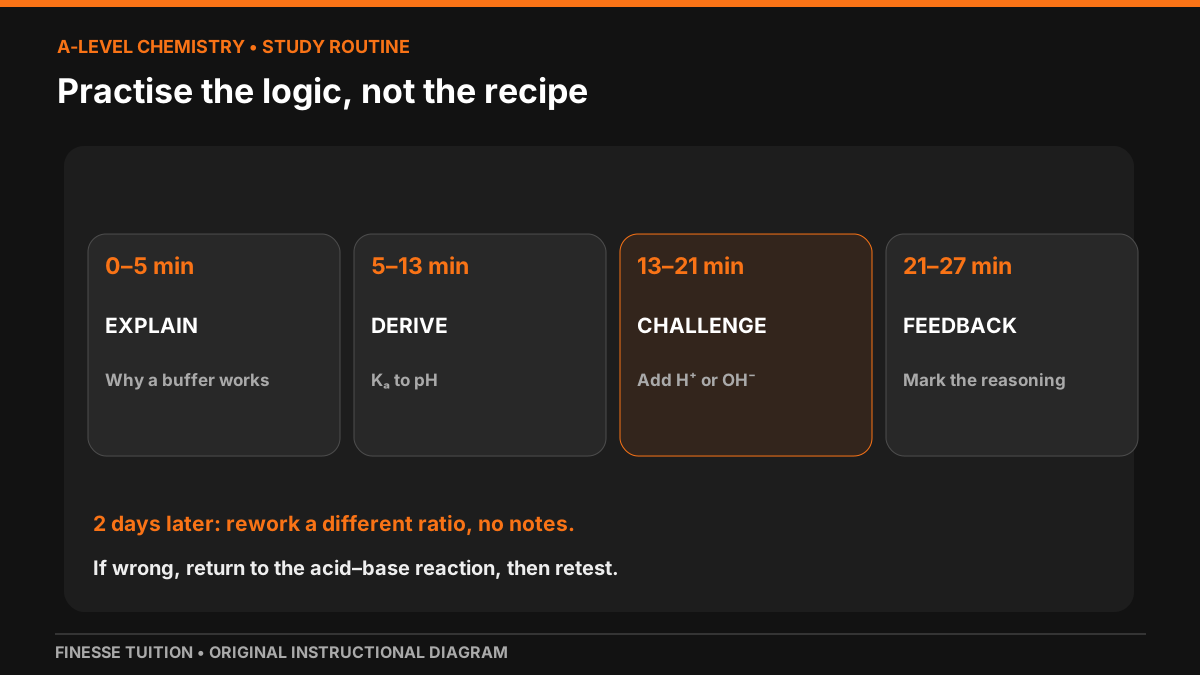
Minutes 0–5: draw an acidic-buffer equilibrium and explain the reactions following addition of H⁺ and OH⁻ from memory. Minutes 5–13: derive [H⁺]=Kₐ[HA]/[A⁻] and calculate pH from a fresh concentration ratio. Minutes 13–21: work a small-addition question in moles, with a two-column table showing how HA and A⁻ change. Minutes 21–27: mark your response using checked guidance, label the error and redo the reasoning rather than only copying the answer.
Two days later, attempt a parallel buffer calculation with different starting concentrations and a small hydroxide addition, without viewing the earlier solution. Practice testing and spaced retrieval are supported in learning-science research: Dunlosky and colleagues' 2013 review identified retrieval practice and distributed practice as generally valuable, while experimental work by Roediger and Karpicke in 2006 demonstrated delayed-memory advantages of testing under particular conditions. None of that research guarantees a fixed grade improvement from this precise routine.
If you cannot reconstruct the acid-base equations, take a short worked-example break before trying again. If you can derive the equations but repeatedly lose marks on the numbers, work on moles and units instead. Target the cause of the mistake. The goal is to make reasoning reliable enough to survive a novel exam context.
Sources & further reading
- AQA Chemistry 7405, section 3.1.12.6 — buffer action and calculations (official specification)
- AQA Autumn 2026 A-Level Science update — extended calculation CPD and Exampro explanations
- Dunlosky et al. (2013) — evidence review of learning techniques
- Roediger and Karpicke (2006) — retrieval testing and long-term retention
- Education Endowment Foundation — feedback to improve pupil learning
Sources checked on 15 October 2026. Check linked guidance for subsequent changes.