
Construct a path with consistent equations and states, then distinguish exact cycle data from average gas-phase bond estimates.
Enthalpy change is independent of route
Hess’s law states that the enthalpy change depends only on the initial and final states, not the route. Reverse an equation and reverse its ΔH sign; multiply the equation and multiply ΔH by the same factor. Add equations and cancel common species.
For an indirect hydration example, an anhydrous salt dissolves with ΔH = −70.0 kJ mol⁻¹ and its hydrate dissolves to the same final solution with ΔH = +10.0 kJ mol⁻¹. The hydration route plus hydrate dissolution must equal direct anhydrous dissolution: ΔHhydration + 10.0 = −70.0, so ΔHhydration = −80.0 kJ mol⁻¹. Amounts of water and final solution states must match.
Use a cycle to derive the signs
Formation arrows run from a shared set of elements to the reactants and to the products. To travel from reactants to products, first reverse the reactant formation arrow, then follow the product formation arrow. Therefore ΔrH = −ΣΔfH(reactants) + ΣΔfH(products). The subtraction is a consequence of the route, not an unrelated rule.
Combustion arrows both run down to identical final combustion products. To travel from reactants to products, follow reactant combustion and reverse product combustion. Therefore ΔrH = ΣΔcH(reactants) − ΣΔcH(products). The directions differ from formation cycles because the common state is now at the ends of the reference reactions.
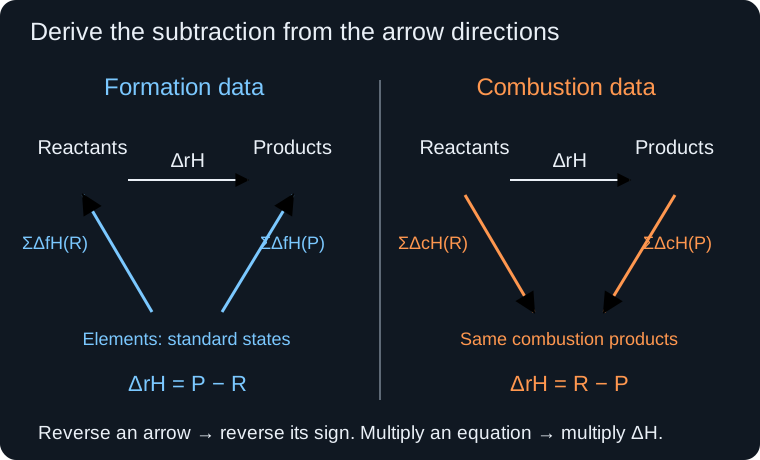
Swipe horizontally to view the whole diagram.
Formation data: products minus reactants
Use Σ(coefficient × ΔfH° of products) − Σ(coefficient × ΔfH° of reactants). An element in its standard state has ΔfH° = 0 by definition; this does not make all its enthalpy changes zero.
Worked example with supplied values: CH₄(g) + 2O₂(g) → CO₂(g) + 2H₂O(l), ΔfH° values −74.8, 0, −393.5, −285.8 kJ mol⁻¹. ΔH = [−393.5 + 2(−285.8)] − [−74.8] = −890.3 kJ mol⁻¹. The water coefficient is essential.
Rearrange for an unknown rather than changing the formula
For CO(g) + ½O₂(g) → CO₂(g), supplied ΔrH° = −283.0 kJ mol⁻¹ and ΔfH°(CO₂) = −393.5 kJ mol⁻¹. Let ΔfH°(CO) = x; oxygen’s formation value is zero. Then −283.0 = −393.5 − x, giving x = −110.5 kJ mol⁻¹.
Check by substituting: −393.5 − (−110.5) = −283.0. The negative sign on x inside the expression is not evidence that x itself must be positive. If the unknown species has coefficient two or three, the unknown term must also be multiplied before solving.
Zero formation enthalpy for O₂(g) does not mean its O=O bond takes no energy to break. It is the reference element in its standard state. O(g), ozone and oxygen in another physical state are different reference transformations.
Combustion data: reactants minus products
Combust both sides to identical final combustion products. The target reaction plus combustion of its products equals combustion of its reactants, hence ΔrH = ΣΔcH(reactants) − ΣΔcH(products), including coefficients.
For C₂H₄(g) + H₂(g) → C₂H₆(g), use supplied combustion enthalpies −1411, −286 and −1560 kJ mol⁻¹. ΔrH = (−1411 − 286) − (−1560) = −137 kJ mol⁻¹. Write the cycle if uncertain: the formula follows its arrow directions.
Make the final solutions chemically identical
For a hydrate experiment, the direct route dissolves the anhydrous salt into water. The indirect route first makes the hydrate, then dissolves it. Match the salt amount, temperature and total water so the final solution is the same for both routes; otherwise their difference includes an extra dilution or mixing effect.
If anhydrous dissolution is −52.0 kJ mol⁻¹ and hydrate dissolution is +8.0 kJ mol⁻¹, then ΔHhydration + 8.0 = −52.0, giving ΔHhydration = −60.0 kJ mol⁻¹. On the cycle, both dissolution arrows point towards the common solution even though one has a positive value.
Calculate each experimental dissolution enthalpy per mole of its own starting salt. Equal masses of hydrate and anhydrous solid are not equal mole amounts. Use the hydrate’s water-containing formula when converting its measured mass to moles.
Break minus make
Average bond enthalpy is the enthalpy needed to break one mole of a specified covalent bond in gaseous molecules, averaged over different compounds. It is positive. Bond formation has the opposite energy change. Estimate reaction ΔH by total bonds broken minus total bonds formed, counting all molecules in the balanced equation.
For H₂(g) + Cl₂(g) → 2HCl(g), supplied bond enthalpies H–H 436, Cl–Cl 242 and H–Cl 431 kJ mol⁻¹ give ΔH = 436 + 242 − 2(431) = −184 kJ mol⁻¹. Average values are approximate and assume gas-phase species; extra phase changes are needed to compare a liquid product.
H032/01 June 2025 Q23(b) required bond counts across the full balanced equation. Draw structures before counting; a coefficient multiplies every bond in that molecule.
Work out a bond enthalpy from the full bond inventory
Constructed example: N₂(g) + 3H₂(g) → 2NH₃(g) has supplied ΔH = −92 kJ mol⁻¹ for the equation. Use N≡N = 946 and H–H = 436 kJ mol⁻¹, and let N–H = x. Bonds broken require 946 + 3(436) = 2254 kJ; two ammonia molecules contain six N–H bonds.
Therefore −92 = 2254 − 6x. Rearranging gives 6x = 2346, so x = 391 kJ mol⁻¹. Dividing by three would overlook the coefficient two in front of NH₃. Use N≡N for nitrogen gas, not the enthalpy of an N–N single bond.
Bond enthalpies describe gas-phase bond breaking and are positive. Using average values to predict a reaction with liquid water omits condensation unless it is separately accounted for. The atomisation route through separated atoms is an energy-accounting route; it is not the actual molecular collision mechanism or the activation-energy peak.
Quick checks
Original Finesse questions. Reveal the indicative worked solutions after attempting each question; these are not official OCR A mark allocations.
Q1. A reaction has ΔH = −125 kJ mol⁻¹. What happens when its equation is reversed?Show answer
The sign becomes +125 kJ mol⁻¹ for the reversed equation.
Q2. Why is ΔfH° of O₂(g) zero?Show answer
O₂(g) is oxygen’s standard state at the stated conditions; its formation from the same standard-state element is the reference zero.
Q3. For A → B, combustion enthalpies of A and B to the same products are −600 and −450. Find ΔH.Show answer
−600 − (−450) = −150 kJ mol⁻¹.
Q4. Bonds broken total 1200 kJ and bonds formed release 1450 kJ. Find the reaction energy.Show answer
1200 − 1450 = −250 kJ for the stated reacting amounts.
Q5. Why can an average-bond calculation differ from experimental ΔH?Show answer
Bond enthalpies vary with molecular environment and are averaged; experimental species may also have different physical states.
Q6. Multiple choice: which expression uses formation enthalpies correctly for 2A → B? A 2ΔfH(A) − ΔfH(B); B ΔfH(B) − 2ΔfH(A); C ΔfH(B) − ΔfH(A); D both values are zero.Show answer
B: products minus reactants, including the coefficient two. A reverses the route; C omits the coefficient; D incorrectly treats compounds as reference elements.
Q7. For 2CO + O₂ → 2CO₂, ΔH = −566.0 and ΔfH(CO₂) = −393.5 kJ mol⁻¹. Find ΔfH(CO).Show answer
−566.0 = 2(−393.5) − 2x. Thus 2x = −221.0 and x = −110.5 kJ mol⁻¹. The unknown is multiplied by two because two CO react.
Q8. Anhydrous dissolution is −44.0 kJ mol⁻¹ and hydrate dissolution to the same final state is +12.0. Find the hydration enthalpy and explain the route.Show answer
Direct dissolution equals hydration plus hydrate dissolution: −44.0 = ΔHhydration + 12.0. Hence ΔHhydration = −56.0 kJ mol⁻¹. Both paths must end at the same solution state.
Q9. For H₂ + Br₂ → 2HBr, supplied gas-phase ΔH is −72 and bond enthalpies H–H = 436, Br–Br = 194 kJ mol⁻¹. Find H–Br.Show answer
−72 = 436 + 194 − 2x. Therefore 2x = 702 and x = 351 kJ mol⁻¹. This uses a supplied gas-phase reaction, not standard liquid bromine without a vaporisation correction.
Sources
Sources and examiner guidance (reviewed 5 October 2026)
- OCR A H032 specification, version 2.0 — 3.2.1(a–h); AS outcomes and additional guidance. Reviewed 3 October 2026.
- Chemrevise — OCR A 3.2.1 enthalpy changes — Pages 1–9; coverage reference. Explanations and questions on this page are original.
- OCR H032/02 mark scheme — June 2025 — Q1(c), Q4(b)(iii); printed pages 9–10, 18. Read with the question paper.
- OCR H032/02 examiner report — June 2025 — Q1(c), Q4(b)(iii); printed pages 7–8, 21. Question-specific assessment guidance.
- OCR H032/01 mark scheme — June 2025 — Q11, Q23(b); printed pages 8, 17. Read with the question paper.
- OCR H032/01 examiner report — June 2025 — Q11, Q23(b); printed pages 11, 28. Question-specific assessment guidance.
- OCR H032/01 question paper — June 2025 — Question context for the question numbers listed with the mark scheme and examiner report.
- OCR H032/02 question paper — June 2025 — Question context for the question numbers listed with the mark scheme and examiner report.
- OCR H032/H432 data sheet — Page 2: constants used in these calculations; reviewed 3 October 2026.
- OCR H032/01 June 2024 mark scheme — Q23(b); printed pp. 16–17. Reviewed 5 October 2026.
- OCR H032/01 June 2024 examiner report — Q23(b); printed pp. 27–28. Reviewed 5 October 2026.
- OCR H032/01 June 2024 question paper — Q23(b); corresponding question context. Reviewed 5 October 2026.
Finesse Tuition is not endorsed by AQA or Chemrevise. All explanations and examples here are our own.