
Convert a measured temperature change into energy for the sample, then into an enthalpy change per mole.
Worked neutralisation calculation
Use qsolution = mcΔT, where m is the mass being warmed, c is its specific heat capacity and ΔT is the temperature change. For dilute aqueous solutions, a question often assumes density 1.00 g cm⁻³ and c = 4.18 J g⁻¹ K⁻¹. State the assumptions.
Mix 25.0 cm³ 1.00 mol dm⁻³ HCl and 25.0 cm³ 1.00 mol dm⁻³ NaOH; temperature rises 6.50 °C. Total solution mass = 50.0 g. q = 50.0 × 4.18 × 6.50 = 1358.5 J. Moles of water = 0.0250 mol. ΔneutH = −1358.5/(1000 × 0.0250) = −54.3 kJ mol⁻¹.
A temperature difference of 6.50 °C is 6.50 K; do not add 273 to a temperature change. Divide by the stoichiometric moles for the definition requested. For sulfuric acid, two moles of water can form per mole of acid.
Choose the reacting amount before dividing by moles
Constructed example: mix 40.0 cm³ of 0.500 mol dm⁻³ HCl with 30.0 cm³ of 0.500 mol dm⁻³ NaOH. The temperature rises by 2.90 K. Assume density 1.00 g cm⁻³, specific heat capacity 4.18 J g⁻¹ K⁻¹ and negligible heat absorbed by the vessel.
HCl amount = 0.0200 mol; NaOH amount = 0.0150 mol. The ratio is 1:1, so NaOH limits and 0.0150 mol water forms. Both solutions warm, so use total solution mass 70.0 g. qsolution = 70.0 × 4.18 × 2.90 = 848.54 J. ΔneutH = −0.84854/0.0150 = −56.6 kJ mol⁻¹.
Dividing by 0.0200 mol acid would incorrectly count acid that did not react. Using 30.0 g as the warmed mass would miss the acid solution that also absorbed energy. The mass in mcΔT and the amount in q/n refer to different quantities; label both.
| Quantity | How obtained | Purpose |
|---|---|---|
| 70.0 g solution | 40.0 + 30.0 cm³ at assumed density | Mass warmed in mcΔT |
| 0.0150 mol water | Limiting NaOH and the 1:1 ratio | Amount for neutralisation enthalpy |
| 2.90 K rise | Final minus initial temperature | Temperature change, not absolute temperature |
Reduce and estimate heat exchange
Use a supported insulated cup and lid, measure reagent quantities and initial temperatures, add and stir, then record temperatures at regular intervals. A temperature–time graph can extrapolate the cooling trend back to mixing time to estimate heat loss, where the reaction is sufficiently rapid for that method.
Heat lost from an exothermic mixture makes the observed rise too small and the calculated ΔH less negative. The cup also absorbs energy; assuming water’s heat capacity and density introduces approximation. Repetition measures scatter but does not eliminate these biases. These are PAG 3 skills.
H032/02 June 2025 Q1(c) used the combined mass of both solutions. A changed concentration can alter temperature rise by changing total solution mass while leaving heat per mole unchanged: concentration and rate are not substitutes for the energy calculation.
Use a cooling curve without inventing a correction
Record a baseline before mixing, the mixing time, and several temperatures after the rapid reaction. Extrapolate the post-reaction cooling trend back to mixing time. The vertical difference between that intercept and the pre-mixing baseline estimates the temperature rise before appreciable heat exchange.
For an illustrative baseline of 20.0 °C, an observed maximum of 25.2 °C and a justified extrapolated intercept of 25.8 °C, use ΔT = 5.8 K instead of 5.2 K. This raises the calculated released-energy magnitude by 5.8/5.2. Do not add 0.6 K as a universal correction to other experiments.
The extrapolation assumes the selected cooling behaviour represents heat exchange near mixing and that the main reaction is sufficiently rapid. A slow reaction and simultaneous cooling may require a more appropriate model. Stirring improves temperature uniformity; it does not remove heat-loss bias.
Compare changes to the method quantitatively
If both reagent volumes are halved at unchanged concentrations and reacting proportions, half as many moles react and approximately half as much heat is released. The solution mass is also halved, so ideal ΔT = q/(mc) stays the same. Molar ΔH remains unchanged. Real smaller-scale measurements may have different relative losses.
If instead the same reacting amount is diluted with extra water, approximately the same heat warms a larger mass and the temperature rise is smaller. Do not confuse this with halving both volumes. Specify what was held constant before predicting the result.
Fuel calorimetry
Weigh a spirit burner before and after heating a known water mass. Use the water mass in q = mcΔT; use fuel mass lost to find fuel moles. Shield draughts, keep apparatus geometry consistent, stir the water and use safe flame controls.
Heat escaping around the vessel, heating the apparatus, incomplete combustion and fuel evaporation can all make the apparent magnitude too small. Soot shows incomplete combustion; a simple open flame experiment is unlikely to establish a precise standard combustion enthalpy.
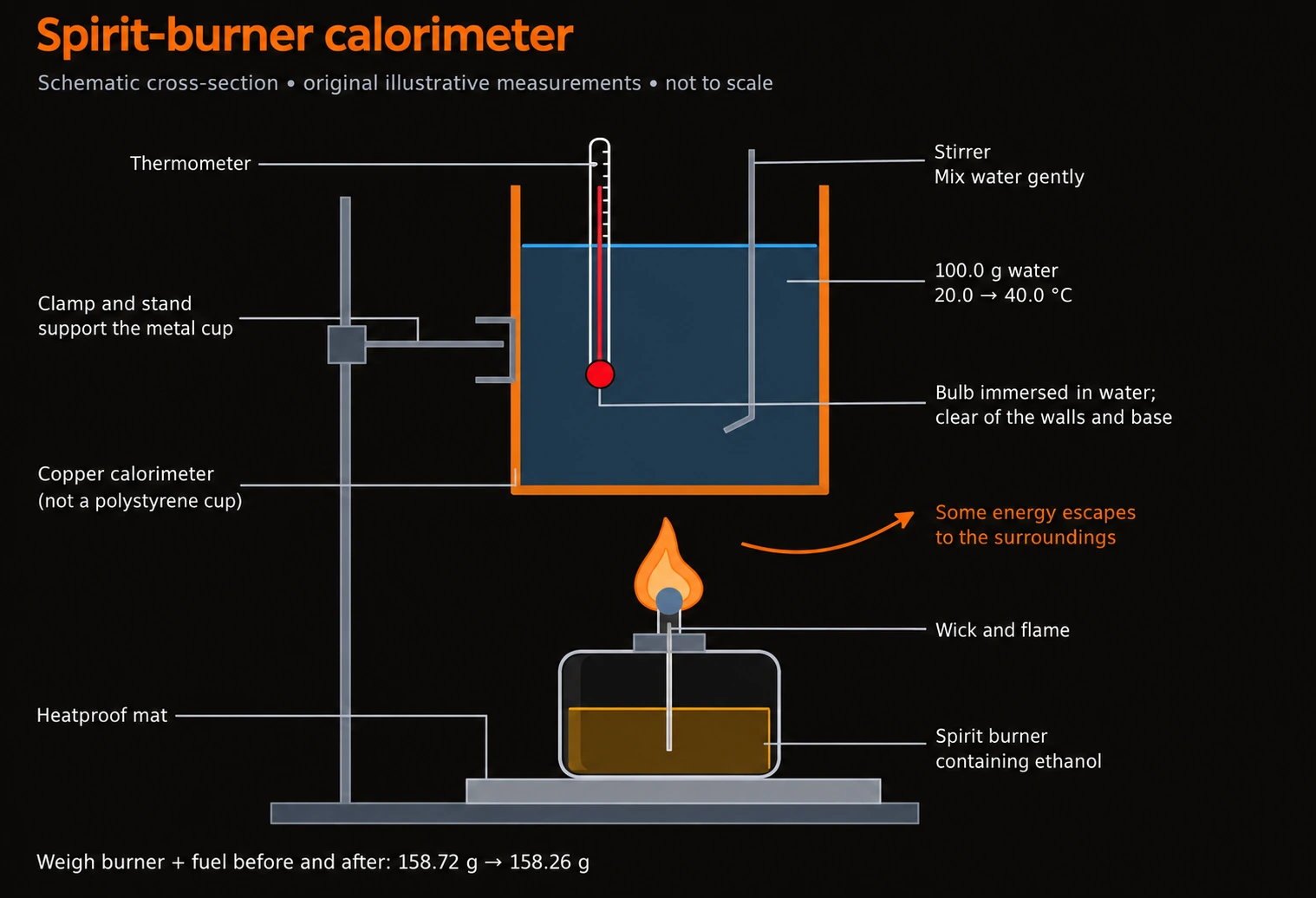
Swipe horizontally to view the whole diagram.
Quick checks
Original Finesse questions. Reveal the indicative worked solutions after attempting each question; these are not official OCR A mark allocations.
Q1. Find q for 80.0 g solution heated by 5.00 K, c = 4.18.Show answer
q = 80.0 × 4.18 × 5.00 = 1672 J = 1.67 kJ.
Q2. That energy came from 0.0400 mol reaction. Find ΔH.Show answer
ΔH = −1.672/0.0400 = −41.8 kJ mol⁻¹.
Q3. Which mass enters q when 30 cm³ acid and 20 cm³ alkali are mixed at density 1.00?Show answer
50.0 g of total solution, not 30 g or the solute mass alone.
Q4. Does heat loss make an exothermic calculated ΔH more or less negative?Show answer
Less negative: the measured temperature rise and inferred released heat are too small.
Q5. Why measure a burner’s mass before and after?Show answer
The difference estimates mass of fuel used; divide by molar mass for moles, while recognising evaporation can bias that difference.
Q6. Application: 60.0 g solution warms by 4.00 K when 0.0200 mol of the limiting reactant reacts 1:1. Calculate molar ΔH with c = 4.18.Show answer
qsolution = 60.0 × 4.18 × 4.00 = 1003.2 J = 1.0032 kJ. Reaction energy is negative. ΔH = −1.0032/0.0200 = −50.2 kJ mol⁻¹.
Q7. Multiple choice: keeping reaction amount unchanged but adding more water ideally gives A greater q and ΔT; B unchanged q and lower ΔT; C lower q and unchanged ΔT; D unchanged q and greater ΔT.Show answer
B. The same reaction amount releases the same heat in the simplified model, but more solution mass shares that energy. It is q/mc that determines the rise.
Q8. Extended response: plan and evaluate a cup-calorimetry experiment for a metal displacing metal ions. Include how to calculate ΔH and distinguish two sources of error.Show answer
Measure solution volume/concentration and initial temperature; use a supported insulated cup, lid and stirring. Add a known amount of metal, sufficient to leave the dissolved reactant limiting, and record temperature against time. Use appropriate chemical and disposal controls.
Calculate heat using the mass and heat capacity specified or explicitly assumed for the warmed solution; identify reacted moles from the equation and limiting amount; change sign and convert J to kJ. A cooling correction may be justified for a sufficiently rapid reaction.
Heat loss systematically reduces the measured rise; insulation/lid and appropriate extrapolation address it. Thermometer uncertainty affects ΔT precision; a suitable higher-resolution probe addresses that. State assumptions about density, heat capacity, completion and vessel heat absorption. The response is judged as connected scientific reasoning, not one invented mark per sentence.
Q9. Fuel mass lost is overestimated because some unburned fuel evaporates. How does that bias the calculated combustion enthalpy?Show answer
The inferred moles burned are too large for the measured heat. Dividing by too large an amount gives too small a magnitude, so the calculated exothermic ΔH is less negative.
Sources
Sources and examiner guidance (reviewed 5 October 2026)
- OCR A H032 specification, version 2.0 — 3.2.1(a–h); AS outcomes and additional guidance. Reviewed 3 October 2026.
- Chemrevise — OCR A 3.2.1 enthalpy changes — Pages 1–9; coverage reference. Explanations and questions on this page are original.
- OCR H032/02 mark scheme — June 2025 — Q1(c), Q4(b)(iii); printed pages 9–10, 18. Read with the question paper.
- OCR H032/02 examiner report — June 2025 — Q1(c), Q4(b)(iii); printed pages 7–8, 21. Question-specific assessment guidance.
- OCR H032/01 mark scheme — June 2025 — Q11, Q23(b); printed pages 8, 17. Read with the question paper.
- OCR H032/01 examiner report — June 2025 — Q11, Q23(b); printed pages 11, 28. Question-specific assessment guidance.
- OCR H032/01 question paper — June 2025 — Question context for the question numbers listed with the mark scheme and examiner report.
- OCR H032/02 question paper — June 2025 — Question context for the question numbers listed with the mark scheme and examiner report.
- OCR H032/H432 data sheet — Page 2: constants used in these calculations; reviewed 3 October 2026.
- OCR H032/02 June 2024 mark scheme — Q3(b–c); printed pp. 15–16. Reviewed 5 October 2026.
- OCR H032/02 June 2024 examiner report — Q3(b–c); printed pp. 19–21. Reviewed 5 October 2026.
- OCR H032/02 June 2024 question paper — Q3(b–c); corresponding question context. Reviewed 5 October 2026.
Finesse Tuition is not endorsed by AQA or Chemrevise. All explanations and examples here are our own.