
Define the reacting system, get the sign right and distinguish activation energy from the overall enthalpy change.
Exothermic and endothermic
Enthalpy change ΔH describes heat transferred at constant pressure. In an exothermic reaction the system transfers energy to the surroundings; products have lower enthalpy and ΔH is negative. In an endothermic reaction the system absorbs energy; products have higher enthalpy and ΔH is positive.
A temperature rise in the surrounding solution indicates an exothermic reaction, not a positive reaction ΔH. Bond breaking requires energy and bond formation releases energy. Whether a reaction is exothermic depends on the balance, not simply on the fact that some bonds break.
Track whose energy is increasing
In a cup experiment, the reacting chemicals form the system and the solution/apparatus receive or supply thermal energy. When the solution warms, it gains thermal energy: qsolution is positive. The reaction supplied that energy, so qreaction is negative. Opposite signs describe the two sides of the same transfer, not a contradiction.
Temperature measures how hot the surroundings become, whereas enthalpy change concerns the energy transferred for a specified reacting amount. A 2 °C rise in a very large mass of water can represent more energy than a 10 °C rise in a small mass. That is why ΔT alone cannot rank molar enthalpy changes.
Breaking bonds never provides the net energy release. Reactant bonds require energy to break, and product bonds release energy as they form. An exothermic result means the formation release is larger than the breaking requirement. It does not mean every intermediate step releases energy.
Use the correct one-mole definition
Standard conditions in this course use 100 kPa and a specified temperature, usually 298 K, with substances in their standard states and aqueous concentrations of 1 mol dm⁻³ where appropriate. Always retain state symbols: forming steam and liquid water gives different ΔH values.
Enthalpy change of reaction, ΔrH, belongs to the reacting amounts in a stated balanced equation. Doubling that equation doubles its enthalpy change; “per mole of reaction” means that stoichiometric equation, not automatically one mole of every substance.
| Quantity | Definition basis | Example equation |
|---|---|---|
| Formation, ΔfH° | One mole of compound formed from its elements in standard states | C(graphite) + O₂(g) → CO₂(g) |
| Combustion, ΔcH° | One mole of substance burned completely in oxygen | CH₄(g) + 2O₂(g) → CO₂(g) + 2H₂O(l) |
| Neutralisation, ΔneutH° | Acid and alkali reacting to form one mole of water | H⁺(aq) + OH⁻(aq) → H₂O(l) |
Write an equation that matches the enthalpy definition
The standard formation equation for liquid ethanol is 2C(s, graphite) + 3H₂(g) + ½O₂(g) → C₂H₅OH(l). Exactly one mole of compound forms from elements in their standard states. Starting from CO₂ or using gaseous carbon atoms would describe another enthalpy change.
The combustion equation for ethanol is C₂H₅OH(l) + 3O₂(g) → 2CO₂(g) + 3H₂O(l). Exactly one mole of the fuel burns completely. The coefficient of water can be three: the one-mole restriction belongs to the substance burned, not every species.
For H₂SO₄ + 2NaOH → Na₂SO₄ + 2H₂O, the enthalpy for the equation as written corresponds to two moles of water. To quote enthalpy of neutralisation per mole of water, divide that energy by two. State which basis you are using before manipulating values.
Activation energy is measured from the reactants
Activation energy Ea is the minimum energy needed for a successful reaction on a particular pathway. On an enthalpy profile, plot enthalpy vertically and reaction progress horizontally. Ea rises from reactant level to the peak; ΔH runs from reactant to product level. It is not the peak height above the page’s baseline.
For an illustrative exothermic profile with reactants at 100, transition state at 180 and products at 40 kJ mol⁻¹ on an arbitrary scale, forward Ea = 80, ΔH = −60 and reverse Ea = 140 kJ mol⁻¹. The reverse reaction has ΔH = +60.
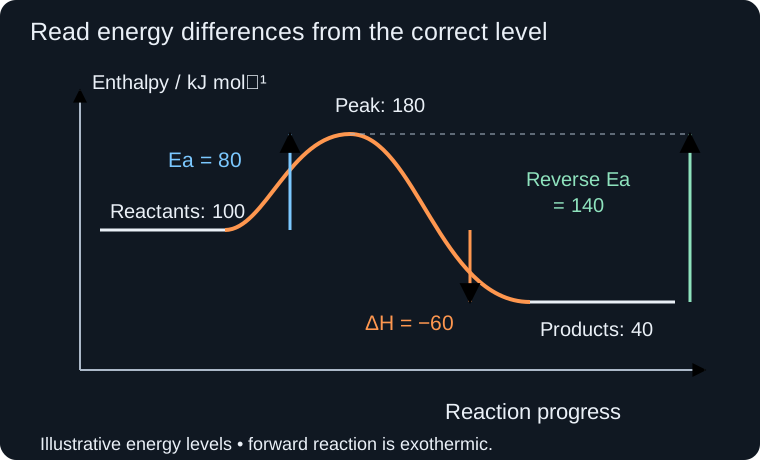
Swipe horizontally to view the whole diagram.
Quick checks
Original Finesse questions. Reveal the indicative worked solutions after attempting each question; these are not official OCR A mark allocations.
Q1. The surrounding solution warms. What sign is reaction ΔH?Show answer
Negative: the system has released heat to the solution.
Q2. Why is 2H₂ + O₂ → 2H₂O not the one-mole formation equation for water?Show answer
It forms two moles. Use H₂(g) + ½O₂(g) → H₂O(l) for standard formation of liquid water.
Q3. Define standard enthalpy of combustion.Show answer
The enthalpy change when one mole of a substance burns completely in oxygen under standard conditions, all reactants and products in their standard states.
Q4. Reactants are at 20, peak at 90 and products at 50 on an illustrative energy scale. Find Ea and ΔH.Show answer
Ea = 90 − 20 = 70; ΔH = 50 − 20 = +30, with the units of the scale.
Q5. Does breaking a bond release energy?Show answer
No. Breaking absorbs energy; forming a bond releases it.
Q6. Multiple choice: an exothermic reaction warms 50 g solution. Which sign pair is correct? A qsolution positive, qreaction negative; B both positive; C both negative; D qsolution negative, qreaction positive.Show answer
A: energy enters the solution and leaves the reacting system. The sign must be assigned to the quantity actually described.
Q7. Write the standard formation equation for Al₂O₃(s).Show answer
2Al(s) + 1½O₂(g) → Al₂O₃(s). It forms one mole from elements in their standard states. A fractional oxygen coefficient is appropriate here.
Q8. The forward activation energy is 90 kJ mol⁻¹ and forward ΔH is +35 kJ mol⁻¹. Find the reverse activation energy.Show answer
Products are 35 above reactants; the peak is 90 above reactants. Reverse barrier = 90 − 35 = 55 kJ mol⁻¹. Sketch the levels to avoid automatically adding ΔH.
Q9. If H₂ + ½O₂ → H₂O(l) has ΔH = −286 kJ mol⁻¹, what energy corresponds to 2H₂O(l) → 2H₂ + O₂?Show answer
Reverse the reaction to change the sign to +286, then multiply all reacting amounts by two: +572 kJ for the equation as written.
Sources
Sources and examiner guidance (reviewed 5 October 2026)
- OCR A H032 specification, version 2.0 — 3.2.1(a–h); AS outcomes and additional guidance. Reviewed 3 October 2026.
- Chemrevise — OCR A 3.2.1 enthalpy changes — Pages 1–9; coverage reference. Explanations and questions on this page are original.
- OCR H032/02 mark scheme — June 2025 — Q1(c), Q4(b)(iii); printed pages 9–10, 18. Read with the question paper.
- OCR H032/02 examiner report — June 2025 — Q1(c), Q4(b)(iii); printed pages 7–8, 21. Question-specific assessment guidance.
- OCR H032/01 mark scheme — June 2025 — Q11, Q23(b); printed pages 8, 17. Read with the question paper.
- OCR H032/01 examiner report — June 2025 — Q11, Q23(b); printed pages 11, 28. Question-specific assessment guidance.
- OCR H032/01 question paper — June 2025 — Question context for the question numbers listed with the mark scheme and examiner report.
- OCR H032/02 question paper — June 2025 — Question context for the question numbers listed with the mark scheme and examiner report.
- OCR H032/H432 data sheet — Page 2: constants used in these calculations; reviewed 3 October 2026.
- OCR H032/02 June 2024 mark scheme — Q3(a); printed pp. 15. Reviewed 5 October 2026.
- OCR H032/02 June 2024 examiner report — Q3(a); printed pp. 18. Reviewed 5 October 2026.
- OCR H032/02 June 2024 question paper — Q3(a); corresponding question context. Reviewed 5 October 2026.
Finesse Tuition is not endorsed by AQA or Chemrevise. All explanations and examples here are our own.