
Count donor bonds rather than ligand molecules, use coordination geometry, and connect ligand exchange to biological function and complex stability.
The ligand donates both electrons of the bond
A ligand is an ion or molecule that donates an electron pair to a central metal atom or ion to form a dative, or coordinate, covalent bond. A complex ion contains a central metal ion surrounded by ligands and has an overall charge. Some complexes, such as Pt(NH₃)₂Cl₂, are neutral. The ligand is the electron-pair donor (Lewis base) and the metal centre is the acceptor (Lewis acid).
Water donates an oxygen lone pair, ammonia a nitrogen lone pair and hydroxide an oxygen lone pair. Each can act as a monodentate ligand, forming one donor bond per ligand to a given centre. Having more than one lone pair on an atom does not make water bidentate: denticity counts donor atoms/bonds attached to the same metal in the complex being described.
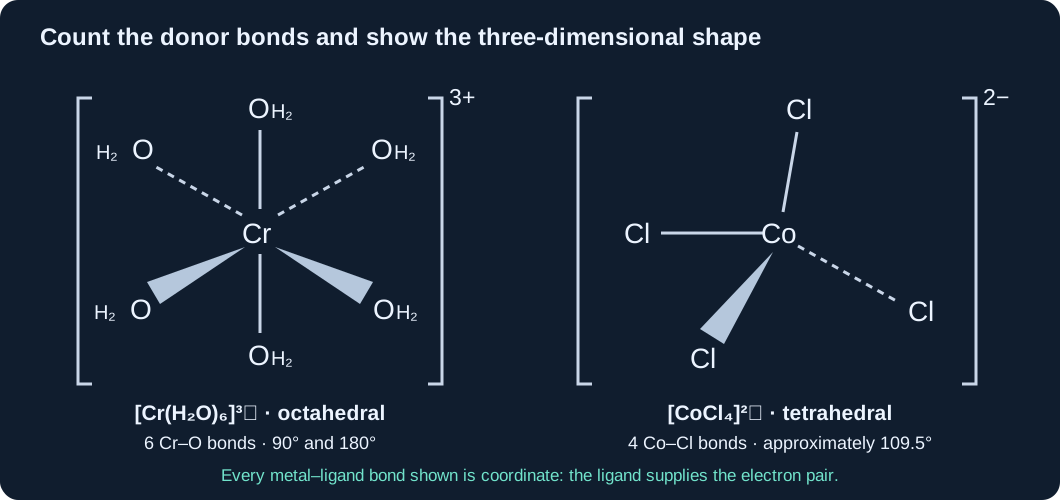
The coordination number is the number of coordinate bonds to the central metal, not the charge and not necessarily the number of ligand molecules. In [Cu(H₂O)₆]²⁺, six monodentate neutral waters give coordination number six and leave the metal at +2. Brackets enclose the complex; counterions, if present, are outside.
Connect coordination number and geometry
Six small ligands such as water or ammonia can fit around the central metal in octahedral positions. Larger ligands occupy more space and can lead to a lower coordination number; chloride substitution is an important example. Metal identity, electron configuration and ligand bonding also affect geometry, so size alone is not a universal rule.
When sketching an octahedron include all six bonds: four around an equatorial plane and two opposite axial positions. A tetrahedral sketch needs three-dimensional wedge/dash information; a square-planar sketch places all four bonds in one plane. Worked charge check: x + 4(−1) = −2 in [CoCl₄]²⁻ gives Co(+2). Six OH⁻ around Cr(+3) give [Cr(OH)₆]³⁻, not a +3 complex.
| Geometry | Coordination and angles | Example and explanation |
|---|---|---|
| Octahedral | Six donor bonds; adjacent 90°, opposite 180° | [Cu(H₂O)₆]²⁺, [Co(NH₃)₆]²⁺ and [Cr(OH)₆]³⁻. Six positions spread the ligands around the metal. |
| Tetrahedral | Four donor bonds; approximately 109.5° | [CoCl₄]²⁻ and the course model of [CuCl₄]²⁻. Relatively large chloride ligands often favour four-fold coordination. |
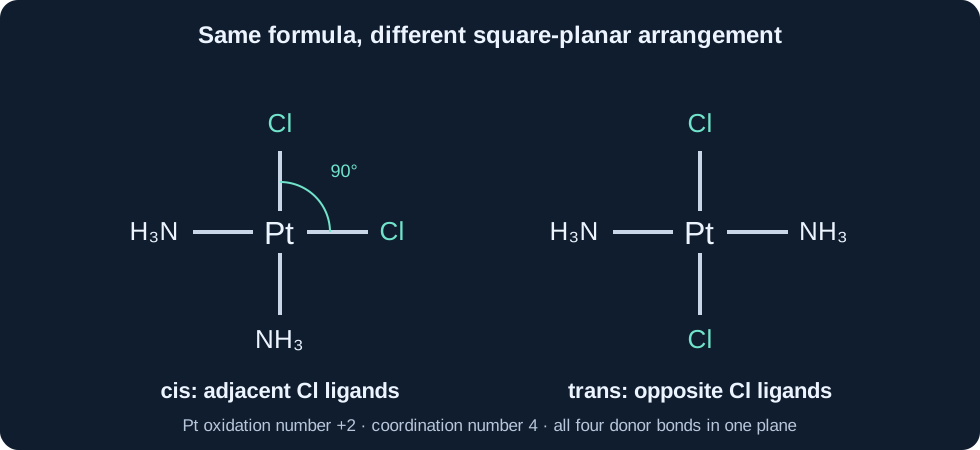
| Square planar | Four coplanar donor bonds; adjacent 90°, opposite 180° | Pt(NH₃)₂Cl₂. Four-coordinate does not automatically mean tetrahedral. |
Swipe horizontally to view the whole diagram.
Adjacent and opposite ligands give different biological behaviour
Square-planar Pt(NH₃)₂Cl₂ has cis and trans geometric isomers. In cis-platin the two chloride ligands are adjacent, with Cl–Pt–Cl = 90°; in the trans form they are opposite, at 180°. Both contain Pt(+2), two ammonia and two chloride ligands, but their spatial arrangements differ. Rotating an entire molecule cannot turn adjacent positions into opposite ones.
Cis-platin is supplied as the cis isomer because its geometry enables the relevant binding and cross-linking of DNA after ligand substitution, disrupting replication and cell division. The trans form does not have equivalent anticancer activity. A mixture would therefore contain material with a different biological effect rather than simply an equally useful second form. The structural distinction matters even though formula and oxidation state are unchanged.
Ligand substitution activates cis-platin: a chloride may be replaced by water before DNA donor atoms coordinate. This is coordination chemistry, not reduction of platinum. Its action can also affect healthy cells, so specificity is not perfect. Here the syllabus point is how molecular geometry changes function, rather than clinical treatment advice.
Swipe horizontally to view the whole diagram.
One ligand can occupy several coordination positions
Ethane-1,2-diamine, H₂NCH₂CH₂NH₂ (often abbreviated en), is bidentate. Each nitrogen has a lone pair and the chain allows both nitrogens to bond to the same metal, forming a chelate ring. Three en ligands can therefore provide six donor bonds in [Co(en)₃]³⁺. Coordination number six does not require six ligand molecules.
EDTA⁴⁻ is a multidentate ligand with six usual donor sites: two nitrogen atoms and four oxygen atoms, one from each carboxylate group. Its condensed connectivity is (⁻OOC–CH₂)₂N–CH₂–CH₂–N(CH₂–COO⁻)₂: each nitrogen has a lone pair, and each of the four carboxylate arms provides one oxygen donor. It can surround a metal with six donor bonds while counting as one ligand. In [Cu(EDTA)]²⁻, Cu(+2) plus EDTA(−4) gives the overall −2 charge. Recognise the available donor atoms rather than counting every oxygen lone pair as a separate donor bond.
Worked example: [Cr(en)₂Cl₂]⁺ contains two neutral bidentate en ligands, contributing four donor bonds, and two chloride ligands, contributing two. Coordination number = six. Charge equation x − 2 = +1 gives chromium(+3). Oxidation number, ligand count and coordination number are three different quantities.
Released monodentate ligands increase system entropy
Replacing several monodentate ligands with fewer bidentate or multidentate ligands releases more independently moving ligand particles into solution. For [Co(NH₃)₆]²⁺ + 3en ⇌ [Co(en)₃]²⁺ + 6NH₃, there are four dissolved reactant particles for every seven product particles in the written equation. The large positive ΔSsystem favours the chelated complex.
In this ammonia/en comparison, six metal–nitrogen bonds are replaced by six metal–nitrogen bonds, so an enormous enthalpy advantage is not needed to explain the equilibrium preference. The entropy term can make ΔG = ΔH − TΔS more negative. Similar donor atoms do not prove ΔH is exactly zero; solvation and bond environments still matter.
EDTA substitution releases six water ligands while one EDTA ligand attaches. The simple particle-count argument captures the entropy advantage, but solvent water is not treated as a concentrated solute term in an equilibrium expression. ‘More stable’ here means thermodynamically favoured formation under appropriate conditions; it does not guarantee that every exchange is rapid or independent of pH.
Ligand exchange can change oxygen transport
Haemoglobin contains iron(II) coordinated within a haem group that acts as a multidentate ligand. The surrounding protein helps provide the metal’s coordination environment, and oxygen binds reversibly at a coordination site. The detailed haem structure is not required by this specification, but the role of Fe²⁺, the multidentate ligand and reversible oxygen binding are.
Carbon monoxide can replace bound oxygen by ligand exchange. Its strong binding reduces the number of sites available to carry oxygen, which explains its toxicity. A schematic Hb–O₂ + CO ⇌ Hb–CO + O₂ represents competition for the binding site, not a complete structural formula. Do not describe normal oxygen binding as Fe²⁺ simply becoming Fe³⁺: the course model is reversible coordination and ligand exchange.
Quick checks
Original Finesse questions. Reveal the indicative worked solutions after attempting each question; these are not official Edexcel mark allocations.
Q1. Why is NH₃ monodentate but H₂NCH₂CH₂NH₂ bidentate?Show answer
NH₃ uses its one nitrogen donor atom to form one coordinate bond. Ethane-1,2-diamine has two suitably separated nitrogen donors, each supplying a lone pair to the same metal. Denticity counts donor bonds in the complex, not the total number of lone pairs in a molecule.
Q2. Find the coordination number and metal oxidation number in [Ni(en)₂Cl₂].Show answer
Two en contribute four donor bonds and two Cl⁻ contribute two, so coordination number = six. The complex is neutral and the chlorides contribute −2, so Ni is +2. There are four ligand molecules/ions, not six.
Q3. Can coordination number four identify a complex’s shape uniquely? Explain using two examples.Show answer
No. [CoCl₄]²⁻ is tetrahedral, with angles near 109.5°, while Pt(NH₃)₂Cl₂ is square planar, with 90°/180° angles. Use chemical or structural information as well as coordination number.
Q4. Why does a cis/trans mixture of Pt(NH₃)₂Cl₂ not have the same usefulness as the pure cis isomer?Show answer
Adjacent leaving groups in the cis geometry permit the relevant DNA binding/cross-linking. The trans geometry produces different biological behaviour and is not an equally active alternative. Same formula and oxidation state do not imply identical function.
Q5. Explain the entropy advantage of replacing six NH₃ ligands with three en ligands, and relate CO to haemoglobin.Show answer
The substitution releases six ammonia molecules while consuming three en molecules, increasing independently moving particles and ΔSsystem. In haemoglobin, CO instead competes with bound O₂ for an iron coordination site and binds strongly, reducing oxygen transport. Both involve ligand exchange, but only the first example illustrates the chelate entropy argument.
Sources
Sources and examiner guidance (reviewed 9 October 2026)
- Pearson Edexcel 9CH0 specification — Issue 3 — Topic 15A/B, printed pp.33–35; UK A-Level content and Core Practical 12.
- Chemrevise — UK Edexcel Topic 15 — Pages 1–13 reviewed as a secondary coverage check; original Finesse teaching and questions.
- Pearson 9CH0/01 mark scheme — June 2025 — Q6(a–f), PDF pp.23–28; 3D coordinate bonding, amphoterism, ammonia substitution, colour and alkaline chromium oxidation.
- Pearson 9CH0/01 examiner report — June 2025 — Q6(a–f), pp.56–78; matching explanation and equations to the species actually given.
- Pearson 9CH0/01 question paper — June 2025 — Q6(a–f), pp.15–18; question context, including the specified Cr(OH)₃(s)/chromate potential.
Finesse Tuition is not endorsed by AQA or Chemrevise. All explanations and examples here are our own.