
Distinguish d-block position from the transition-metal definition, write configurations correctly and use ligand-induced d-orbital splitting to explain colour.
Remove 4s electrons before 3d electrons
The Period 4 d-block runs from scandium to zinc. Write the atomic configuration from the atomic number, then remove 4s electrons first when forming the usual positive ions. Chromium and copper are atomic exceptions to the simple filling pattern: Cr is [Ar]3d⁵4s¹ and Cu is [Ar]3d¹⁰4s¹. Orbital energies depend on electron occupation, so ‘4s fills first’ does not imply that it is retained during ion formation.
Worked example: chromium has Z = 24. Cr has six electrons beyond [Ar], arranged 3d⁵4s¹. Cr²⁺ loses the 4s electron and one 3d electron, becoming [Ar]3d⁴. Cr³⁺ loses one more, becoming [Ar]3d³. Check totals: 18 + 4 = 22 = 24 − 2 for Cr²⁺. If asked for a full configuration, expand [Ar] to 1s²2s²2p⁶3s²3p⁶.
| Element (Z) | Atom | Example ion |
|---|---|---|
| Sc (21) | 3d¹4s² | Sc³⁺: 3d⁰ |
| Ti (22) | 3d²4s² | Ti³⁺: 3d¹ |
| V (23) | 3d³4s² | V³⁺: 3d² |
| Cr (24) | 3d⁵4s¹ | Cr³⁺: 3d³ |
| Mn (25) | 3d⁵4s² | Mn²⁺: 3d⁵ |
| Fe (26) | 3d⁶4s² | Fe²⁺: 3d⁶; Fe³⁺: 3d⁵ |
| Co (27) | 3d⁷4s² | Co²⁺: 3d⁷ |
| Ni (28) | 3d⁸4s² | Ni²⁺: 3d⁸ |
| Cu (29) | 3d¹⁰4s¹ | Cu⁺: 3d¹⁰; Cu²⁺: 3d⁹ |
| Zn (30) | 3d¹⁰4s² | Zn²⁺: 3d¹⁰ |
An incomplete d subshell in a stable ion is the defining feature
A transition metal is a d-block element that forms one or more stable ions with an incompletely filled d subshell. ‘Incomplete’ means partially filled: d¹ through d⁹. Sc³⁺ is d⁰ and Zn²⁺ is d¹⁰, so scandium and zinc do not meet the course definition. Copper does because Cu²⁺ is d⁹, even though Cu⁺ is d¹⁰.
Coloured compounds, variable oxidation states, complexes and catalytic activity are characteristic behaviours, but they are not substitutes for the definition. A metal can form a colourless ion and still be a transition metal; the criterion needs only one suitable stable ion. Conversely, making a complex alone does not prove an element is a transition metal.
Several oxidation states are energetically accessible
The 3d and 4s electrons have sufficiently similar energies that different numbers can participate in bonding or be removed. Energy released by forming bonds, hydration or a crystal lattice can compensate for different ionisation-energy costs. Consequently several oxidation states can be stable in different chemical environments. This is more informative than saying transition metals ‘lose any number of electrons’.
Iron commonly changes between +2 and +3, copper between +1 and +2, and vanadium has important +2, +3, +4 and +5 states. A high oxidation state in an oxoanion is not a bare aqueous cation of that charge: Mn in MnO₄⁻ is +7, but the ion’s total charge is −1. Use oxygen at −2 and the total ion charge to deduce the metal oxidation number.
Worked check: in Cr₂O₇²⁻, 2x + 7(−2) = −2, so x = +6. In [Co(NH₃)₆]³⁺ the neutral ammonia ligands contribute zero, so cobalt is +3. Changes in ligand identity can alter stability without changing oxidation number; always calculate the number rather than inferring it from colour.
Ligands split d orbitals into different energies
The five d orbitals of an isolated ion have the same energy. Ligands approach in particular directions and their electron pairs interact differently with differently oriented d orbitals. In an octahedral complex the d orbitals split into a lower group of three and a higher group of two. Detailed orbital names and high-spin/low-spin arrangements are not required here; the energy separation is the key model.
If there is a suitable occupied lower d orbital and an available higher d orbital, an electron can absorb a photon whose energy matches the separation and become excited. ΔE = hf = hc/λ. If this absorption lies in the visible range, some wavelengths are removed from white light. The transmitted or reflected light gives the observed colour, which is complementary to the absorbed region. A blue solution is not blue because it absorbs blue light.
Changing the metal’s oxidation number, the ligand or the coordination number can change d-orbital splitting, so a different wavelength is absorbed and the observed colour changes. Colour is evidence about the electronic environment, not proof of which one of these changes occurred. In the chloride substitutions of Cu²⁺ and Co²⁺, the oxidation state stays +2 even though the colour and shape change.
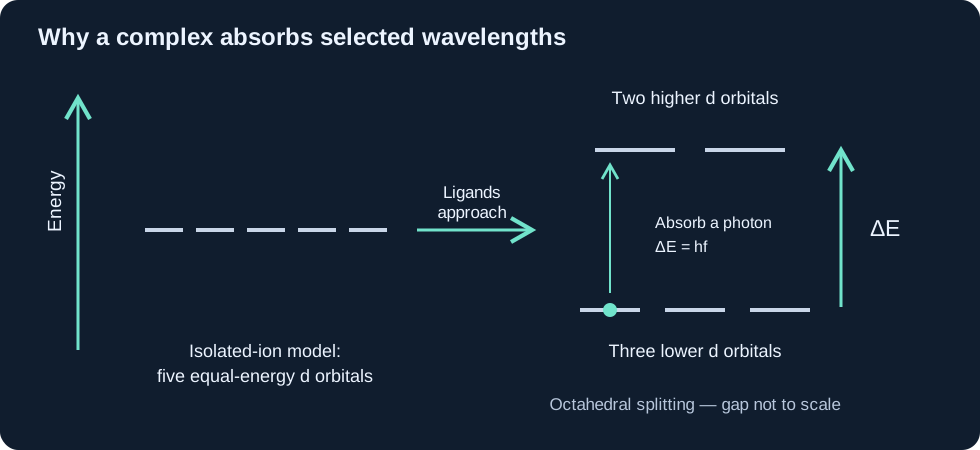
Swipe horizontally to view the whole diagram.
Explain colourless ions without overgeneralising
Sc³⁺ has no d electrons to excite; Zn²⁺ and Cu⁺ have full d subshells without an available higher d state within the split d set. They therefore cannot give the usual visible d–d absorption described above and their simple aqueous ions are colourless. A d-electron transition must also have an energy in the visible range to produce a visible colour.
The d–d explanation is not the only way a compound can absorb light. MnO₄⁻ is intensely purple despite manganese(VII) being formally d⁰; ligand-to-metal charge-transfer absorption explains this exception at a more advanced level. This extension prevents the incorrect universal claim ‘every d⁰ compound is colourless’. Likewise, the colour of a precipitate or mixed solution need not be the pure hexaaqua-ion colour.
For typical solutions remember Cu²⁺ blue, Fe²⁺ pale green and Co²⁺ pink. A pure chromium(III) hexaaqua ion is violet, although aqueous chromium(III) mixtures commonly appear green because other coordinated species are present. Iron(III) solutions commonly appear yellow to brown through hydrolysis/speciation. Record the observed shade and conditions rather than forcing every solution into one idealised colour.
Quick checks
Original Finesse questions. Reveal the indicative worked solutions after attempting each question; these are not official Edexcel mark allocations.
Q1. Write the full electron configuration of Co²⁺, Z = 27.Show answer
Co is [Ar]3d⁷4s². Removing the two 4s electrons gives 1s²2s²2p⁶3s²3p⁶3d⁷. The electron total is 25, which equals 27 − 2.
Q2. Explain why copper qualifies as a transition metal and zinc does not.Show answer
Cu forms stable Cu²⁺ with an incomplete 3d⁹ subshell. Zn’s stable usual Zn²⁺ ion is 3d¹⁰, so it does not meet the definition. Copper’s d¹⁰ Cu⁺ ion does not disqualify the element because only one suitable stable ion is required.
Q3. Why can iron form both Fe²⁺ and Fe³⁺?Show answer
The 4s and 3d electrons have relatively similar energies, so different numbers can be removed or used in bonding. The energy costs can be offset by hydration, lattice or bonding energies in different environments. This allows more than one stable oxidation state.
Q4. A complex absorbs mainly orange light. Explain why its solution can appear blue.Show answer
A d-electron transition absorbs photons matching the orbital energy gap. Removing orange wavelengths from incident white light leaves transmitted light that appears blue, approximately the complementary colour. The observed colour is not the colour absorbed.
Q5. A student says a colour change proves redox and every d⁰ species must be colourless. Correct both claims.Show answer
Changing ligand or coordination number can change orbital splitting and colour without changing oxidation state. Simple d⁰ ions cannot undergo d–d excitation, but another absorption mechanism can give colour; MnO₄⁻ is a charge-transfer example. Compute oxidation numbers independently.
Sources
Sources and examiner guidance (reviewed 9 October 2026)
- Pearson Edexcel 9CH0 specification — Issue 3 — Topic 15A/B, printed pp.33–35; UK A-Level content and Core Practical 12.
- Chemrevise — UK Edexcel Topic 15 — Pages 1–13 reviewed as a secondary coverage check; original Finesse teaching and questions.
- Pearson 9CH0/01 mark scheme — June 2023 — Q7(b–c), Q8; PDF pp.22–24 and 26–27. Electronic configurations, aqua-ion acidity and catalytic explanations.
- Pearson 9CH0/01 examiner report — June 2023 — Q7(b–c), Q8, pp.26–30 and 33–35. Question-specific evidence, not a universal checklist of mark allocations.
- Pearson 9CH0/01 mark scheme — June 2025 — Q6(a–f), PDF pp.23–28; 3D coordinate bonding, amphoterism, ammonia substitution, colour and alkaline chromium oxidation.
- Pearson 9CH0/01 examiner report — June 2025 — Q6(a–f), pp.56–78; matching explanation and equations to the species actually given.
- Pearson 9CH0/01 question paper — June 2025 — Q6(a–f), pp.15–18; question context, including the specified Cr(OH)₃(s)/chromate potential.
Finesse Tuition is not endorsed by AQA or Chemrevise. All explanations and examples here are our own.