
Compare a perfect ionic model with real bonding, then separate lattice disruption from hydration when a salt dissolves.
Use disagreement with a model as chemical evidence
A theoretical lattice energy calculated from an ideal ionic model treats ions as spherical charge distributions with purely electrostatic interactions and no covalent contribution. A Born–Haber value uses experimental thermochemical data for the real compound. Similar values support predominantly ionic bonding within the model’s accuracy.
If the experimental formation value is significantly more exothermic than the purely ionic prediction, the ionic model is missing stabilisation. Polarisation and partial covalent character provide an explanation: the cation distorts the anion’s electron cloud, increasing electron density between them. This is evidence about bonding, not a claim that every such solid has become a giant covalent structure.
For original illustrative values −850 kJ mol⁻¹ experimental and −790 kJ mol⁻¹ theoretical, the real lattice formation releases 60 kJ mol⁻¹ more energy. State the direction of the difference, then connect it to model assumptions. Simply saying that both numbers are “different” does not explain the chemistry.
Pearson 9CH0/01 June 2023 Q9(b) used this comparison for silver chloride. Its report noted confusion about which ion distorts the other. The electron cloud of the anion is polarised by the cation; the appropriate charge and relative size matter.
Separate polarising power from polarisability
A small, highly charged cation concentrates positive charge in a small volume and produces a strong electric field near the neighbouring anion. It therefore has high polarising power. For comparable partners, Al³⁺ polarises more strongly than a larger singly charged cation.
A large anion has outer electrons farther from its nucleus and an electron cloud that is more readily distorted: it is more polarisable. Increased negative charge also increases electron–electron repulsion and can make the electron cloud easier to distort, when other factors are comparable. Radius and charge both matter.
Thus a small, highly charged cation paired with a large, highly charged anion tends to show more covalent character. Comparing LiCl and LiI, the same cation encounters a larger, more polarisable iodide ion, so LiI is expected to depart further from the ideal ionic model. This trend is not the same question as comparing their ionic lattice strengths.
Water stabilises ions through ion–dipole attractions
The enthalpy change of hydration is the change when one mole of gaseous ions becomes aqueous ions, sufficiently dilute that further dilution produces no further enthalpy change. For example, M²⁺(g) → M²⁺(aq). It is exothermic because attractive interactions form between ions and polar water molecules.
Water’s δ⁻ oxygen end points toward cations; its δ⁺ hydrogen ends point toward anions. Higher ionic charge and smaller radius generally give more negative hydration enthalpies because the ion attracts nearby water molecules more strongly. For same-charge ions, Mg²⁺ is hydrated more exothermically than the larger Ba²⁺.
Hydration is not breaking an O–H bond to make the ion. Water molecules surround it and orient their dipoles. In transition-metal chemistry a defined number may form coordinate bonds in a complex; the bulk hydration enthalpy still refers to the gas-ion-to-aqueous-ion process.
A dissolving lattice has two competing enthalpy changes
The enthalpy change of solution is the change when one mole of a substance dissolves in enough solvent that further dilution gives no further heat change. For an ionic solid MX₂, the overall equation is MX₂(s) → M²⁺(aq) + 2X⁻(aq).
The conceptual cycle first separates the solid into gaseous ions, reversing formation lattice energy, then hydrates the ions. Therefore ΔsolH = −ΔlattH(formation) + ΣΔhydH. The hydration sum includes the number of each ion in one formula unit. This route is an accounting device; dissolving crystals do not actually release a cloud of gas ions.
For an original illustrative MX₂, lattice formation energy is −2100 kJ mol⁻¹; hydration enthalpies are −1500 for M²⁺ and −320 for X⁻. ΔsolH = −(−2100) + (−1500) + 2(−320) = −40 kJ mol⁻¹. The process is exothermic because hydration releases slightly more energy than separating the lattice requires.
If ΔsolH instead were +25 kJ mol⁻¹ for the same lattice and anion hydration data, the unknown cation hydration enthalpy would satisfy 25 = 2100 + ΔhydH(M²⁺) − 640. Hence ΔhydH(M²⁺) = −1435 kJ mol⁻¹. Always check the result is consistent with the direction of hydration.
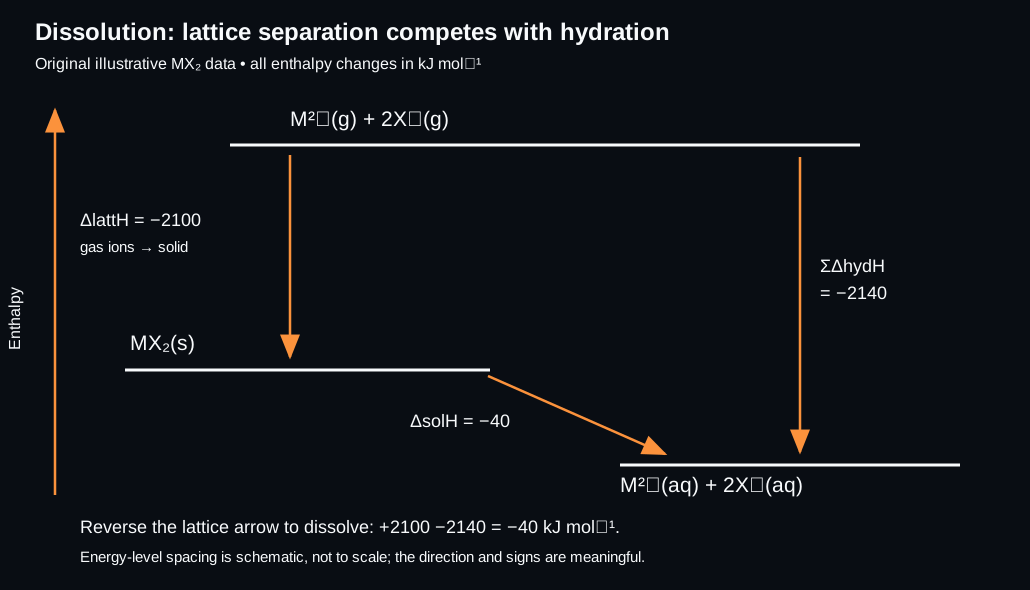
Swipe horizontally to view the whole diagram.
Measure a solution enthalpy and evaluate it
Weigh a known amount of a suitable soluble salt, measure water into an insulated cup, record a temperature baseline, add the salt, stir and record temperature against time. An insulated lid reduces exchange with the surroundings; complete dissolution and consistent mixing are needed before interpreting the temperature change. Use substance-specific protection and disposal, not an assumption that every salt is harmless.
If the solution mass is 100.0 g, assumed specific heat capacity is 4.18 J g⁻¹ K⁻¹ and temperature falls by 2.50 K, qsolution = 100.0 × 4.18 × (−2.50) = −1045 J. The dissolving system absorbs +1045 J. For 0.0200 mol dissolved, ΔsolH = +1045/(1000 × 0.0200) = +52.3 kJ mol⁻¹.
The cup also exchanges heat, and solution heat capacity may differ from water’s. For this endothermic case, heat entering from the room reduces the observed cooling and makes the simple calculated positive ΔsolH too small. A time–temperature graph extrapolated back to mixing can improve the estimate, but does not remove every heat-capacity or transfer assumption.
An endothermic solution process can still occur. Enthalpy alone cannot determine solubility: spreading particles tends to increase entropy, while ordering water around ions can oppose it. The total entropy change or Gibbs energy is needed, together with concentration and equilibrium. Avoid the rule that every exothermic salt dissolves completely at every temperature.
Quick checks
Original Finesse questions. Reveal the indicative worked solutions after attempting each question; these are not official Edexcel mark allocations.
Q1. Why does Al³⁺ have greater polarising power than a larger singly charged cation?Show answer
Its higher charge and smaller radius give a stronger electric field at the neighbouring anion, distorting that anion’s electron cloud more strongly.
Q2. Which is more polarisable, Cl⁻ or I⁻, and why?Show answer
I⁻ is larger and its outer electron cloud is less tightly held and more readily distorted. The comparison holds the anion charge constant.
Q3. For MX, lattice formation is −780 and hydration enthalpies are −400 and −350 kJ mol⁻¹. Find ΔsolH.Show answer
ΔsolH = +780 −400 −350 = +30 kJ mol⁻¹. Lattice separation costs slightly more than hydration releases.
Q4. Explain the orientation of water around a positive ion and how radius affects hydration.Show answer
The δ⁻ oxygen end faces the positive ion. At equal charge, a smaller ion attracts water more strongly at shorter separation, so hydration is more exothermic.
Q5. Why does a positive ΔsolH not prove that a salt cannot dissolve?Show answer
Dissolution can increase system entropy enough that total entropy rises despite cooling the surroundings. Feasibility depends on both enthalpy and entropy, and on the solution conditions.
Sources
Sources and examiner guidance (reviewed 9 October 2026)
- Pearson Edexcel 9CH0 specification — Issue 3, February 2024 — Topic 13; the scope authority. Reviewed 9 October 2026.
- Chemrevise — Edexcel Topic 13 — Pages 3 and 5–6; explanatory and coverage cross-check. Teaching, examples and practice here are original Finesse material.
- Pearson 9CH0/01 mark scheme — June 2023 — Q9(a)(iii), PDF p.29, and Q9(b), PDF pp.30–31: Born–Haber algebra, ionic-model assumptions and polarisation.
- Pearson 9CH0/01 examiner report — June 2023 — Q9(a)–(b), printed/PDF pp.39–44: calculation checks, theoretical model and which ion polarises the other.
Finesse Tuition is not endorsed by AQA or Chemrevise. All explanations and examples here are our own.