
Define each physical process precisely, construct a route from elements to gaseous ions and use Hess’s law to find an inaccessible lattice energy.
Lattice energy has a direction
Edexcel defines lattice energy as the enthalpy change when one mole of an ionic solid forms from its gaseous ions. For sodium chloride: Na⁺(g) + Cl⁻(g) → NaCl(s). Formation is exothermic because electrostatic attraction lowers the energy as oppositely charged ions assemble. Units are kJ mol⁻¹ of ionic solid formed.
Some data sources instead quote lattice dissociation enthalpy, for separating one mole of solid into gaseous ions. It has the same magnitude and opposite sign. Write the defining equation before using a number; “lattice energy is positive” or “negative” is meaningless without its direction.
A more negative formation lattice energy generally indicates stronger ionic attraction. Greater ionic charges increase attraction; smaller ionic radii bring centres of charge closer together. Compare similar crystal structures and stoichiometries where possible. “Greater lattice energy” can be ambiguous, so state more exothermic or greater magnitude.
Name the species and state in every definition
The enthalpy change of atomisation is the change when one mole of gaseous atoms forms from an element in its standard state. For chlorine: ½Cl₂(g) → Cl(g). For a metal: M(s) → M(g). Atomisation is endothermic; a diatomic bond dissociation enthalpy produces two moles of atoms, so it is twice the atomisation enthalpy in that case.
The first ionisation enthalpy removes one electron from each atom in one mole of gaseous atoms: M(g) → M⁺(g) + e⁻. The second removes an electron from each gaseous singly charged ion: M⁺(g) → M²⁺(g) + e⁻. Both are endothermic. Making M²⁺ requires IE₁ + IE₂, not 2IE₁.
The first electron affinity is the enthalpy change when one mole of gaseous atoms each gains an electron to form gaseous singly negative ions: X(g) + e⁻ → X⁻(g). For the halogens this is exothermic because the incoming electron is attracted by the nucleus. Electron affinity describes electron gain, not electron removal.
The second electron affinity adds electrons to already negative gaseous ions: O⁻(g) + e⁻ → O²⁻(g). It is endothermic because energy is required to overcome repulsion between an electron and the negative ion. A stable oxide solid can still form because other steps, especially lattice formation, release enough energy to offset this cost.
Construct the cycle before substituting
A Born–Haber cycle connects two routes from the elements in their standard states to one mole of ionic solid. The direct route is the enthalpy of formation. The indirect route atomises the elements, forms gaseous cations and anions, then forms the lattice. Hess’s law makes their enthalpy sums equal.
For MX₂, atomise one mole of M and two moles of X atoms, apply the first and second metal ionisation enthalpies, apply two first electron affinities of X, and use one formation lattice energy for MX₂. Keep the two released electrons in the intermediate level until both are consumed; this conserves charge.
For an oxide MO, use one atomisation of oxygen, not a full O=O bond enthalpy unless the coefficient calls for it, and both EA₁(O) and EA₂(O). Successive affinities change the same ion; two first affinities would instead make two O⁻ ions.
On an energy-level drawing, positive enthalpy arrows point toward higher levels and negative enthalpy arrows toward lower levels. The top intermediate need not always be the separated gaseous ions because a second electron affinity can raise their energy. The diagram below is a labelled route cycle; arrow direction shows the process and the adjacent sign identifies its energy change.
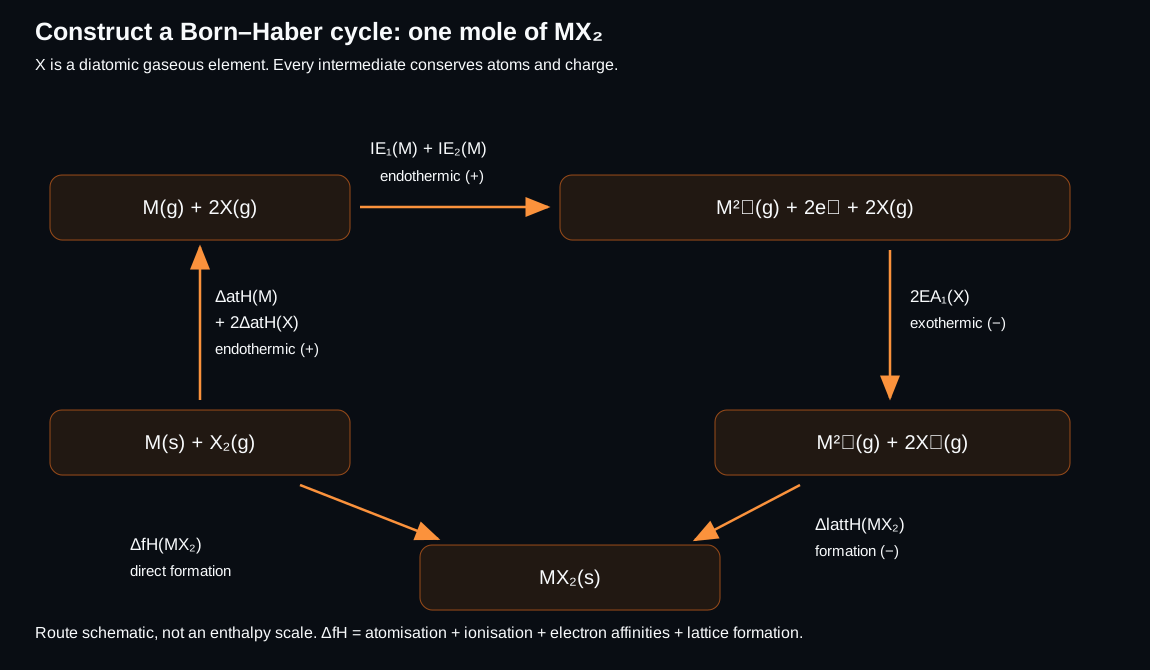
Swipe horizontally to view the whole diagram.
Worked example: keep the formation convention
Use these original illustrative data for a hypothetical MCl₂: ΔfH = −650; metal atomisation = +150; IE₁ = +600; IE₂ = +1200; chlorine atomisation = +120; first chlorine electron affinity = −350, all in kJ mol⁻¹ of the defined step.
Indirect steps before lattice formation sum to 150 + 600 + 1200 + 2(120) + 2(−350) = +1490 kJ mol⁻¹. Thus −650 = +1490 + ΔlattH, giving ΔlattH = −2140 kJ mol⁻¹. Recombining +1490 and −2140 recovers the stated −650, a useful sign check.
For an inverse problem, suppose the lattice formation energy is known and atomisation of the metal is missing. Rearrange the same equation to isolate that term; do not reverse individual signs merely because a value is being “moved around the cycle”. If the metal coefficient in the solid is two, its atomisation term must also be multiplied by two.
Born–Haber lattice energies are often called experimental values because they are deduced from measured thermochemical data. They are not normally measured by physically collecting a mole of separated gas ions and making a crystal. Distinguish the experimental-data route from the electrostatic theoretical model.
Quick checks
Original Finesse questions. Reveal the indicative worked solutions after attempting each question; these are not official Edexcel mark allocations.
Q1. Define lattice energy for MgO using a balanced equation and the Edexcel convention.Show answer
Mg²⁺(g) + O²⁻(g) → MgO(s). It is the enthalpy change when one mole of ionic solid forms from gaseous ions; formation is exothermic.
Q2. The Cl–Cl bond dissociation enthalpy is +244 kJ mol⁻¹. What atomisation enthalpy corresponds to ½Cl₂(g) → Cl(g)?Show answer
Half a mole of Cl₂ bonds is broken per mole of atoms formed, so ΔatH = +122 kJ mol⁻¹.
Q3. Why does making Mg²⁺ use IE₁ + IE₂ rather than 2IE₁?Show answer
The second electron is removed from Mg⁺, not a neutral atom. Its electrostatic environment differs, so the second ionisation enthalpy is a separate value.
Q4. A Born–Haber cycle has ΔfH = −400 kJ mol⁻¹ and all non-lattice steps sum to +520 kJ mol⁻¹. Find the lattice formation and dissociation enthalpies.Show answer
−400 = +520 + ΔlattH, so formation is −920 kJ mol⁻¹. The reverse dissociation is +920 kJ mol⁻¹.
Q5. Explain why the second electron affinity of oxygen is positive although O²⁻ occurs in stable oxides.Show answer
Adding an electron to O⁻ requires overcoming repulsion. In a whole formation cycle, the large exothermic lattice formation and other terms can outweigh the endothermic costs. One unfavourable step does not determine the net process.
Sources
Sources and examiner guidance (reviewed 9 October 2026)
- Pearson Edexcel 9CH0 specification — Issue 3, February 2024 — Topic 13; the scope authority. Reviewed 9 October 2026.
- Chemrevise — Edexcel Topic 13 — Pages 1–4; explanatory and coverage cross-check. Teaching, examples and practice here are original Finesse material.
- Pearson 9CH0/01 mark scheme — June 2023 — Q9(a)(iii), PDF p.29, and Q9(b), PDF pp.30–31: Born–Haber algebra, ionic-model assumptions and polarisation.
- Pearson 9CH0/01 examiner report — June 2023 — Q9(a)–(b), printed/PDF pp.39–44: calculation checks, theoretical model and which ion polarises the other.
Finesse Tuition is not endorsed by AQA or Chemrevise. All explanations and examples here are our own.