
Resolve isomers by testing one candidate against every piece of evidence, with an original idealised proton spectrum and an aromatic symmetry investigation.
Give each method a clear job
Begin with the molecular formula or derive it from elemental composition and accurate mass. Use chemical tests and IR to identify plausible functional groups; count ¹³C environments and note carbonyl/aromatic regions; use ¹H shifts, integrals and splitting to build fragments. Assemble candidates, then check every atom and observation.
Evidence has different specificity. A carbonyl IR band establishes a bond type; a DNPH precipitate favours an aldehyde/ketone; a molecular formula gives composition; a triplet/quartet pair suggests a simple ethyl group. No single clue automatically supplies the entire molecule.
Use the supplied data table for shifts and IR ranges. If a spectrum is drawn as percentage transmittance, absorption is a downward trough; if it is absorbance, absorption is an upward peak. The axes determine the interpretation. A fingerprint-region match can support identity, but a single isolated band does not prove purity.
Investigation A: original data for an oxygen-containing compound
Accurate molecular-mass data give 88.0522 using ¹²C = 12.0000, ¹H = 1.0078 and ¹⁶O = 15.9949. Candidate formula C₄H₈O₂ gives 48.0000+8.0624+31.9898=88.0522 and fits the stated elemental information. Mass alone leaves several isomers.
The supplied IR has a strong absorption at 1742 cm⁻¹, no broad acid/alcohol OH absorption, and C–O-region absorption. Within the candidate set of simple saturated acids/esters, this favours an ester. Four ¹³C signals at illustrative δ 9.2, 27.8, 51.6 and 174.8 show four different carbons, including an ester carbonyl.
The original idealised ¹H data are δ 1.10 triplet 3 H, δ 2.32 quartet 2 H and δ 3.67 singlet 3 H. The plotted spectrum is a first-order teaching model at 100 MHz with J = 7 Hz for the ethyl pair. It is not a measured spectrum; exact shifts can vary with actual solvent and conditions.
| δ/ppm | Integrated H | Multiplicity | Initial fragment inference |
|---|---|---|---|
| 1.10 | 3 | Triplet | CH₃ beside CH₂ |
| 2.32 | 2 | Quartet | CH₂ beside CH₃ and near C=O |
| 3.67 | 3 | Singlet | OCH₃ without adjacent coupled carbon-bound H |
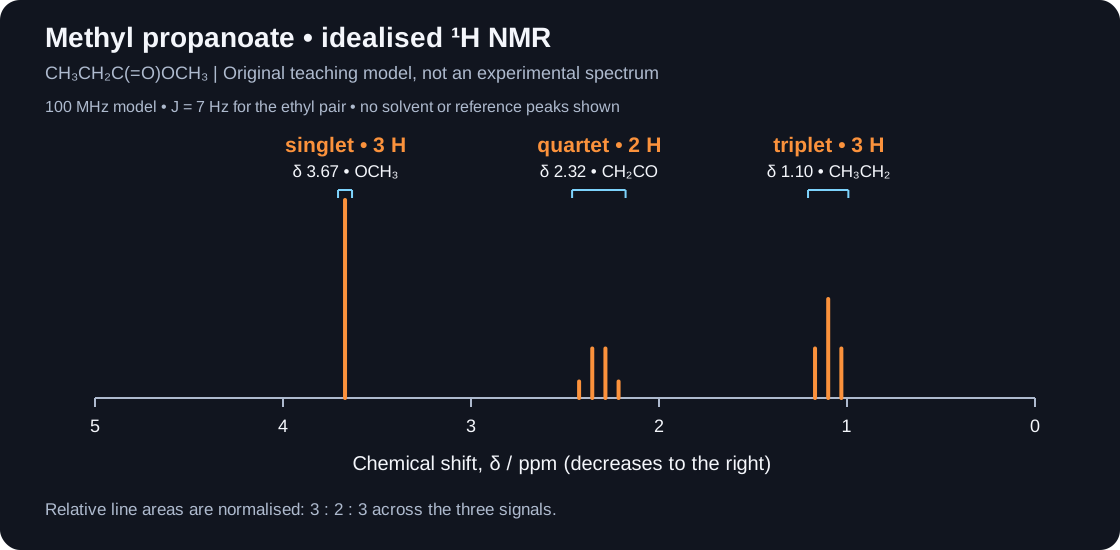
Swipe horizontally to view the whole diagram.
Build the fragments and reject the competing ester
The triplet and quartet give CH₃CH₂. The quartet at δ 2.32 places CH₂ next to a carbonyl rather than directly bonded to O. The 3 H singlet at δ 3.67 supports OCH₃. Joining the pieces through an ester gives CH₃CH₂C(=O)OCH₃, methyl propanoate.
Audit it: four C, eight H and two O; one ester carbonyl; four carbon environments; three proton sets in 3:2:3; a terminal methyl split by 2 H; a CH₂ split by 3 H; an OCH₃ without an adjacent coupled carbon-H set. Every item is accounted for.
Ethyl ethanoate has the same formula and the same overall 3:2:3 integration and triplet/quartet/singlet types. However, its 2 H quartet is OCH₂ and should lie near δ 4.1 in this simple comparison, while its acyl methyl singlet is near δ 2.0. The actual shift-to-integral pairing rejects that alternative. Do not discard integration or shift once you have spotted an ethyl group.
A corroborating chemical experiment would hydrolyse methyl propanoate to propanoic acid and methanol in acid, or propanoate and methanol in alkali. Identifying those products independently strengthens the assignment. Acidic versus alkaline medium controls which form of the acid is obtained.
Investigation B: symmetry resolves a positional isomer
An original unknown is known to be one of the three methylbenzoic-acid positional isomers, each C₈H₈O₂. It effervesces with carbonate, and the gas clouds limewater, supporting its COOH group. A broad IR band in the acid-OH region and a carbonyl band are consistent. These observations do not yet locate the methyl group relative to COOH.
Its resolved proton-decoupled ¹³C spectrum has six compound signals: one carboxyl carbon, one methyl carbon and four aromatic environments. A para structure has two unique substituted ring carbons, one equivalent pair at positions 2/6 and another at 3/5, giving the required four ring environments. The candidate is 4-methylbenzoic acid.
The ortho and meta members of this stated candidate set normally have six distinct ring carbons, so eight overall signals would be expected. The deduction assumes sufficient resolution: accidental overlap can otherwise mimic a lower environment count. Two aromatic proton sets each integrating to 2 H support para symmetry; their aromatic coupling can be more complex than simple isolated first-order doublets.
The aromatic structure must contain C₆H₄ between its two substituents, not C₆H₅. Adding CH₃ and COOH gives C₈H₈O₂:4ringH+3methylH+1acidH. This final formula check catches a frequent error in condensed aromatic structures.
Fragments must preserve charge and account for the lost atoms
A plausible mass-fragment assignment should fit both mass and chemistry. For a butan-2-one molecular ion at nominal m/z 72, a fragment at 43 can be CH₃CO⁺, an acylium ion, with an ethyl radical lost. The neutral radical is not itself detected by the mass analyser.
The same nominal fragment 43 might instead be C₃H₇⁺ in another molecule, so a fragment mass alone is not unique evidence. Accurate fragment masses or additional spectra can distinguish compositions. Draw the ion with its charge and show neutral/radical loss where an equation is requested.
For any final proposal, check total C/H/heteroatoms, formal charges, every carbon’s valency, expected carbon symmetry, proton totals, shifts, splitting and the qualitative reactions. If two candidates remain, state which further observation would discriminate them. A justified limitation is better than an unsupported unique name.
Write the chain of reasoning, not a catalogue of peaks
Pearson 9CH0/03 June 2023 Q9(b), scheme PDF p.40 and report p.93, combines chemical reactions with carbon-NMR environment counts. The useful transferable habit is to make the connection explicit: observation → functional group or symmetry constraint → compatible structure. These original investigations use different data and are not copied exam questions.
For an unfamiliar molecule, supplied reactions may replace a familiar test. Treat that information as another structural constraint, then use the same atom and evidence audit. A confident guess that happens to match one peak is weaker than a complete, internally consistent argument.
Quick checks
Original Finesse questions. Reveal the indicative worked solutions after attempting each question; these are not official Edexcel mark allocations.
Q1. Calculate accurate Mᵣ for C₄H₈O using the isotope masses in Investigation A.Show answer
4(12.0000)+8(1.0078)+15.9949=72.0573. Omitting one oxygen relative to C₄H₈O₂ lowers the accurate mass by 15.9949, not by an arbitrarily rounded 16.0000.
Q2. Why does the 3 H singlet at δ 3.67 in Investigation A favour methyl propanoate over ethyl ethanoate?Show answer
It supports OCH₃, three equivalent H on a carbon directly bonded to O with no ordinary adjacent-carbon splitting partner. Ethyl ethanoate instead has an OCH₂ quartet integrating to 2 H and a lower-shift acyl-methyl singlet.
Q3. How can an eight-carbon aromatic molecule give only six ¹³C signals?Show answer
Some carbons are equivalent by symmetry. In 4-methylbenzoic acid, positions 2/6 and 3/5 form two pairs; the other two ring carbons plus methyl and acid carbon are unique. That gives six environments for eight atoms.
Q4. An ester hydrolysate contains ethanol and propanoic acid. Write the starting ester and molecular formula.Show answer
CH₃CH₂COOCH₂CH₃, ethyl propanoate, C₅H₁₀O₂. The acid contributes three carbons including its carbonyl and the alcohol contributes two; the ester has lost H₂O from the pair.
Q5. A molecular radical cation at nominal m/z 86 fragments to an ion at 57 and a neutral radical. What is the lost nominal mass, and does that alone prove its structure?Show answer
The lost mass is 86−57=29. An ethyl radical is one plausible loss in an appropriate structure, but mass difference alone is not unique identification. Check the precursor’s atoms, likely cleavage and other spectral evidence.
Sources
Sources and examiner guidance (reviewed 9 October 2026)
- Pearson Edexcel 9CH0 specification, Issue 3 — Topic 19, printed pp.43–44; IR and NMR reference charts in Appendix 8, printed pp.95–96.
- Pearson 9CH0 data booklet — Official infrared and nuclear-magnetic-resonance reference data. Use the supplied chart rather than treating approximate example shifts as rigid boundaries.
- Chemrevise: UK Edexcel Spectroscopy and chromatography — Guide pp.4–5, 8; relevant AS foundations and secondary cross-check. Accurate mass and carbon NMR are completed against Pearson scope and reference data.
- Pearson 9CH0/03 June 2023 mark scheme — Q9(b), PDF p.40: combined structural evidence and aromatic carbon environments.
- Pearson 9CH0/03 June 2023 examiner report — Q9(b), printed/PDF p.93: connect functional-group clues and carbon-NMR symmetry; original Finesse investigations use different data.
Finesse Tuition is not endorsed by AQA or Chemrevise. All explanations and examples here are our own.