
Read a mass spectrum as evidence about charged particles, assign fragment masses and test candidate structures without treating one peak as a complete identification.
What the axes and peaks mean
A mass spectrum plots mass-to-charge ratio, m/z, against relative abundance. A peak represents detected ions with that m/z. For the usual singly charged organic ions, z = 1 and the numerical m/z equals the ion’s nominal relative mass. A neutral molecule or radical does not produce the corresponding detected ion peak unless it is ionised.
The base peak is the most abundant peak and is conventionally assigned a relative abundance of 100. It need not be the molecular ion and does not mean every molecule has that mass. The molecular ion is the whole molecule after ionisation without fragmentation; its peak may be weak or absent depending on how the molecule fragments and the ionisation method.
Do not call the tallest peak the molecular ion or assume the furthest-right small peak always gives Mᵣ. Isotopes can produce M+1 or M+2 signals, and impurities can add peaks. First identify the molecular-ion region using the information given, then distinguish the main molecular-ion peak from its isotope companions.
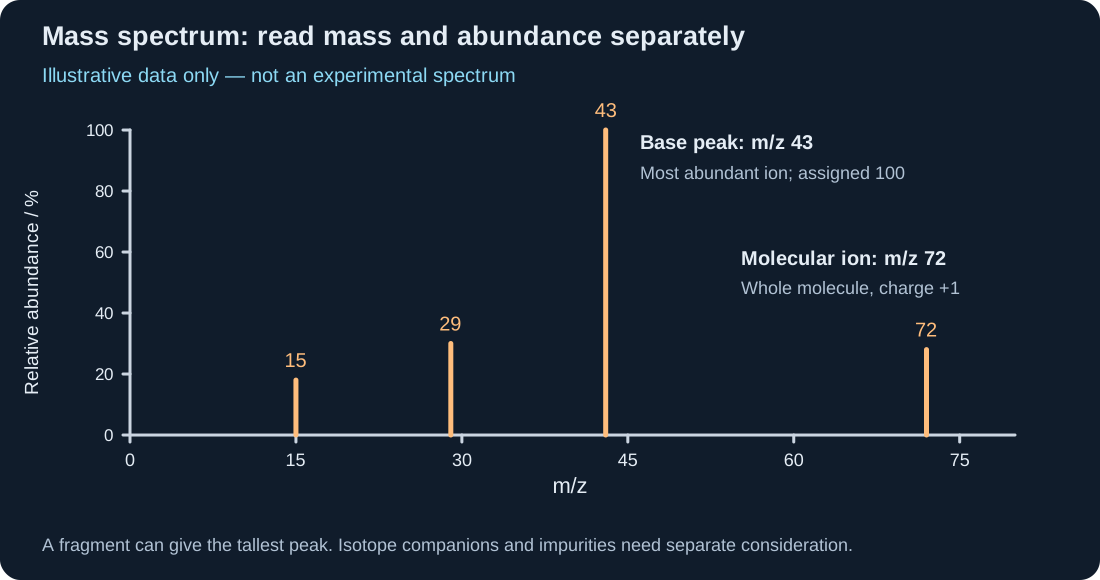
Swipe horizontally to view the whole diagram.
Ionisation and fragmentation are different events
In the common electron-ionisation picture, a molecule loses one electron and becomes a positive radical ion, M⁺•. It is positive because an electron has been removed and a radical because an unpaired electron remains. A shorthand ionisation equation is M → M⁺• + e⁻. If the incident electron is included explicitly, M + e⁻ → M⁺• + 2e⁻ conserves charge.
The energised molecular ion can then fragment by bond breaking, typically forming a positive ion plus a neutral radical. The positive fragment produces a peak; the neutral partner explains the remaining atoms but is not itself detected as an ion in that event. This prevents a common mistake: assigning two positive fragments from one +1 molecular ion without accounting for charge.
Use the whole-molecule peak to restrict the formula
Using integer masses C = 12, H = 1 and O = 16, a molecular ion at m/z 72 with charge +1 is consistent with C₄H₈O: 4(12) + 8(1) + 16 = 72. It is not consistent with C₄H₁₀O, which has nominal mass 74. Several different formulae can share the same nominal mass, so use elemental or other information before declaring a formula unique.
Worked formula restriction: a compound contains only carbon, hydrogen and oxygen and has empirical formula C₂H₄O. Its empirical formula mass is 44. If its molecular ion is at m/z 88, the multiplier is 88/44 = 2, so its molecular formula is C₄H₈O₂. Mass spectrometry gives this size information but does not alone locate the two oxygen atoms.
For chlorine- or bromine-containing molecules, molecular ions with different isotopes have different m/z. A single-chlorine molecular-ion pair often has an approximate 3:1 M:M+2 pattern; a single bromine gives about 1:1. These are a synoptic link to Topic 1. The isotope-specific peak mass is not automatically the same as a tabulated average relative molecular mass calculated with averaged atomic masses.
Propose an ion and check its mass and origin
For each proposed fragment, write its formula with a positive charge, calculate its nominal mass and check that the parent could supply those atoms through a plausible cleavage. CH₃⁺ has m/z 15; C₂H₅⁺ has 29; CH₂OH⁺ has 31; CH₃CO⁺ has 43. Merely naming “a carbon fragment” does not connect a structure to the observed number.
Worked fragmentation of butan-2-one: [CH₃COCH₂CH₃]⁺• can give CH₃CO⁺ and CH₃CH₂•. The ion mass is 43 and the neutral radical mass is 29; 43 + 29 = 72 matches the parent. Carbon, hydrogen, oxygen and total charge all balance. A peak at 29 would require a different event with the charge retained on that fragment, not detection of the neutral radical from this equation.
Peak intensity depends on how readily fragments form and survive, as well as conditions. Stable fragment ions often give prominent signals, but intensity is not a direct count of that group in a molecule. Do not use one small peak to claim a structure is impossible: rearrangements and alternative fragmentation can occur.
| m/z | Possible ion | Mass check and limitation |
|---|---|---|
| 15 | CH₃⁺ | 12 + 3 = 15; common, often not diagnostic |
| 29 | C₂H₅⁺ or CHO⁺ | 24 + 5 or 12 + 1 + 16; same nominal mass, different formulae |
| 31 | CH₂OH⁺ | 12 + 3 + 16 = 31; can support a CH₂OH-containing structure |
| 43 | CH₃CO⁺ or C₃H₇⁺ | 24 + 3 + 16 or 36 + 7; use other evidence to distinguish |
Compare candidate structures using the same evidence
Propan-1-ol and propan-2-ol both have molecular formula C₃H₈O and nominal molecular-ion mass 60. The molecular ion cannot distinguish them. In the simple bond-cleavage model, propan-1-ol can give CH₂OH⁺ at m/z 31 by cleavage adjacent to its terminal OH-bearing carbon, whereas propan-2-ol readily gives a different oxygen-containing fragment such as CH₃CHOH⁺ at m/z 45.
Pearson 8CH0/02 June 2023 Q5(c) asked for a discriminating peak between these two candidates and credited an explained 29 or 31 assignment for propan-1-ol. The report noted that some answers omitted m/z. The general skill is to give both the number and the charged fragment in the stated comparison; that question’s simplified discrimination is not a universal statement that a real spectrum can never contain another weak fragment.
For an unfamiliar problem, list candidates compatible with the molecular formula, reject those inconsistent with the stated functional-group evidence, then ask which can plausibly produce the given ions. State a supported candidate when the evidence is incomplete instead of pretending nominal mass guarantees a unique structure.
Worked combined mass evidence
An illustrative unknown is known to be an acyclic ketone containing one oxygen, has molecular ion m/z 72 and a strong fragment at m/z 43. The molecular formula C₄H₈O fits 72. The only simple acyclic four-carbon ketone is butan-2-one, CH₃COCH₂CH₃. Cleavage giving CH₃CO⁺ explains 43, and a neutral C₂H₅ radical accounts for the remaining 29 mass units.
Notice which clue did which job: the molecular ion restricted size, the stated ketone group restricted connectivity, and fragmentation supported the proposal. If the ketone information were removed, m/z 72 and 43 alone would be insufficient. IR and a chemical test can supply that missing functional-group evidence in the next part.
Quick checks
Original Finesse questions. Reveal the indicative worked solutions after attempting each question; these are not official Edexcel mark allocations.
Q1. An organic compound has a base peak at 43 and a labelled molecular ion at 86. What is its nominal relative molecular mass for z = 1?Show answer
86. The 43 peak is the most abundant ion, probably a fragment. Peak height does not determine which ion is the whole molecule.
Q2. Calculate the m/z of CH₃CH₂CO⁺ using C = 12, H = 1 and O = 16.Show answer
The ion is C₃H₅O⁺: 3(12) + 5(1) + 16 = 57. Its charge is +1, so m/z = 57.
Q3. Complete [CH₃COCH₂CH₃]⁺• → CH₃CO⁺ + ? and explain which product gives the m/z 43 peak.Show answer
The other product is CH₃CH₂•, a neutral ethyl radical. CH₃CO⁺ gives m/z 43; the neutral radical does not give an ion peak from this event. The equation conserves atoms and overall +1 charge.
Q4. A compound has empirical formula CH₂O and a molecular-ion peak at 90. Find its molecular formula.Show answer
Empirical formula mass = 12 + 2 + 16 = 30. Multiplier = 90/30 = 3, giving C₃H₆O₃. This determines atom counts, not a unique structural formula.
Q5. Why can a peak at m/z 29 not alone prove an ethyl group is present?Show answer
C₂H₅⁺ gives nominal mass 29, but CHO⁺ also gives 29. Other evidence and plausible fragmentation from the parent are needed; nominal m/z alone does not specify one ion formula.
Sources
Sources and examiner guidance (reviewed 9 October 2026)
- Pearson Edexcel 9CH0 specification — Issue 3 — Topic 7 7.1(i–ii), printed page 21; reviewed 9 October 2026.
- Pearson Edexcel 8CH0 specification — Issue 3 — Topic 7 printed page 19; infrared correlation table printed page 48. AS scope verified.
- Chemrevise — Edexcel Mass spectra and IR — Pages 1; secondary explanation checked against Pearson. Original examples and practice.
- Pearson 8CH0/02 — June 2023 mark scheme — Q5(c), PDF page 26, read with question paper printed page 20; candidate-specific fragment assignment.
- Pearson 8CH0/02 — June 2023 examiner report — Q5(c), PDF page 6; missing m/z in some otherwise partly correct answers.
Finesse Tuition is not endorsed by AQA or Chemrevise. All explanations and examples here are our own.