
Distinguish the amount of solute from its concentration, prepare a solution of known concentration and use it to standardise sodium hydroxide.
Concentration uses the final solution volume
Amount concentration is moles of solute per dm³ of solution: c = n/V. A concentration of 0.200 mol dm⁻³ does not mean a flask necessarily contains 0.200 mol; a 25.0 cm³ portion contains 0.200 × 0.0250 = 0.00500 mol. The final solution volume is used, not the initial volume of solvent added to dissolve the solid.
Dissolve 2.650 g anhydrous Na₂CO₃ and make the final solution volume 250.0 cm³. M = 106.0 g mol⁻¹, so n = 2.650/106.0 = 0.02500 mol and c = 0.02500/0.2500 = 0.1000 mol dm⁻³. Mass concentration = 2.650/0.2500 = 10.60 g dm⁻³. Multiplying 0.1000 mol dm⁻³ by 106.0 g mol⁻¹ gives the same answer.
Count ions, then conserve solute during dilution
Assuming complete dissolution, 0.100 mol dm⁻³ CaCl₂ supplies [Ca²⁺] = 0.100 mol dm⁻³ and [Cl⁻] = 0.200 mol dm⁻³. The two chloride ions per formula unit double the chloride amount without doubling the solution volume. Do not confuse the concentration of one ion with the total concentration of all ions.
During simple dilution no solute is created or lost, so c₁V₁ = c₂V₂. Pipetting 20.0 cm³ of 0.500 mol dm⁻³ solution into a 250.0 cm³ volumetric flask and making up to the mark gives c₂ = (0.500 × 20.0)/250.0 = 0.0400 mol dm⁻³. Volumes can share the same units in this ratio; if separately calculating moles, convert to dm³.
The final volume is 250.0 cm³, not 270.0 cm³. 'Make up to 250.0 cm³' differs from 'add 250.0 cm³ water'. In a volumetric preparation the calibration line defines the final solution volume, avoiding assumptions that solvent and solute volumes are exactly additive.
Core Practical 2: prepare a known acid solution
A standard solution has an accurately known concentration. A suitable solid standard has known purity and composition and is stable during weighing and preparation. Sodium hydroxide is unsuitable for simply weighing an exact amount of pure NaOH from a bench bottle: it absorbs water and reacts with carbon dioxide. Standardising its solution against a suitable acid determines its actual concentration.
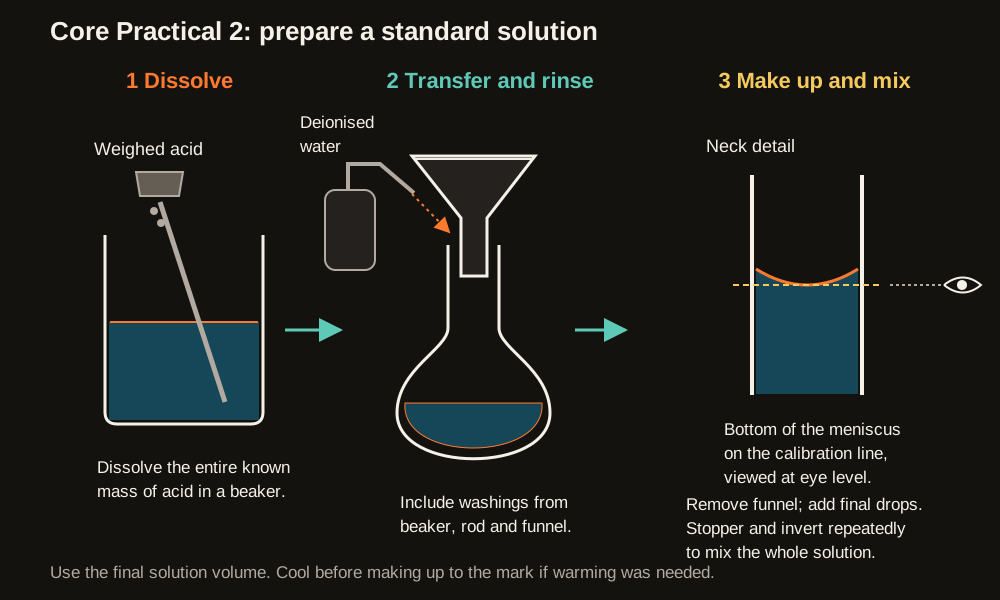
Pearson's CP2 example uses sulfamic acid, NH₂SO₃H, M = 97.1 g mol⁻¹, a monoprotic solid acid. Measure the mass transferred, dissolve completely in a beaker, then transfer quantitatively to a volumetric flask. Rinse the beaker, rod and funnel into the flask so that measured solute is not left behind. If warmed to dissolve, cool to the flask's calibration temperature before making up the volume.
Add deionised water close to the mark, then dropwise until the bottom of the meniscus lies on the line at eye level. Stopper and invert repeatedly to mix throughout. The narrow neck makes a small volume change produce a visible meniscus movement; the bulb stores most of the solution. A beaker's graduations do not provide the same volume precision.
Use the acid to standardise NaOH
In the Pearson example, the sulfamic acid goes in the burette and a measured 25.0 cm³ NaOH aliquot goes in a conical flask. Add a few drops of methyl orange and deliver acid while swirling, dropwise near the end point. The flask changes from yellow through orange towards red as acid is added; use the specified end point consistently. Repeat to obtain concordant titres and calculate a mean from suitable concordant runs, excluding the rough result.
Because sulfamic acid is monoprotic, its reaction with NaOH is 1:1. In an original example, 2.4275 g acid made to 250.0 cm³ gives n = 2.4275/97.1 = 0.02500 mol and c = 0.1000 mol dm⁻³. A mean acid titre of 24.60 cm³ contains 0.1000 × 0.02460 = 0.002460 mol acid. The 25.0 cm³ alkali therefore contains 0.002460 mol NaOH: c(NaOH) = 0.002460/0.0250 = 0.0984 mol dm⁻³.
Use the acid titre volume to find the acid amount; use the pipetted alkali volume to find the alkali concentration. The two volumes perform different roles. A 1:1 reaction does not make their concentrations equal unless the reacting volumes are also equal.
Explain each preparation error through concentration
Failure to transfer all the weighed acid makes the true acid concentration lower than the calculated concentration. More acid volume is then required to neutralise the alkali; using the falsely high acid concentration with that titre overestimates NaOH concentration. Overfilling the volumetric flask has the same concentration effect. Do not attempt to fix an overfilled flask by removing mixed solution: that removes solute as well as water; prepare again.
Incomplete mixing gives aliquots with different concentrations and unpredictable errors. Rinsing the pipette with NaOH after water removes dilution of the measured alkali aliquot. Rinsing the conical flask with water is acceptable because it changes volume but not the moles already pipetted. Rinsing that flask with NaOH would add an unknown extra amount and increase the acid titre.
Wear goggles, use a safety pipette filler and fill a clamped burette below eye level. Avoid ingestion or skin contact with the solid acid. Match precautions to the supplied solutions and their hazard information. Practical records should retain actual mass, initial and final burette readings, units and observations, rather than just the final concentration.
Swipe horizontally to view the whole diagram.
Quick checks
Original Finesse questions. Reveal the indicative worked solutions after attempting each question; these are not official Edexcel mark allocations.
Q1. Find the mass of KCl needed for 200.0 cm³ of 0.150 mol dm⁻³ solution; M(KCl) = 74.6 g mol⁻¹.Show answer
n = cV = 0.150 × 0.2000 = 0.0300 mol. m = nM = 0.0300 × 74.6 = 2.24 g to 3 s.f. Dissolve and make the solution up to 200.0 cm³.
Q2. Convert 4.00 g dm⁻³ NaOH to mol dm⁻³.Show answer
M(NaOH) = 40.0 g mol⁻¹. c = 4.00/40.0 = 0.100 mol dm⁻³. Division cancels grams; multiplication would have the wrong dimensions.
Q3. 10.0 cm³ of stock solution is diluted to 100.0 cm³. The diluted concentration is 0.0250 mol dm⁻³. Find the stock concentration.Show answer
c₁ = c₂V₂/V₁ = 0.0250 × 100.0/10.0 = 0.250 mol dm⁻³. Dilution made the concentration ten times smaller, so reversing it requires multiplication by ten.
Q4. Why can the volumetric flask be wet with deionised water, but the titration pipette should be rinsed with the solution it will deliver?Show answer
The flask's final volume is set after all additions, so initial water does not change final solute amount or volume. Water remaining in the pipette dilutes the fixed-volume aliquot and changes its solute amount.
Q5. 0.1000 mol dm⁻³ monoprotic acid gives a mean titre of 18.75 cm³ for 25.0 cm³ NaOH. Find c(NaOH).Show answer
n(acid) = 0.1000 × 0.01875 = 0.001875 mol. The 1:1 ratio gives the same NaOH amount. c = 0.001875/0.0250 = 0.0750 mol dm⁻³.
Sources
Sources and examiner guidance (reviewed 9 October 2026)
- Pearson Edexcel 9CH0 specification, Issue 3 — Topic 5, printed pp. 15–16; checked against 8CH0 pp. 13–14. Reviewed 9 October 2026.
- Chemrevise — Formulae, equations and amounts of substance — Pages 1–17 used for coverage. Original Finesse explanations, examples and questions; source simplifications are corrected where necessary.
- Pearson Core Practical 2 worksheets — Teacher pp. 1–2 and student pp. 1–2: sulfamic acid standard and sodium hydroxide titration. Reviewed 9 October 2026.
Finesse Tuition is not endorsed by AQA or Chemrevise. All explanations and examples here are our own.