
Relate gas volume to amount at stated conditions, determine a volatile substance's molar mass, and evaluate the practical measurement of molar volume.
Gas volume ratios require the same temperature and pressure
Equal volumes of ideal gases at the same temperature and pressure contain equal amounts. Coefficients can therefore give reacting gas-volume ratios directly, but only for gases measured under the same conditions. A liquid-water coefficient is not a gas volume. If products cool and water condenses, remove that water from the final gas-volume total.
For 2CO(g) + O₂(g) → 2CO₂(g), mix 80.0 cm³ CO with 60.0 cm³ O₂. The CO needs 40.0 cm³ O₂ and is limiting. At the original temperature and pressure, products contain 80.0 cm³ CO₂ and 20.0 cm³ unreacted O₂: total 100.0 cm³. Do not count only the desired product when asked for the final mixture.
Molar volume Vm = V/n is the volume per mole. Use the value and conditions stated in the question. About 24 dm³ mol⁻¹ is a convenient room-condition approximation, not an exact constant at every temperature and pressure; calculate from pV = nRT when precise conditions are supplied.
Use one consistent unit system
With R = 8.31 J mol⁻¹ K⁻¹, use pressure in Pa, volume in m³ and absolute temperature in K. Convert kPa to Pa by multiplying by 1000, cm³ to m³ by dividing by 10⁶, and °C to K by adding 273 for normal examination precision. Kelvin is essential because gas volume is proportional to absolute temperature, not to the Celsius number.
Example: find the mass of CO₂ occupying 300 cm³ at 101 kPa and 300 K. n = pV/RT = (101000 × 3.00 × 10⁻⁴)/(8.31 × 300) = 0.012154 mol. m = nM = 0.012154 × 44.0 = 0.535 g to 3 s.f. The volume is only 0.300 dm³, so a mass below one gram is plausible.
The model treats gas particles as having negligible volume and no intermolecular attractions. Real gases depart more from ideal behaviour at high pressure and low temperature. If a gas mixture is treated as ideal, n in pV = nRT is the total amount of all gases occupying that volume.
Molecular formula from a vaporised liquid
A 0.150 g sample of a volatile compound completely vaporises to occupy 74.8 cm³ at 100 kPa and 360 K. n = (100000 × 74.8 × 10⁻⁶)/(8.31 × 360) = 0.0025003 mol. M = 0.150/0.0025003 = 60.0 g mol⁻¹. Elemental analysis gives empirical formula CH₂O, with empirical formula mass 30.0. The multiplier is 60.0/30.0 = 2, so the molecular formula is C₂H₄O₂.
If a different investigation gave M = 72.0 g mol⁻¹ but empirical formula CH₂O, 72.0/30.0 = 2.4 would not be close to an integer. Recheck the data, unit conversions, purity and vaporisation assumptions rather than inventing fractional subscripts. The integer check is an important validation.
If vaporisation is incomplete, the measured vapour amount is smaller than the amount represented by the weighed sample. Dividing the full mass by this underestimated n makes the apparent molar mass too high. Air already present, leaks, condensation and incorrect temperature can each alter the result; identify which measured variable is affected before predicting direction.
Core Practical 1: measure, rather than assume, molar volume
Pearson's example reacts weighed calcium carbonate with excess ethanoic acid and collects carbon dioxide over water. One mole of CaCO₃ forms one mole of CO₂. Determine the solid actually delivered by weighing its container before and after transfer; solid left behind is then excluded. Vary the mass through several suitable values, measure the final gas volume and record temperature and pressure.
Check the collection system for leaks and trapped air in the initially water-filled measuring cylinder. The delivery tube must remain open. Fit the bung promptly; a stronger acid can increase gas lost before closure. A sealed arrangement that keeps acid and solid apart until mixing removes that initial loss more effectively than merely trying to work faster. Use eye protection and an appropriate clamp; do not obstruct a gas-generating vessel.
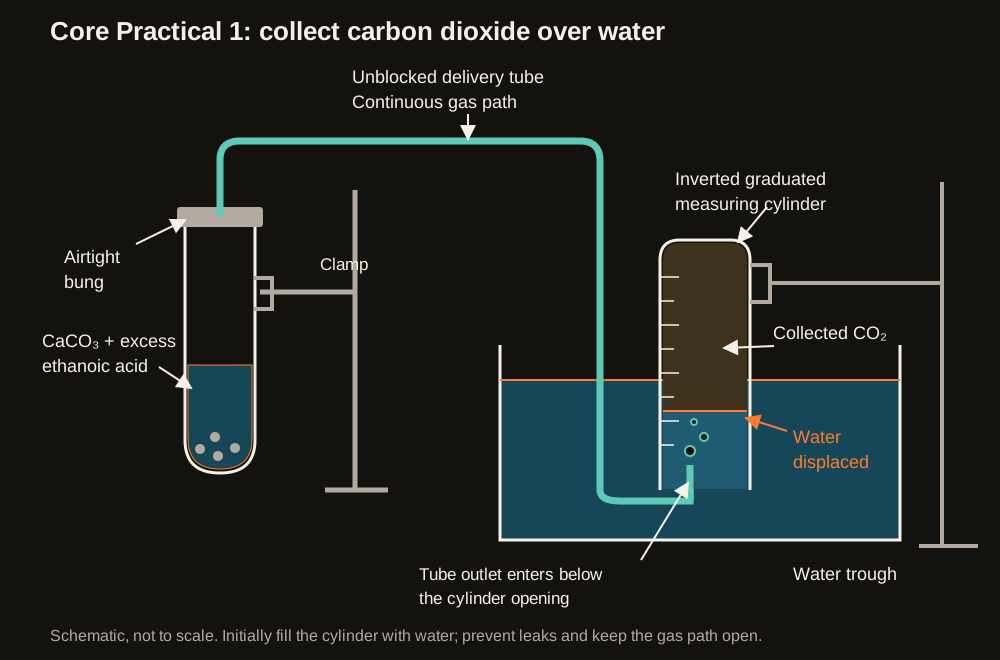
Swipe horizontally to view the whole diagram.
Use a graph and check the excess reagent
Plot gas volume against mass of carbonate and draw the required best-fit line. The ideal stoichiometric model predicts a proportional relationship through the origin. Pearson's worksheet specifies an origin-constrained line; in an unfamiliar investigation, an unexpected intercept should also prompt investigation of trapped air or systematic gas loss rather than being silently removed.
An original illustrative best-fit reading is 71.0 cm³ CO₂ for 0.300 g CaCO₃. n(CaCO₃) = 0.300/100.1 = 0.0029970 mol, equal to n(CO₂). Vm = 0.0710/0.0029970 = 23.7 dm³ mol⁻¹ at the measured conditions. Equivalently, a gradient in cm³ g⁻¹ multiplied by 100.1 g mol⁻¹ gives cm³ mol⁻¹, then divide by 1000.
If the largest mass is 0.400 g and the acid is 30.0 cm³ of 1.00 mol dm⁻³, carbonate amount = 0.400/100.1 = 0.003996 mol and acid required = 0.007992 mol. Acid available = 1.00 × 0.0300 = 0.0300 mol, so it is in excess. This numerical check validates using the carbonate amount to predict gas amount.
Follow the direction of the error
Gas escaping before sealing or CO₂ dissolving in water makes measured V too small while n from carbonate is unchanged, so Vm is underestimated. A gas syringe reduces dissolution but can stick or leak, so the replacement has its own checks. Initially trapped air gives too large a collected volume. Reading warm gas before it returns to room temperature gives too large a volume for a result labelled with room temperature.
Repeats expose scatter and improve the estimate of a mean; they do not recover gas lost on every run. Use larger measurable volumes within apparatus capacity to reduce relative scale uncertainty, and several masses to test proportionality. Do not increase the mass until the acid is no longer in excess or the collector overfills.
Quick checks
Original Finesse questions. Reveal the indicative worked solutions after attempting each question; these are not official Edexcel mark allocations.
Q1. 30.0 cm³ N₂ reacts completely with excess H₂ to form NH₃. Find H₂ consumed and NH₃ formed at the same conditions.Show answer
N₂ + 3H₂ → 2NH₃ gives a 1 : 3 : 2 gas-volume ratio. H₂ consumed = 90.0 cm³; NH₃ formed = 60.0 cm³. This is a complete-reaction stoichiometry calculation; an actual equilibrium may not convert all the nitrogen.
Q2. Calculate the amount in 250 cm³ gas at 100 kPa and 298 K, using R = 8.31.Show answer
p = 100000 Pa and V = 2.50 × 10⁻⁴ m³. n = 25.0/(8.31 × 298) = 0.0101 mol to 3 s.f.
Q3. A 0.145 g vapour has amount 0.00250 mol and empirical formula C₃H₆O. Find the molecular formula.Show answer
M = 0.145/0.00250 = 58.0 g mol⁻¹. Empirical formula mass = 3(12.0) + 6(1.0) + 16.0 = 58.0. Multiplier = 1, so C₃H₆O.
Q4. A CP1 run gives 48.0 cm³ CO₂ from 0.200 g CaCO₃. Calculate Vm.Show answer
n(CO₂) = n(CaCO₃) = 0.200/100.1 = 0.0019980 mol. Vm = 0.0480/0.0019980 = 24.0 dm³ mol⁻¹ to 3 s.f. Do not report 24000 dm³ mol⁻¹: that misses the cm³ conversion.
Q5. Explain why repeating a leaking CP1 setup does not remove its main error, and suggest a targeted improvement.Show answer
The leak systematically lowers V, so every calculated Vm can be too low even if repeat results agree. Leak-test and secure the joints, and arrange for reagents to mix after the apparatus is sealed. Repetition addresses scatter rather than a persistent loss.
Sources
Sources and examiner guidance (reviewed 9 October 2026)
- Pearson Edexcel 9CH0 specification, Issue 3 — Topic 5, printed pp. 15–16; checked against 8CH0 pp. 13–14. Reviewed 9 October 2026.
- Chemrevise — Formulae, equations and amounts of substance — Pages 1–17 used for coverage. Original Finesse explanations, examples and questions; source simplifications are corrected where necessary.
- Pearson Core Practical 1 worksheets — Teacher and student sheets: calcium carbonate, ethanoic acid and gas collection. Reviewed 9 October 2026.
Finesse Tuition is not endorsed by AQA or Chemrevise. All explanations and examples here are our own.