
Choose a measurable change, control the comparison and use a tangent for the rate at a particular instant.
Choose a signal linked to reaction progress
| Method | Suitable context | Limitation to address |
|---|---|---|
| Gas volume against time | Gas-producing reaction, using a syringe | Leaks, sticking, gas dissolving and start-time delay |
| Mass loss against time | Gas leaves an open reaction vessel | Gas must give a measurable mass change; avoid spray loss |
| Time to fixed cloudiness | Precipitate obscures a cross | Subjective end point; keep viewing conditions and total volume constant |
| Colour intensity against time | Coloured species changes concentration | Calibrate instrument and account for other coloured species |
Choose a method that measures a useful change
A gas syringe gives repeated volume readings during a gas-producing reaction. It should be gas-tight yet permit the plunger to move freely. Choose capacity above the expected final volume, start timing consistently and record temperature and pressure when converting volume to amount.
Mass loss works when gas escapes from a vessel on a balance. A cotton-wool plug can reduce spray loss without sealing the outlet. Hydrogen may give too little mass loss for the available balance even when its volume is readily measurable. A gas-producing reaction is not automatically equally suitable for both methods.
For a coloured species, a calibrated colorimeter can follow a changing signal. For a disappearing cross, use the same viewing geometry and final liquid depth. Taking aliquots for later analysis requires a justified way to stop or sufficiently slow further reaction; otherwise the sample changes while you measure it. Use supplied method information for unfamiliar contexts.
Rate is a gradient, not the total product
Mean rate = change in measured quantity/change in time. Instantaneous rate is the gradient of a tangent. For concentration, units may be mol dm⁻³ s⁻¹; gas-volume rate may be cm³ s⁻¹. A reactant concentration falls, so its gradient is negative; quote a positive rate of disappearance with the sign convention stated.
Illustrative gas volumes are 0, 24 and 36 cm³ at 0, 20 and 40 s. Mean rate over 0–20 s = 1.20 cm³ s⁻¹; over 20–40 s = 0.60 cm³ s⁻¹. A tangent is needed for the rate at exactly 20 s. A graph’s greater height does not mean a greater rate.
For a fixed amount of precipitate needed to obscure a cross, 1/time is a comparative rate measure, not automatically a concentration rate. It is valid only if the same extent of reaction defines each end point.
Use two points on the tangent, not two points on the curve
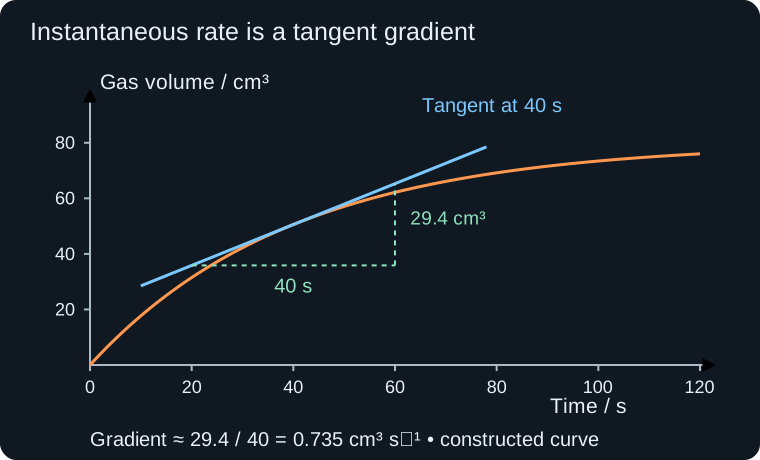
The illustrative curve shows V = 80(1 − e^(−t/40)) cm³ as a constructed model, not measured data or a required AS rate-law derivation. At 40 s the volume is about 50.6 cm³. A tangent through that point passes approximately through (20 s, 35.9 cm³) and (60 s, 65.3 cm³).
Gradient = (65.3 − 35.9)/(60 − 20) = 0.735 cm³ s⁻¹, or about 0.74 from the plotted line. By contrast V(40)/40 = 1.26 cm³ s⁻¹ is a mean rate from time zero. It is not the instantaneous rate at 40 s. The tangent’s endpoint coordinates need not be measured data points.
Use a large triangle so reading uncertainty has less relative effect. Include both axis units when stating the rate. If the plotted variable is concentration rather than gas volume, the units change accordingly.
Swipe horizontally to view the whole diagram.
Compare rate and final amount separately
To vary acid concentration, dilute a stock solution with water while keeping total liquid volume constant. Keep temperature and carbonate mass/surface area constant. Repeat to estimate scatter. For a temperature investigation, equilibrate reactants in a thermostatic bath before mixing.
A faster curve can reach the same final volume sooner if the same limiting moles are present. Adding more limiting reactant can instead increase the final volume. Separate statements about initial gradient from statements about the plateau.
A reaction slows as a dissolved reactant is depleted and collision frequency falls. It stops when a limiting reactant is used up, even if another remains in excess. These are PAG 9 rate-measurement skills.
Predict the slope and plateau independently
For a fixed amount of carbonate with acid in excess, a higher acid concentration can steepen the initial gas-volume curve while leaving the final plateau unchanged. If acid is limiting instead, increasing its amount can raise the plateau as well. Always determine the limiting amount before sketching the final height.
A catalyst or higher temperature can reach the same final product amount sooner in a simple effectively complete reaction with unchanged limiting amount. To compare gas-volume plateaus, measure or correct volumes to the same temperature and pressure: a hotter gas occupies more volume even when its amount is unchanged. Do not apply the unchanged-product prediction automatically to a reversible equilibrium, because temperature may alter equilibrium composition as well as rate.
For hydrogen peroxide decomposition, 2H₂O₂ → 2H₂O + O₂, an illustrative 72.0 cm³ final oxygen at RTP corresponds to 0.00300 mol O₂ and therefore 0.00600 mol H₂O₂. If the starting solution volume was 40.0 cm³, its concentration was 0.150 mol dm⁻³. Gas volume and solution volume play different roles.
Quick checks
Original Finesse questions. Reveal the indicative worked solutions after attempting each question; these are not official OCR A mark allocations.
Q1. A gas volume rises from 12 to 42 cm³ between 10 and 40 s. Find the mean rate.Show answer
(42 − 12)/(40 − 10) = 1.00 cm³ s⁻¹.
Q2. How do you find rate at 25 s on a curved graph?Show answer
Draw a tangent at 25 s and calculate its gradient using a large triangle.
Q3. Does the same final gas volume imply the same rate?Show answer
No. Curves can have different gradients but the same plateau because the limiting amount is unchanged.
Q4. Why keep total volume constant in a disappearing-cross experiment?Show answer
It helps keep optical depth and the amount of precipitate needed to obscure the cross comparable.
Q5. Why can Mg remain when gas production stops in acid?Show answer
The acid may be the limiting reactant and be fully consumed while Mg is in excess.
Q6. Multiple choice: the gradient of a tangent to a gas-volume graph gives A final gas amount; B instantaneous gas-volume rate; C reactant concentration directly; D activation energy.Show answer
B. Gradient means change in gas volume divided by time at that instant. The plateau gives final volume; neither concentration nor Ea is directly the tangent gradient.
Q7. A tangent passes through (15 s, 18 cm³) and (65 s, 48 cm³). Calculate its gradient.Show answer
(48 − 18)/(65 − 15) = 30/50 = 0.60 cm³ s⁻¹. Use coordinate differences, not 48/65.
Q8. A 25.0 cm³ H₂O₂ sample produces 60.0 cm³ O₂ at RTP. Calculate H₂O₂ concentration using 2H₂O₂ → 2H₂O + O₂.Show answer
n(O₂) = 60.0/24000 = 0.00250 mol. n(H₂O₂) = 0.00500 mol. c = 0.00500/0.0250 = 0.200 mol dm⁻³.
Q9. Extended response: design a comparison of acid concentration and carbonate reaction rate that can distinguish rate from total gas yield.Show answer
Use several acid concentrations at equal total volume, equal carbonate mass and similar particle size, and constant temperature. Select acid amounts that remain in excess if the intended final plateau is fixed by carbonate.
Measure gas volume at regular times with a suitably sized syringe; mix/start timing consistently and minimise initial gas loss. Repeat to assess scatter, plot curves and compare initial tangent gradients separately from final volumes.
A steeper initial gradient indicates faster production; equal plateaus support equal total reacting carbonate amounts. Identify leaks, syringe friction and gas dissolution as method-specific limitations, with relevant improvements. This is an original indicative plan, not an official mark allocation.
Sources
Sources and examiner guidance (reviewed 5 October 2026)
- OCR A H032 specification, version 2.0 — 3.2.2(a–g); AS outcomes and additional guidance. Reviewed 3 October 2026.
- Chemrevise — OCR A 3.2.2 reaction rates — Pages 1–5; coverage reference. Explanations and questions on this page are original.
- OCR H032/01 mark scheme — June 2025 — Q21(d)(ii); printed pages 12. Read with the question paper.
- OCR H032/01 examiner report — June 2025 — Q21(d)(ii); printed pages 23. Question-specific assessment guidance.
- OCR H032/01 question paper — June 2025 — Question context for the question numbers listed with the mark scheme and examiner report.
- OCR H032/02 June 2024 mark scheme — Q4(b–c); printed pp. 18–19. Reviewed 5 October 2026.
- OCR H032/02 June 2024 examiner report — Q4(b–c); printed pp. 23–26. Reviewed 5 October 2026.
- OCR H032/02 June 2024 question paper — Q4(b–c); corresponding question context. Reviewed 5 October 2026.
Finesse Tuition is not endorsed by AQA or Chemrevise. All explanations and examples here are our own.