
Explain changes in rate through collision frequency and the fraction of particles with enough energy to react.
A collision must be effective
Reacting particles must collide with sufficient energy and an appropriate orientation. Activation energy Ea is the minimum energy needed for reaction along the pathway. More collisions alone do not make every collision successful.
Increasing concentration gives more reacting particles per unit volume, increasing collision frequency. Compressing reacting gases has a similar effect through higher gas concentration. Increasing the exposed surface area of a solid provides more accessible sites for collisions; it does not increase the concentration of that pure solid.
Increasing temperature raises particle speeds and collision frequency, but the major explanation is the increased fraction with energy at least Ea. Do not say all particles now possess the activation energy. Nor can you assume doubling concentration always doubles rate without evidence of the rate dependence.
Give a different explanation for each change
Concentration changes how many reacting particles occupy each unit volume. At unchanged temperature the energy distribution is unchanged, but collisions become more frequent. Temperature changes the distribution of energies, so a larger fraction of particles can overcome the activation barrier; it also changes collision frequency.
For a solid, only accessible surface sites can make contact with a solution. Crushing a fixed mass exposes more sites without adding more moles of solid. The reaction can therefore be faster but make the same final product amount when the same limiting amount is used.
The phrase “more successful collisions” needs a cause. For concentration, connect more particles per unit volume to more collisions per second. For temperature, connect the greater high-energy fraction to more collisions with sufficient energy. For a catalyst, connect the alternative pathway to a lower activation threshold.
| Change | Main change | What is not implied |
|---|---|---|
| Increase concentration at fixed T | Collision frequency | Particles individually gain energy |
| Increase temperature | Fraction with sufficient energy | Activation energy becomes smaller |
| Add catalyst at fixed T | Alternative route with lower barrier | Energy distribution shifts right |
| Crush a fixed mass of solid | Accessible surface area | More total moles of solid |
Read a Boltzmann distribution
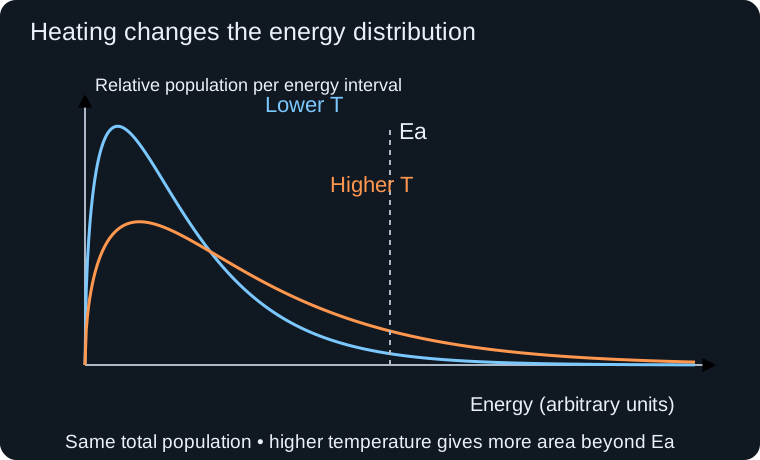
Plot number of particles per energy interval (or a normalised fraction) against energy. The curve starts at the origin, rises to a peak and falls towards the axis with a long high-energy tail. The peak is the most probable energy, not the mean. The area under a number distribution represents the total number of particles.
For the same number of particles at higher temperature, the curve has a lower peak shifted right and a larger high-energy tail, while total area stays the same. Mark Ea and compare the area to its right. Ea itself does not move when only temperature changes.
Swipe horizontally to view the whole diagram.
Read area, height and the tail correctly
The curve height at a chosen energy describes particles within an energy interval, not the total number able to react. The fraction with enough energy is represented by the area to the right of Ea. Raising a single point on the curve is therefore not a substitute for comparing that area.
For the same sample at higher temperature, total area stays constant because no particles have been added. The most probable energy is at the peak; the mean is farther right because of the long tail. There is no sharp maximum energy at which all particles stop.
Particles continually exchange energy in collisions. The small fraction above Ea is not a permanent team of molecules that can react while every other molecule is forever inactive. As particles collide, different particles can enter the high-energy portion. This explains why reaction can continue even when the instantaneous energetic fraction is small.
An alternative pathway with lower Ea
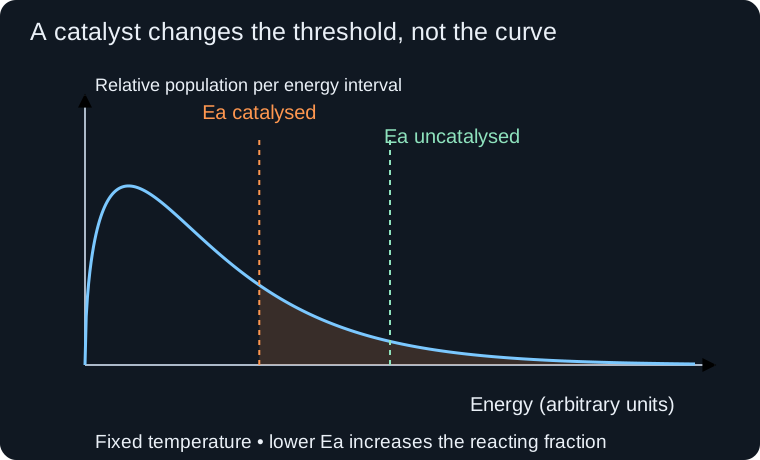
A catalyst increases rate by providing an alternative reaction pathway with lower activation energy. It participates in steps but is regenerated overall. At the same temperature it does not give particles extra energy or change the distribution; it shifts the threshold to a lower Ea so more collisions can lead to reaction.
A homogeneous catalyst is in the same phase as the reactants; a heterogeneous catalyst is in a different phase, often a solid surface with gas reactants. A catalyst changes neither the energy difference between reactants and products nor the equilibrium position.
Catalysts may permit lower temperatures and less energy use. Selective catalysts can reduce unwanted products and enable a different route with less waste or less hazardous reagents. The catalyst’s production, scarcity, toxicity and recovery also matter when judging a process.
Swipe horizontally to view the whole diagram.
A catalyst participates without changing the overall reaction
A catalyst can form intermediates and change during individual steps, but is regenerated by the complete cycle. “Never reacts” is therefore a misleading description. Regeneration means it is not consumed in the ideal overall equation; practical catalysts can still become contaminated, poisoned or lost.
An alternative mechanism may involve several smaller barriers rather than one lower hump. The overall reactant and product enthalpy levels stay the same, so ΔH does not change. At fixed temperature a catalyst does not change the equilibrium constant or equilibrium composition.
For heterogeneous catalysis, available surface matters. A finely divided solid provides more accessible sites than the same mass in large pieces. A practical comparison must control not only catalyst mass but also surface area or particle size when the purpose is to compare materials.
Quick checks
Original Finesse questions. Reveal the indicative worked solutions after attempting each question; these are not official OCR A mark allocations.
Q1. Why does higher gas pressure often increase rate?Show answer
Compression increases reacting particles per unit volume, increasing collision frequency.
Q2. What happens to the area under a Boltzmann curve when the same sample is heated?Show answer
It stays constant because the number of particles stays constant, while the distribution shifts.
Q3. Does a catalyst move the Boltzmann curve to higher energies?Show answer
No. At fixed temperature the curve is unchanged; the alternative pathway has a lower Ea.
Q4. Why does powdered CaCO₃ react faster than equal-mass large chips?Show answer
It exposes a larger total surface for collisions with acid.
Q5. Distinguish homogeneous and heterogeneous catalysis.Show answer
Homogeneous: same phase as reactants. Heterogeneous: different phase, commonly reaction on a solid surface.
Q6. Multiple choice: which changes when a catalyst is added at fixed temperature? A most probable energy; B total area under the distribution; C activation threshold for the available route; D reaction ΔH.Show answer
C. The pathway changes, lowering its activation barrier. The population and temperature distribution stay the same, and the endpoints defining ΔH do not change.
Q7. A student says heating makes Ea smaller. Rewrite the explanation.Show answer
Heating changes the energy distribution so a greater fraction of particles have energy at least Ea. Ea for the same pathway stays fixed. More collisions per second can then be successful.
Q8. Why can crushed limestone react faster than the same mass of large lumps without necessarily producing more CO₂?Show answer
Crushing exposes more surface sites for collisions, increasing rate. The total carbonate amount is unchanged, so the final CO₂ is unchanged if the same carbonate amount reacts completely and acid is sufficiently in excess.
Q9. Explain why a catalyst can appear in a mechanism but not in the overall equation.Show answer
It is used in an intermediate step and regenerated in another. Adding the steps cancels it, so it is not consumed overall. That differs from claiming it takes no part in the chemistry.
Sources
Sources and examiner guidance (reviewed 5 October 2026)
- OCR A H032 specification, version 2.0 — 3.2.2(a–g); AS outcomes and additional guidance. Reviewed 3 October 2026.
- Chemrevise — OCR A 3.2.2 reaction rates — Pages 1–5; coverage reference. Explanations and questions on this page are original.
- OCR H032/01 mark scheme — June 2025 — Q21(d)(ii); printed pages 12. Read with the question paper.
- OCR H032/01 examiner report — June 2025 — Q21(d)(ii); printed pages 23. Question-specific assessment guidance.
- OCR H032/01 question paper — June 2025 — Question context for the question numbers listed with the mark scheme and examiner report.
- OCR H032/02 June 2024 mark scheme — Q4(a); printed pp. 17. Reviewed 5 October 2026.
- OCR H032/02 June 2024 examiner report — Q4(a); printed pp. 22. Reviewed 5 October 2026.
- OCR H032/02 June 2024 question paper — Q4(a); corresponding question context. Reviewed 5 October 2026.
Finesse Tuition is not endorsed by AQA or Chemrevise. All explanations and examples here are our own.