
Build on electron transfer and oxidation numbers to explain how separate half-reactions produce a measurable voltage, and how to investigate cells reliably.
Separate the two electron-transfer processes
Oxidation is loss of electrons and an increase in oxidation number; reduction is gain of electrons and a decrease in oxidation number. These definitions apply throughout the periodic table: Mg → Mg²⁺ + 2e⁻ is s-block oxidation, Cl₂ + 2e⁻ → 2Cl⁻ is p-block reduction, and Fe³⁺ + e⁻ → Fe²⁺ is d-block reduction. Oxidation number is bookkeeping: an increase does not require the substance to contain a free ion of that charge.
When zinc directly contacts copper(II) solution, electrons transfer at the metal surface. Separating Zn/Zn²⁺ and Cu²⁺/Cu into half-cells forces the electron transfer through an external conductor. Zinc atoms become Zn²⁺ and leave electrons in the zinc electrode; Cu²⁺ accepts electrons at the copper electrode and deposits copper. The potential difference represents the energy available per unit charge, measured in volts.
In a discharging galvanic cell, oxidation occurs at the negative anode and reduction at the positive cathode. Electrons travel through the wire from zinc to copper. Ions carry charge through the solutions and salt bridge: nitrate can move towards the zinc compartment as Zn²⁺ forms, and potassium towards the copper compartment as Cu²⁺ is removed. Electrons do not travel through the salt bridge.
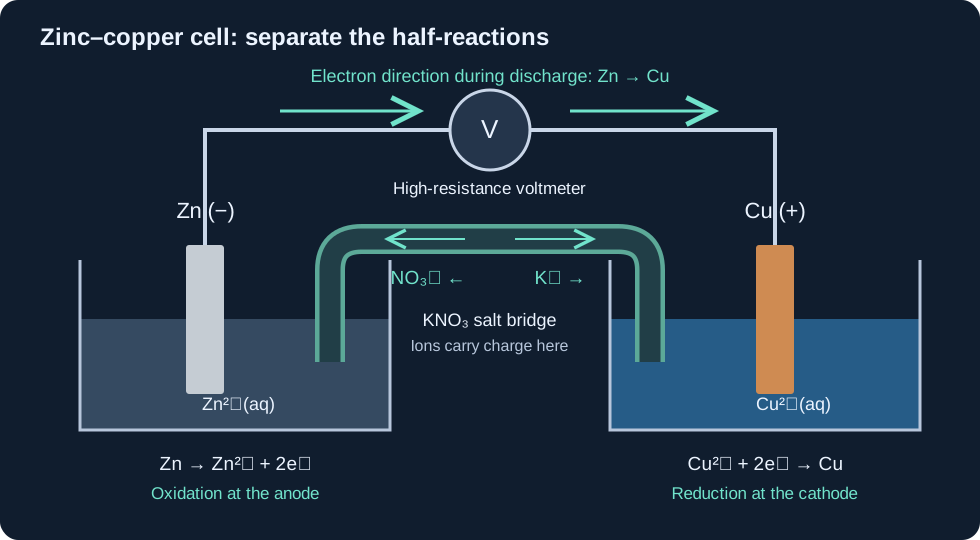
Swipe horizontally to view the whole diagram.
A reference electrode makes comparisons possible
A voltmeter measures a difference between two electrode potentials; it cannot measure the absolute potential of an isolated half-cell. The standard hydrogen electrode (SHE) is the reference, assigned E° = 0.00 V. The standard electrode potential of a half-cell is its potential relative to the SHE under standard conditions, with effectively no current flowing.
Use 298 K, gas pressures of 100 kPa and relevant aqueous ion concentrations of 1.00 mol dm⁻³. The SHE has hydrogen gas contacting an inert platinum electrode coated with finely divided platinum, in a solution with [H⁺] = 1.00 mol dm⁻³. Platinum conducts electrons and provides a surface for the H₂/H⁺ reaction; platinum is not consumed. Connect it to the other half-cell through a salt bridge and high-resistance voltmeter.
Published electrode potentials conventionally describe reduction half-equations. A positive value means the reduction has a greater tendency than H⁺ reduction under standard conditions; it does not mean an electrode is always positive in every pairing. A metal with E° = +0.34 V becomes the oxidation electrode if paired with a sufficiently more positive system.
Choose an electrode and all the necessary chemical species
For a standard Fe³⁺/Fe²⁺ half-cell, the final concentration of each ion must be 1.00 mol dm⁻³. Mixing equal volumes of two 1.00 mol dm⁻³ stock solutions halves each concentration; writing ‘1 M solutions mixed’ is not sufficient. Also account for two Fe³⁺ per formula unit of Fe₂(SO₄)₃ when preparing solutions.
For MnO₄⁻/Mn²⁺ in acid, an inert Pt electrode needs both manganese species and H⁺. Suitable substances include potassium manganate(VII), manganese(II) sulfate and sulfuric acid. Naming only the ions is insufficient if asked for the chemicals to use. Avoid chloride-containing reagents here because a competing oxidation can occur.
| System | What is present | Why |
|---|---|---|
| Metal/metal ion | Cu strip in a solution containing Cu²⁺ | Copper supplies the conducting surface and is a reacting species. |
| Non-metal/ion | Pt in contact with H₂ gas and H⁺ solution (or a suitable halogen/halide system) | The redox substances do not provide a suitable conducting metal surface. |
| Two aqueous oxidation states | Pt in a mixture containing Fe³⁺ and Fe²⁺ | Both members of the redox pair must be present; Pt transfers electrons without supplying a new metal couple. |
Write a conventional cell diagram and calculate emf
A single vertical line is a phase boundary; a comma separates species in the same phase; a double line represents the salt bridge. Put the oxidation half-cell on the left and the reduction half-cell on the right for the spontaneous discharge direction. Include an inert conductor such as Pt when the redox pair has none. Cell notation is not a balanced equation: do not insert electron coefficients into it.
For any diagram written left to right, E°cell = E°right − E°left, using both listed values as reduction potentials. For Zn²⁺/Zn = −0.76 V and Cu²⁺/Cu = +0.34 V, E°cell = 0.34 − (−0.76) = +1.10 V. Reversing the diagram reverses the sign. Multiplying a half-equation to balance electrons does not multiply its potential: voltage is energy per charge, not a total energy.
Worked unfamiliar pairing: Fe³⁺/Fe²⁺ = +0.77 V paired with Cu²⁺/Cu = +0.34 V gives +0.43 V with iron reduction on the right. Double the Fe³⁺ reduction half-equation to accept the two electrons from each Cu atom. The reaction is Cu + 2Fe³⁺ → Cu²⁺ + 2Fe²⁺; the potential remains 0.77 − 0.34, not 2 × 0.77 − 0.34.
Core Practical 10: construct, measure and evaluate cells
Clean the metal strips with abrasive paper to expose metal beneath oxide or dirt. Place each in its matching ion solution, connect a fresh potassium-nitrate-soaked bridge and attach a high-resistance voltmeter. Record the temperature, solution concentrations, sign, value and electrode connections. Repeat with combinations of Zn, Fe, Cu and Ag half-cells, following the laboratory’s concentrations and risk assessment. Wear eye protection and collect metal-containing waste as directed.
A high resistance limits current, so concentrations and electrode surfaces change very little and the measured voltage approaches the open-circuit emf. A bridge must conduct ions without introducing a precipitate, complex or redox reaction. A metal wire across the solutions cannot replace it. Use fresh bridges and rinse equipment between combinations to reduce contamination.
Evaluate the measured values against the actual conditions. Pearson’s CP10 uses 0.10 mol dm⁻³ silver nitrate rather than the standard 1.00 mol dm⁻³ solution, so its silver cells are not standard cells. Record this deliberate limitation. A drift may come from oxidation of Fe²⁺ by air, poor contacts, changing concentrations or a reactive electrode; magnesium also reacts with water. Repeat stable readings and report their spread, but repeating does not remove a concentration bias.
Illustrative instrument check: if the stated meter uncertainty is ±0.01 V, a reading of 1.08 V has a relative uncertainty of 0.01/1.08 × 100 = 0.93%. Comparing 1.08 V with 1.10 V gives a 0.02 V difference. This is not proof of a faulty meter: theoretical values assume standard conditions and experimental junctions also contribute. Use the instrument’s actual uncertainty, not an automatic number of decimal places. Written understanding supports CP10; observed competence is separately assessed for the practical endorsement.
Quick checks
Original Finesse questions. Reveal the indicative worked solutions after attempting each question; these are not official Edexcel mark allocations.
Q1. In a Zn/Cu cell delivering current, where do electrons and salt-bridge ions move?Show answer
Electrons move in the external wire from Zn, where oxidation releases them, to Cu, where Cu²⁺ reduction uses them. Nitrate migrates towards the zinc side and potassium towards the copper side to counter charge accumulation. The bridge carries ions, not electrons.
Q2. A student measures a copper electrode alone with one voltmeter lead. Explain the problem and describe the reference needed.Show answer
Potential difference needs two electrodes. Connect the copper half-cell to a standard hydrogen electrode via a salt bridge and high-resistance voltmeter. The SHE uses Pt, H₂ at 100 kPa, [H⁺] = 1.00 mol dm⁻³ and 298 K, with an assigned 0 V potential.
Q3. Ag⁺/Ag has E° = +0.80 V and Fe³⁺/Fe²⁺ has E° = +0.77 V. Write the spontaneous cell diagram and emf.Show answer
Pt(s) | Fe²⁺(aq), Fe³⁺(aq) || Ag⁺(aq) | Ag(s). Fe²⁺ is oxidised on the left, Ag⁺ reduced on the right. E°cell = 0.80 − 0.77 = +0.03 V. The small emf makes departures from standard conditions particularly significant.
Q4. Equal volumes of 1.00 mol dm⁻³ Fe²⁺ and 1.00 mol dm⁻³ Fe³⁺ solutions are mixed. Is the resulting half-cell standard?Show answer
No. Assuming additive volumes and no reaction, each species is diluted to 0.500 mol dm⁻³. Standard conditions require the final concentration of each to be 1.00 mol dm⁻³, even though this particular equal ratio can produce a potential close to the standard value.
Q5. A student doubles the silver half-equation and calculates 2(0.80) − (−0.76) for a Zn/Ag cell. Correct the calculation.Show answer
Balance electrons to obtain Zn + 2Ag⁺ → Zn²⁺ + 2Ag, but retain E°(Ag⁺/Ag) = +0.80 V. E°cell = 0.80 − (−0.76) = +1.56 V. Potentials do not scale with stoichiometric coefficients.
Sources
Sources and examiner guidance (reviewed 9 October 2026)
- Pearson Edexcel 9CH0 specification — Issue 3 — Topic 14, printed pp.31–32; UK A-Level scope and Core Practicals 10–11.
- Chemrevise — UK Edexcel Topic 14 — Pages 1–11 used as a secondary coverage check. Teaching, examples and questions here are original Finesse material.
- Pearson Core Practical 10 — electrochemical cells — Teacher and student sheets, PDF pp.1–4; apparatus, comparison with standard values and practical limitations.
- Pearson 9CH0/03 mark scheme — June 2023 — Q5(a–e), PDF pp.20–23; half-cell reagents, reduction limits, cell notation and fuel cells.
- Pearson 9CH0/03 examiner report — June 2023 — Q5(a–e), pp.40–49; read alongside the paper and mark scheme.
Finesse Tuition is not endorsed by AQA or Chemrevise. All explanations and examples here are our own.