
Read what the data can support, translate between equations and graphs, and assemble a clear answer when a question combines familiar chemistry in an unfamiliar setting.
Record enough information for someone else to check it
Put the quantity and unit in each table heading and use a consistent precision for readings from the same instrument. Record raw readings before calculating differences or means. For a titration, keep initial and final burette readings as well as the titre; that makes subtraction and transcription errors visible.
A mean should represent comparable, justified measurements. A rough titre locates the endpoint but need not belong in the mean of accurate concordant titres. If a result is excluded, give a scientific or procedural reason and keep the original record.
Choose axes and a line that fit the question
Usually place the independent variable on the horizontal axis and the dependent variable on the vertical axis. Label quantities and units, choose a usable scale and plot the actual observations accurately. A best-fit line or curve expresses the trend, not a dot-to-dot journey through measurement noise.
Do not force a line through the origin unless both the physical model and the evidence justify it. An intercept can reveal a background signal or a systematic offset. An unusual point is a reason to inspect the measurement and repeat it where possible, not permission to delete inconvenient evidence.
A gradient is a rate of change with units
An average gas-production rate over an interval is ΔV/Δt. An instantaneous rate is the gradient of a tangent to the volume–time curve at the chosen time. Use two well-separated positions on the drawn tangent to calculate its slope; they do not have to be measured data points.
If the tangent passes through (10.0 s, 16.0 cm³) and (40.0 s, 43.0 cm³), its gradient is (43.0 − 16.0)/(40.0 − 10.0) = 0.900 cm³ s⁻¹. For a reactant concentration–time graph, the gradient is negative because concentration falls; the rate of disappearance is the positive magnitude when defined that way.
A curve becoming flatter shows the measured rate is decreasing. A plateau in collected gas may show the limiting reactant has been consumed, but apparatus capacity, a leak or stopped collection must also be considered before interpreting unfamiliar data.
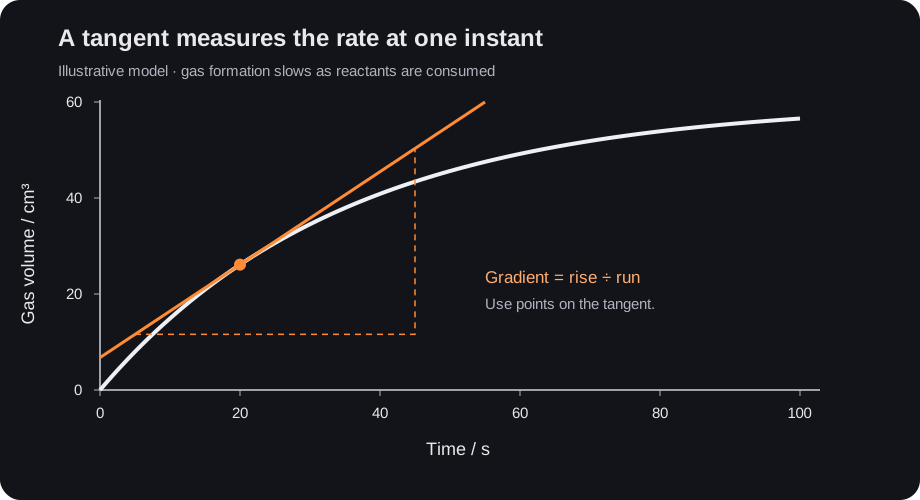
Swipe horizontally to view the whole diagram.
Use the equation to interpret a straight line
Compare a rearranged chemical equation with y = mx + c. The vertical variable corresponds to y, the horizontal variable to x, the gradient to m and the intercept to c. A numerical gradient has units set by the axes, so it is not automatically the physical constant being sought.
For additional A-Level work, ln k = −Ea/(RT) + ln A gives a straight-line plot of ln k against 1/T, with gradient −Ea/R. If the gradient is −7.20 × 10³ K, Ea = −gradient × R = 7.20 × 10³ × 8.31 = 5.98 × 10⁴ J mol⁻¹ = 59.8 kJ mol⁻¹. Multiplying by R and converting J to kJ are separate essential steps.
A plot against 1000/T has a scaled horizontal axis and therefore a different numerical gradient. Read the axis label and derive its relationship before inserting the slope into a memorised formula.
Let the command word shape the answer
Describe reports the relevant pattern or events; explain supplies the chemical reason. A comparison should explicitly address both objects. A deduction should use the supplied evidence to reach a conclusion. An evaluation weighs evidence and limitations to make a supported judgment.
For a boiling-point comparison, naming hydrogen bonding is only a start. Identify which molecules form which attractions, why the comparison is meaningful and how the attraction difference changes the energy needed to separate molecules. For a calculation, show an identifiable route with units; a bare number hides the reasoning.
| Task | What to include | Common omission |
|---|---|---|
| Describe a graph | Direction, shape and relevant data | Giving only a mechanism without stating the observed trend |
| Explain a trend | Observation linked to a chemical cause | Repeating the trend in different words |
| Compare | Matched statements about both cases | Discussing only one substance |
| Deduce | Evidence followed by inference | Stating a memorised conclusion unrelated to the supplied data |
| Evaluate | Strengths, limitations, consequences and judgment | A generic list with no effect on the conclusion |
| Calculate | Equation, substitution, units and rounded result | Unlabelled arithmetic or premature rounding |
Connect topics by following the species
For an unfamiliar experiment, list the species before and after each step. Then ask which principles connect the steps: a titration may determine moles, a mass measurement may give a yield, and IR may test whether the intended functional group changed. One piece of evidence rarely proves everything.
A high isolated mass can reflect wet crystals rather than good conversion. A melting range can support a purity assessment, while IR tests functional groups. Interpret their agreement and limitations together. The purpose of Paper 3 practice is to apply known chemistry to the information given, not to recognise a memorised practical title.
Worked synoptic calculation: gas, stoichiometry and purity
An original sample contains magnesium and an inert impurity. Its mass is 0.150 g, and excess dilute acid produces 120 cm³ of hydrogen at 298 K and 100 kPa. Assume complete reaction, no gas loss, dry ideal gas and an impurity that neither reacts nor produces gas.
Use SI units in pV = nRT: p = 1.00 × 10⁵ Pa and V = 1.20 × 10⁻⁴ m³. Therefore n(H₂) = 12.0/(8.31 × 298) = 0.004846 mol. Mg + 2H⁺ → Mg²⁺ + H₂ gives n(Mg) = n(H₂). Taking M(Mg) = 24.3 g mol⁻¹, the magnesium mass is 0.1178 g and percentage purity = 0.1178/0.150 × 100 = 78.5%.
A gas leak would make the inferred magnesium amount and purity too low. Water vapour in a wet collected gas would need consideration because total pressure would not equal hydrogen partial pressure. The assumptions are part of the model, not facts guaranteed by the arithmetic.
Check the conclusion against the evidence
Before finishing, check the species and equation, the mole ratio, units, sign and approximate scale. A purity above 100% is a prompt to revisit assumptions, measurements and arithmetic. A negative rate constant or a negative absolute temperature is physically inconsistent in these contexts.
When asked to justify a method or conclusion, make the evidence-to-conclusion connection explicit. Clear prose and labelled working let an examiner see the chemistry you understand. Treat question-specific marking evidence as guidance for that context, while maintaining scientifically sound reasoning in a new one.
Quick checks
Original Finesse questions. Reveal the indicative worked solutions after attempting each question; these are not official Edexcel mark allocations.
Q1. A tangent passes through (15 s, 12 cm³) and (55 s, 38 cm³). Calculate the instantaneous rate represented by it.Show answer
Gradient = (38 − 12)/(55 − 15) = 26/40 = 0.65 cm³ s⁻¹. The points are taken from the tangent, which represents the local rate at its contact with the curve.
Q2. Why should a best-fit line not always be forced through the origin?Show answer
A nonzero intercept can be physically meaningful or reveal an offset. Forcing zero without a justified model can distort the slope and any constant derived from it. Use the experimental context and plotted evidence.
Q3. Additional A-Level: an ln k versus 1/T graph has gradient −6.00 × 10³ K. Find Ea using R = 8.31 J mol⁻¹ K⁻¹.Show answer
Ea = −gradient × R = 6000 × 8.31 = 49 860 J mol⁻¹ = 49.9 kJ mol⁻¹ to three significant figures. The negative gradient corresponds to positive activation energy.
Q4. A recovered organic solid has a calculated yield of 108%. Give a plausible explanation and a relevant check.Show answer
The measured solid may retain solvent or contain impurities, inflating the mass. Dry appropriately to constant mass and use relevant purity evidence such as a melting range. The percentage alone does not identify the cause; check the calculation and limiting-reactant basis too.
Q5. A student writes “rate increases because it is faster” in an explanation of increasing reactant concentration. Improve it.Show answer
Higher concentration places more reacting particles in a given volume. At the same temperature this can increase the frequency of effective collisions, so reaction rate rises. The original wording only restated the observation; it supplied no causal mechanism.
Sources
Sources and examiner guidance (reviewed 9 October 2026)
- Pearson Edexcel 9CH0 specification, Issue 3 — Appendix 5a, pp77–78; mathematical skills, pp85–89; command words, pp91–92. AS students use the common skills, with advanced examples signposted.
- Chemrevise: Edexcel practical guide — Secondary practical coverage check; pp1–8 for measurement and volumetric techniques. Methods and conclusions here are original Finesse teaching.
- Pearson June 2023 9CH0/03 mark scheme — Q7(a)(iii), PDF p27: comparing percentage uncertainty for a combined delivered volume.
- Pearson June 2023 9CH0/03 examiner report — Introduction, p3; Q7(a)(ii–iii), pp61–62: calculation presentation, rounding and choosing the correct total-volume denominator.
Finesse Tuition is not endorsed by AQA or Chemrevise. All explanations and examples here are our own.