Recognise a chiral centre, distinguish molecular chirality from sample rotation, and use stereochemical evidence to compare SN1 and SN2 mechanisms.
Find four different groups, not four different first atoms
Prerequisite: a carbon with four single bonds is approximately tetrahedral. A chiral object cannot be superimposed on its mirror image. For the single-centre molecules required here, a carbon bonded to four different groups gives two non-superimposable mirror-image arrangements: a pair of enantiomers, also called optical isomers. They have the same connectivity but different spatial arrangements.
In butan-2-ol, CH₃CH(OH)CH₂CH₃, carbon 2 is bonded to H, OH, CH₃ and CH₂CH₃. The two carbon-based groups differ when followed beyond their first atom. In propan-2-ol the two CH₃ groups are identical, so carbon 2 is not chiral. A carbonyl carbon is trigonal planar, not a tetrahedral chiral centre.
To audit an unfamiliar structure, mark each carbon with four single bonds, list its four complete substituents and reject any repeated group. A ring can require tracing both directions around the ring. Several stereocentres and internal symmetry need more analysis; “contains a tetrahedral carbon” alone never proves chirality.
Show the three-dimensional arrangement explicitly
Use two ordinary bonds in the plane of the page, a solid wedge towards the viewer and a hashed wedge away. Reflect the whole arrangement to draw the mirror image, retaining all four groups. A whole-molecule rotation changes the viewpoint but not the configuration; exchanging two groups at one centre changes the configuration.
In an examination drawing, include the substituents and the carbon to which they are attached. A flat cross with no viewing convention is ambiguous. Neither the side of the drawing occupied by OH nor a wedge alone tells you the experimentally measured direction of optical rotation.
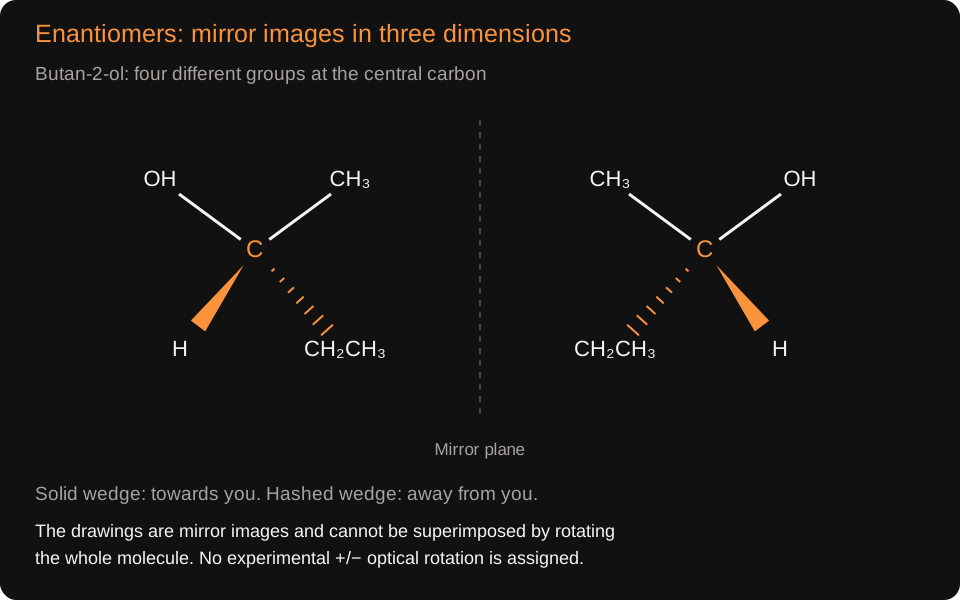
Swipe horizontally to view the whole diagram.
A racemate contains chiral molecules but has no net rotation
Optical activity is the ability to rotate the plane of polarisation of plane-polarised monochromatic light. A pure enantiomer rotates that plane in one direction; its partner rotates it equally in the opposite direction under the same temperature, wavelength, concentration and path length. These controlled conditions matter when comparing measurements.
A racemic mixture contains equal amounts of the two enantiomers. Their rotations cancel, so the sample is optically inactive although its individual molecules remain chiral. An achiral substance can also show zero rotation, so zero rotation alone does not establish that a sample is racemic.
Original worked interpretation: under specified identical conditions the pure enantiomers give +12.0° and −12.0°. A mixture with 75% of the first and 25% of the second gives an illustrative net rotation of 0.75(12.0) + 0.25(−12.0) = +6.0°. This uses additive rotation at a fixed total concentration; it is explanatory practice, not a new required formula.
SN1: a planar intermediate permits attack from both faces
In an SN1 model, the carbon–halogen bond breaks heterolytically first: both bonding electrons go to the halogen. The carbocation formed at the reacting carbon is planar. A nucleophile can then approach either face and form the new bond. If the product has four different groups, both configurations can result.
For an initially single-enantiomer substrate, formation of an approximately racemic substitution product supports a planar carbocation intermediate. In the ideal simple model both faces are equally accessible. Real solvent cages or ion pairs can favour one face, so experimental results may show partial rather than complete racemisation.
A mechanism answer must connect observation to structure: loss of optical purity → access from both faces → planar intermediate → evidence consistent with SN1. Evidence of a rate depending on substrate concentration but not nucleophile concentration strengthens the proposed rate-determining ionisation step. Optical data are evidence, not proof of every elementary step.
SN2: backside attack inverts the reacting centre
In an SN2 model, the nucleophile attacks opposite the leaving group while the carbon–halogen bond breaks in the same step. There is one transition state and no freely rotating carbocation intermediate. Backside attack reverses the spatial arrangement at the reacting tetrahedral carbon: inversion of configuration.
A single-enantiomer substrate giving a single stereoisomer with inverted configuration supports SN2, provided the product remains chiral. A rate proportional to both substrate and nucleophile concentrations provides complementary evidence for a bimolecular rate-determining event.
Do not equate inversion with reversal of the sign of optical rotation. Replacing Br with OH changes the molecule; the sign of its rotation cannot be predicted from the substrate’s sign. The product is also not an enantiomer of the starting material because their chemical compositions differ. Compare the product with the other possible enantiomer of that same product.
| Observation | Mechanistic interpretation | Essential qualification |
|---|---|---|
| Two product enantiomers in equal amounts | Equal attack on the two faces of a planar intermediate | Product must actually have a chiral centre |
| One product configuration, inverted at the reacting centre | Backside attack consistent with SN2 | Optical sign alone does not establish inversion |
| No measured optical rotation | Could be racemate or achiral product | Check product structure and sample composition first |
Quick checks
Original Finesse questions. Reveal the indicative worked solutions after attempting each question; these are not official Edexcel mark allocations.
Q1. Identify the chiral centre, if any, in CH₃CHBrCH₂CH₃ and in CH₃CBr₂CH₂CH₃.Show answer
The CHBr carbon in the first compound has H, Br, CH₃ and CH₂CH₃, so it is chiral. The CBr₂ carbon in the second has two identical Br groups, so it is not a chiral centre.
Q2. Why is a racemic sample optically inactive even though its molecules are chiral?Show answer
It contains equal amounts of the two enantiomers. Under identical conditions their rotations are equal in magnitude and opposite in direction, giving zero net rotation; the molecules do not become achiral.
Q3. A chiral substrate produces a nearly racemic substitution product that remains chiral. Explain the SN1 interpretation.Show answer
Heterolytic loss of the leaving group produces a planar carbocation. Nucleophile attack on either face gives the two configurations. Similar access to both faces explains the near-equal amounts; this is evidence consistent with SN1.
Q4. A student says an SN2 reaction must convert a positive optical rotation into a negative one. Correct the statement.Show answer
SN2 gives inversion of configuration at the reacting centre. The product is chemically different from the substrate, so its rotation sign is not fixed by that inversion. Structural stereochemical evidence is needed.
Q5. Under the conditions of the worked example, predict the rotation of a 60:40 mixture of the +12.0° and −12.0° enantiomers.Show answer
0.60 × 12.0 + 0.40 × (−12.0) = +2.4°. The excess of the positive enantiomer determines the sign; a 50:50 mixture would give zero.
Sources
Sources and examiner guidance (reviewed 9 October 2026)
- Pearson Edexcel 9CH0 specification, Issue 3 — Topic 17, printed pp.38–39; Year 13 content building on 8CH0/9CH0 Topic 6.
- Chemrevise: UK Edexcel Organic Chemistry II — Guide pp.7–8; secondary coverage reference. Explanations, worked data and questions are original Finesse material.
Finesse Tuition is not endorsed by AQA or Chemrevise. All explanations and examples here are our own.