
Explain how two ongoing reactions produce an apparently unchanging mixture, then predict and justify its response to concentration, pressure and temperature changes.
Equal rates do not mean equal concentrations
A reversible reaction can proceed in both directions. In a closed system under suitable fixed conditions, it may reach dynamic equilibrium: the forward and reverse reactions continue at equal rates, so reactant and product concentrations remain constant. Closed means matter cannot escape or enter; energy transfer can still occur, for example when temperature is controlled by a water bath.
Starting with reactants, the forward reaction initially dominates. As reactants are used and products accumulate, the forward rate commonly falls and the reverse rate rises until they match. At equilibrium molecules continue reacting, but every net conversion is balanced by reverse conversion. Equilibrium is therefore not a stopped reaction.
Equal rates do not require equal concentrations. For A ⇌ B, equilibrium could contain twice as much B as A if their conversion tendencies differ. Concentrations remain constant at their own values. A visible colour that stops changing is consistent with equilibrium, but could also signal a completed reaction; reversibility and system conditions supply the additional evidence.
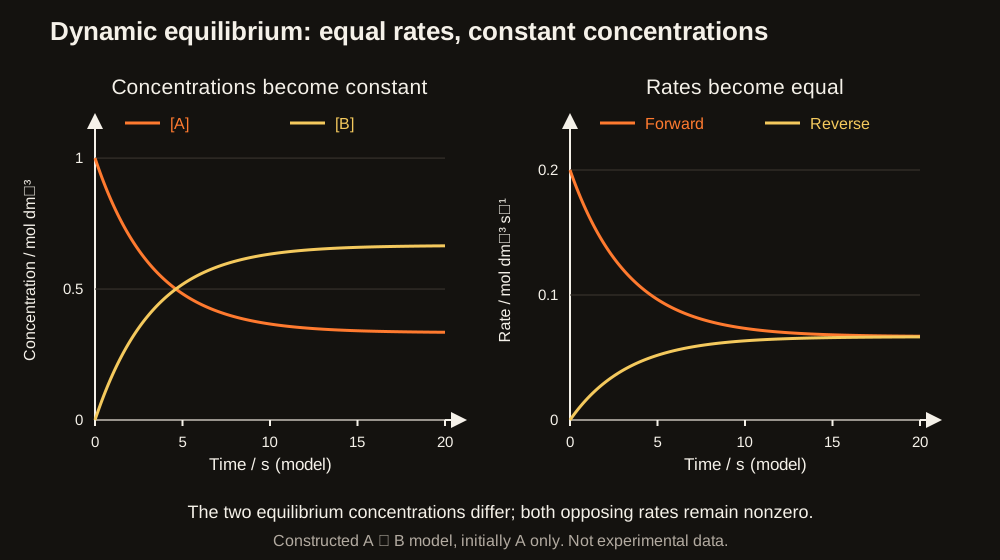
Swipe horizontally to view the whole diagram.
Changing concentration disturbs the balance
Le Chatelier's principle predicts that an equilibrium mixture responds to a disturbance in a direction that tends to oppose it. For A + B ⇌ C, adding A at fixed temperature and volume makes the forward process temporarily dominate. Some A and B are converted into C until equal rates are restored at a new composition. The system only partly counteracts the addition; it need not remove all the extra A or return to the original concentrations.
Removing a product also favours net forward reaction, replacing some of that product. Removing a reactant favours the reverse direction. Name the changed species and the direction that consumes or replaces it, then state the effect on the requested product. 'Moves to oppose' alone does not specify the chemistry.
Adding a solution can also change total volume and dilute other species, so use the question's conditions. In a simple sketch where A is suddenly added at fixed volume, [A] jumps immediately; concentrations of other species change over time as reaction occurs. A reaction-driven shift is not an instantaneous jump of every concentration.
Count gas coefficients for a volume change
Compressing a gas equilibrium at constant temperature increases reacting gas concentrations. The new equilibrium composition favours the side with fewer moles of gas, partly reducing the imposed pressure increase. Count coefficients of gaseous species only. For N₂(g) + 3H₂(g) ⇌ 2NH₃(g), four gas moles become two, so compression favours ammonia; expansion favours reactants.
For H₂(g) + I₂(g) ⇌ 2HI(g), there are two gaseous moles on each side. Compression changes all concentrations but does not favour either composition in the ideal-gas model. A reaction with equal gas coefficients can still run faster under compression: rate and equilibrium position answer different questions.
An inert gas added at constant volume raises total pressure without changing the reacting gases' concentrations, so it does not shift their equilibrium in this model. If pressure is held constant instead, adding inert gas expands the mixture; that is a different disturbance. These conditions explain why 'higher total pressure always favours fewer moles' is too broad.
Identify which direction is endothermic
Raising temperature favours the endothermic direction, which absorbs energy; lowering it favours the exothermic direction. For an exothermic forward reaction, heating shifts composition towards reactants. For an endothermic forward reaction, heating shifts it towards products. State the sign of ΔH for the equation as written before naming a direction.
For N₂(g) + 3H₂(g) ⇌ 2NH₃(g), ΔH is negative in the forward direction. Heating favours the endothermic reverse reaction and lowers equilibrium ammonia yield. Nevertheless, both reactions usually become faster when heated, so equilibrium is reached more rapidly. A lower yield at equilibrium does not imply a slower initial production rate.
Temperature changes the equilibrium constant; changing concentration or compressing at fixed temperature changes equilibrium composition while leaving the constant for that temperature unchanged. Topic 11 develops this quantitatively. A catalyst provides a quicker route to the same equilibrium at the same temperature and does not favour one equilibrium side.
Use colour changes as evidence with suitable controls
A simplified iron(III)–thiocyanate equilibrium is Fe³⁺(aq) + SCN⁻(aq) ⇌ [FeSCN]²⁺(aq), where the complex is red. Adding either reactant usually deepens the red colour as more complex forms. Compare small portions against an unchanged control using the same optical path. Simply diluting a coloured solution makes it paler even without a chemical shift, so colour intensity alone must be interpreted with the dilution change in mind.
For the commonly demonstrated cobalt equilibrium, pink [Co(H₂O)₆]²⁺ reacts with chloride to form blue [CoCl₄]²⁻. Forward formation of the blue complex is endothermic in the usual demonstration: warming shifts towards blue, cooling towards pink; adding chloride also favours blue. This illustrates two different disturbances affecting the same equilibrium, not one universal rule connecting blue colour to temperature.
Use teacher-approved small-scale or demonstration methods, eye protection and the appropriate hazard controls for the supplied solutions. Cobalt salts and concentrated chloride-acid reagents need particular care and correct waste collection. A water bath allows controlled heating/cooling without exposing test tubes directly to a flame. These are suggested investigations, not a new numbered core practical.
A complete prediction names the disturbance and response
State whether a question asks for equilibrium composition, rate, or the amount ultimately collected after separation. These are connected quantities, but one cannot replace another in the explanation.
| Disturbance | Reason | Equilibrium methanol yield |
|---|---|---|
| Add H₂, fixed T and volume | Net forward reaction consumes some added reactant | Increases |
| Compress at fixed T | Three gas moles on left, one on right | Increases |
| Increase temperature | Endothermic reverse direction favoured | Decreases |
| Add catalyst, fixed T | Forward/reverse approaches accelerated; same equilibrium | Unchanged |
| Remove methanol | Net forward reaction replaces some removed product | Further methanol can be produced |
Quick checks
Original Finesse questions. Reveal the indicative worked solutions after attempting each question; these are not official Edexcel mark allocations.
Q1. At equilibrium, must reactant and product concentrations be equal? Explain.Show answer
No. Their concentrations are constant, while forward and reverse rates are equal. Different constant concentrations can produce equal opposing rates. Reactions continue in both directions.
Q2. For exothermic 2SO₂(g) + O₂(g) ⇌ 2SO₃(g), predict separate effects of heating and compression on equilibrium SO₃ yield.Show answer
Heating favours the endothermic reverse direction, decreasing SO₃ yield. Compression at constant temperature favours the side with fewer gas moles: two on the right versus three on the left, increasing SO₃ yield.
Q3. For H₂(g) + I₂(g) ⇌ 2HI(g), explain why compression can affect rate without shifting equilibrium composition.Show answer
Gas concentrations rise, increasing collision frequencies. There are equal total gas coefficients on both sides, so compression does not favour either equilibrium composition in the ideal-gas model.
Q4. A red iron–thiocyanate solution becomes paler when water is added. Why is colour alone not enough to quantify the equilibrium shift?Show answer
Dilution directly lowers the coloured species concentration, even before any shift. A shift may also occur. Controlled volumes, path lengths and suitable reference measurements are needed to separate these effects.
Q5. A catalyst is added to an equilibrium mixture at constant temperature. What happens to equilibrium concentrations?Show answer
They remain unchanged. The catalyst changes the pathways and speeds the opposing reactions while preserving the same equilibrium composition; it does not selectively increase the equilibrium product yield.
Sources
Sources and examiner guidance (reviewed 9 October 2026)
- Pearson Edexcel 9CH0 specification, Issue 3 — Topic 10, printed p. 25; AS scope verified against 8CH0 p. 23. Reviewed 9 October 2026.
- Chemrevise — Equilibrium I — Pages 1–3: dynamic equilibrium, qualitative shifts, industrial reasoning and expressions. Kc calculation is developed in Year 13 Topic 11.
Finesse Tuition is not endorsed by AQA or Chemrevise. All explanations and examples here are our own.