
Read a whole titration curve, choose an indicator from its range and determine Ka through a deliberately prepared half-neutralised mixture.
Build a curve from measurements
Pipette a known acid aliquot into a suitable vessel and record its initial pH with a calibrated probe. Add a known base from a burette, mix and allow each pH reading to settle. Record cumulative volume and pH. Use smaller additions near the steep change, then continue beyond equivalence so that the final region is measured.
Calibrate with appropriate known buffers covering the useful pH range, rinse the probe with deionised water between solutions and blot carefully. Keep temperature stable because both electrode response and equilibrium constants depend on it. A magnetic stirrer can improve mixing; keep its bar from striking the electrode.
The equivalence point is the stoichiometric completion of neutralisation. The indicator end point is the observed colour change. A good method makes them close but they are not definitions of the same event. A curve plotted with acid added to base falls instead of rises; always read the axis label.
Explain all four monobasic acid–base combinations
Strong acid with strong base begins at low pH and ends at high pH, with a large steep region. At equivalence, the ions from the acid and base do not appreciably hydrolyse, so the solution is neutral, pH 7 at 25 °C.
Weak acid with strong base starts at a higher pH than an equimolar strong acid. Partial neutralisation creates both HA and A⁻, forming a buffer region before equivalence. At equivalence the solution contains A⁻, which accepts H⁺ from water and produces OH⁻, so pH is above 7 at 25 °C.
Strong acid with weak base starts at low pH and approaches a lower final pH than an equimolar strong base would give. At equivalence, the conjugate acid BH⁺ donates protons to water, so pH is below 7. Beyond equivalence there may be a BH⁺/B buffer region.
Weak acid with weak base usually has no sufficiently sharp pH change for a simple visual indicator. The equivalence pH depends on the relative strengths of the weak acid and weak base and is not always 7. The illustration uses approximately matched strengths to show a near-neutral equivalence; that is an example, not a general rule.
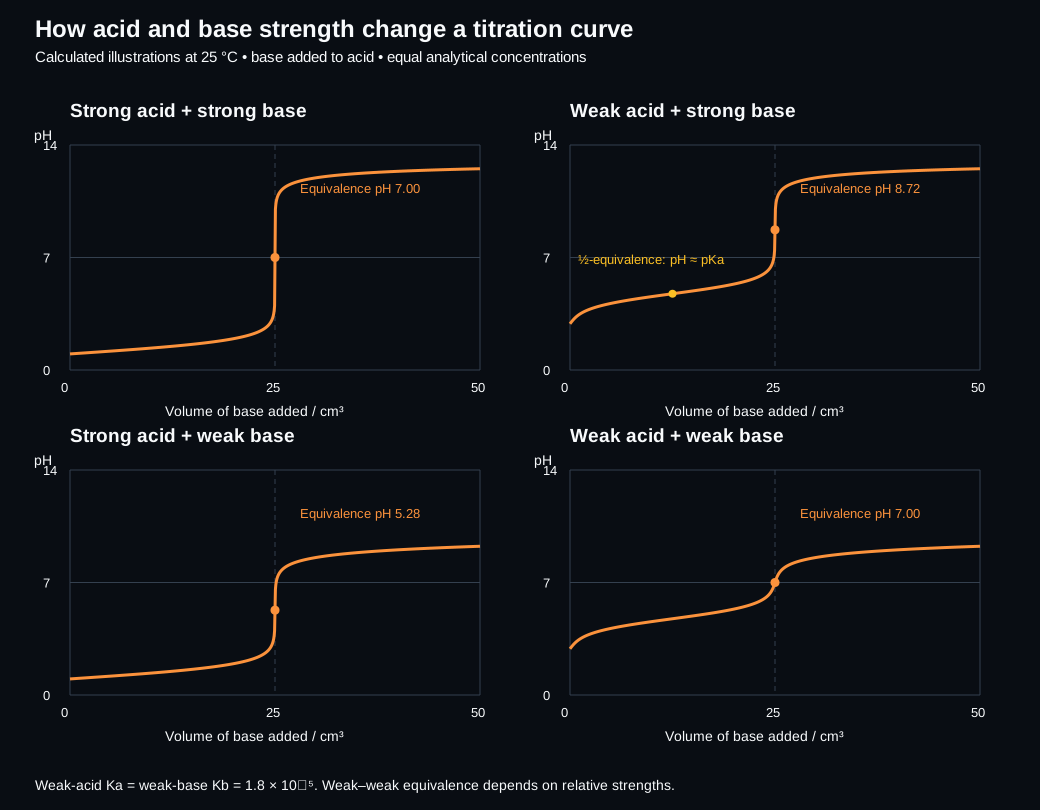
Swipe horizontally to view the whole diagram.
Locate equivalence and half-equivalence
For 25.0 cm³ of 0.0800 mol dm⁻³ monobasic acid titrated with 0.100 mol dm⁻³ NaOH, initial acid amount is 0.0250 × 0.0800 = 0.00200 mol. Equivalence requires 0.00200 mol OH⁻, so V = 0.00200/0.100 = 0.0200 dm³ = 20.0 cm³. Half-equivalence is at 10.0 cm³.
In the weak acid–strong base case, at half-equivalence half the original HA remains and the other half is A⁻. Since both occupy the same solution volume, [HA] ≈ [A⁻]. Substitution into Ka gives Ka ≈ [H⁺], so pH ≈ pKa. Equal buffer components are not equal to the much smaller [H⁺].
After equivalence, calculate excess hydroxide and divide by total mixed volume. For the same acid aliquot after 25.0 cm³ NaOH, excess OH⁻ = 0.00250 − 0.00200 = 0.000500 mol in 0.0500 dm³. [OH⁻] = 0.0100 mol dm⁻³; pH = 12.00 at 25 °C. The acid’s original strength no longer controls this excess-alkali calculation.
Choose using the transition range
Many indicators are weak acids whose HIn and In⁻ forms have different colours: HIn ⇌ H⁺ + In⁻. Increasing [H⁺] favours HIn; adding alkali removes H⁺ and favours In⁻. An indicator changes over a range rather than at one exact pH.
Select a transition range lying within the steep region of the particular curve. Then a tiny volume change spans the colour transition and the end point is close to equivalence. The indicator need not have its mid-range exactly at the equivalence pH. Use the supplied ranges and the actual curve, especially for unusual concentrations.
For typical laboratory concentrations, phenolphthalein is suitable for weak acid–strong base and methyl orange for strong acid–weak base. Both often work for strong acid–strong base. Neither generally gives a reliable end point for weak acid–weak base. Do not choose an indicator solely because its range happens to contain pH 7.
| Indicator | Approximate transition range | Acidic → alkaline colour |
|---|---|---|
| Methyl orange | pH 3.1–4.4 | Red → yellow |
| Phenolphthalein | pH 8.2–10.0 | Colourless → pink |
Core Practical 9: deliberately make equal buffer components
Pearson’s CP9 method first neutralises a measured aliquot of weak acid with sodium hydroxide using a suitable end point, then adds a second equal aliquot of the original acid to the same flask. The first aliquot has become conjugate base; the fresh aliquot supplies the same amount of HA. Mixing therefore gives approximately equal amounts of HA and A⁻, and a measured pH gives pKa.
Use a volumetric pipette and filler for each acid aliquot. Rinse the pipette with the acid and the burette with the alkali; remove any air bubble in the burette tip. Add only a few drops of phenolphthalein, place a white tile beneath the flask and approach the first persistent pale pink slowly while swirling. A deep pink colour indicates overshooting.
After adding the equal fresh acid aliquot, mix thoroughly and measure pH using the calibrated probe. An original reading of pH 4.82 gives Ka = 10⁻⁴·⁸² = 1.51 × 10⁻⁵ mol dm⁻³. Independently repeating the preparation tests reproducibility; reporting more decimal places than the electrode supports does not improve accuracy.
Alternatively, determine the equivalence volume from a full weak acid–strong base pH curve and read the pH at half that volume. This requires enough points to locate equivalence reliably and careful interpolation. The region is relatively flat, so a small volume error near half-equivalence usually changes pH less than a similar error close to equivalence.
If the first aliquot is overshot with alkali, some added fresh acid is also neutralised: the final A⁻/HA ratio is greater than one, pH is too high and Ka calculated as 10⁻ᵖᴴ is too low. An electrode calibration bias will persist through repeat preparations. Better end-point control and fresh calibration address different errors.
Wear eye protection and a lab coat, use a pipette filler, and handle alkali to avoid eye or skin contact. These notes teach interpretation and evaluation; observed competence for 9CH0/04 still requires supervised practical work and an authentic record.
Quick checks
Original Finesse questions. Reveal the indicative worked solutions after attempting each question; these are not official Edexcel mark allocations.
Q1. Why is the equivalence point of ethanoic acid with NaOH above pH 7 at 25 °C?Show answer
At equivalence, ethanoate remains. CH₃COO⁻ + H₂O ⇌ CH₃COOH + OH⁻ makes the solution alkaline. This is not caused by excess NaOH at the stoichiometric equivalence point.
Q2. 20.0 cm³ of 0.150 mol dm⁻³ monobasic acid is titrated with 0.100 mol dm⁻³ NaOH. Find equivalence and half-equivalence volumes.Show answer
n(acid) = 0.0200 × 0.150 = 0.00300 mol. V at equivalence = 0.00300/0.100 = 0.0300 dm³ = 30.0 cm³. Half-equivalence is 15.0 cm³.
Q3. A weak-acid titration has pH 4.60 at half-equivalence. Determine Ka.Show answer
pKa ≈ 4.60 because [HA] ≈ [A⁻]. Ka = 10⁻⁴·⁶⁰ = 2.51 × 10⁻⁵ mol dm⁻³.
Q4. A curve rises steeply from pH 7.7 to 10.5. Choose methyl orange or phenolphthalein and explain.Show answer
Phenolphthalein changes over roughly 8.2–10.0, within the steep region, so a small added volume completes its colour transition. Methyl orange changes too early.
Q5. Why does adding an equal fresh acid aliquot after neutralising the first one make CP9 useful?Show answer
The neutralised first aliquot supplies A⁻ and the second supplies the same amount of HA. The common volume cancels in their concentration ratio. Ka = [H⁺][A⁻]/[HA] therefore reduces to Ka ≈ [H⁺]. It does not imply [H⁺] equals [HA].
Sources
Sources and examiner guidance (reviewed 9 October 2026)
- Pearson Edexcel 9CH0 specification — Issue 3, February 2024 — Topic 12; the scope authority. Reviewed 9 October 2026.
- Chemrevise — Edexcel Topic 12 — Pages 3 and 7–8; explanatory and coverage cross-check. Teaching, examples and practice here are original Finesse material.
- Pearson Core Practical 9 — determine Ka for a weak acid — Teacher/student/technician sheets reviewed. Neutralise one acid aliquot, add an equal fresh aliquot and measure pH; the correct relation is [HA] ≈ [A⁻], hence Ka ≈ [H⁺].
Finesse Tuition is not endorsed by AQA or Chemrevise. All explanations and examples here are our own.