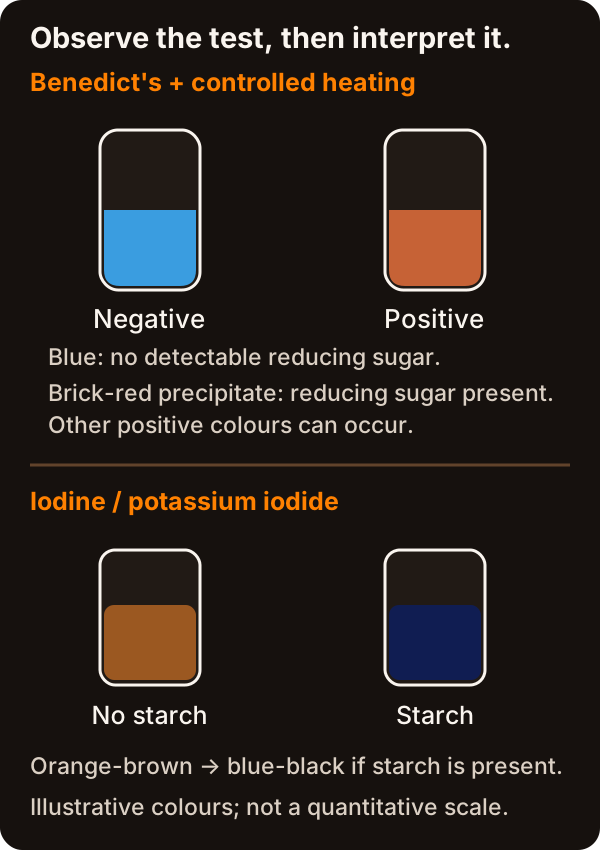
1. Benedict's test identifies reducing sugars
Specification: 3.1.2 · Reducing-sugar tests
Use Benedict's reagent and warm the mixture in a hot water bath according to the risk-assessed procedure. Reducing sugars can reduce copper(II) ions to copper(I) oxide, which forms an insoluble coloured precipitate.
A negative result remains blue. Depending on the conditions and reducing-sugar amount, positive mixtures may produce green, yellow, orange or brick-red precipitate. Colour comparisons alone are only approximate and must be interpreted using consistent experimental conditions.
A colour change is not a definitive glucose identification: other reducing sugars can also react. Use a suitable control and compare the sample with standards where quantification is intended.