
Work from composition to molecular formula, then use IR and both NMR spectra to choose and test a complete structure.
Use each technique for the question it answers
Elemental analysis gives relative atom amounts and an empirical formula. A reliable molecular mass converts that to a molecular formula. IR identifies characteristic bond vibrations and supports functional-group assignments. Carbon-13 NMR constrains carbon environments and symmetry; proton NMR constrains hydrogen environments and neighbouring groups.
Start with the formula before proposing elaborate structures. Account for every atom and any unsaturation implied by the formula. Use distinctive IR and NMR features to build fragments, then connect those fragments in a way that explains all the evidence simultaneously.
A molecular-ion assignment from mass spectrometry must be appropriate to the supplied spectrum; the highest displayed m/z is not automatically the molecular ion in every context. Use labelled or justified Mr information. Fragment peaks can support substructures but should not override an incompatible formula.
Worked example, stage 1: empirical and molecular formula
An original teaching dataset gives 54.55% C, 9.09% H and 36.36% O by mass. For 100 g, divide by Ar: C = 54.55/12 = 4.546 mol, H = 9.09/1 = 9.09 mol and O = 36.36/16 = 2.273 mol. Divide by the smallest to obtain C:H:O = 2:4:1.
The empirical formula is C₂H₄O, with empirical formula mass 44.0. A stated molecular mass of 88.0 gives a factor of 88.0/44.0 = 2, so the molecular formula is C₄H₈O₂. Do not stop at the empirical formula if the molecular mass is available.
Compared with a saturated acyclic four-carbon formula, the molecule has one degree of unsaturation. In this dataset the subsequent carbonyl evidence accounts for it. The formula alone does not distinguish an ester from a carboxylic acid or other possible arrangements.
Worked example, stage 2: assemble the evidence
The illustrative IR spectrum has a strong C=O absorption near 1740 cm⁻¹ and no broad OH absorption. The carbon-13 spectrum has four signals at approximately 14, 21, 60 and 171 ppm. These observations support an ester with four distinct carbon environments. All values here are constructed teaching data within plausible regions, not a claimed measurement.
The proton data below contains an ethyl pattern and a separate methyl singlet. The quartet at 4.12 ppm suggests CH₂ attached to O, while the 2.05 ppm methyl singlet is consistent with CH₃ next to C=O and no adjacent proton set across that carbonyl carbon.
An IR assignment should identify both the bond and the proposed functional group, using the data-sheet range. “There is oxygen” is too vague; “C=O consistent with an ester, supported by the other data” states what the observation contributes.
| δ / ppm | Relative integral | Splitting | Initial interpretation |
|---|---|---|---|
| 1.25 | 3 | Triplet | CH₃ next to CH₂ |
| 2.05 | 3 | Singlet | CH₃ with no relevant neighbouring H set; near C=O |
| 4.12 | 2 | Quartet | O–CH₂ next to CH₃ |
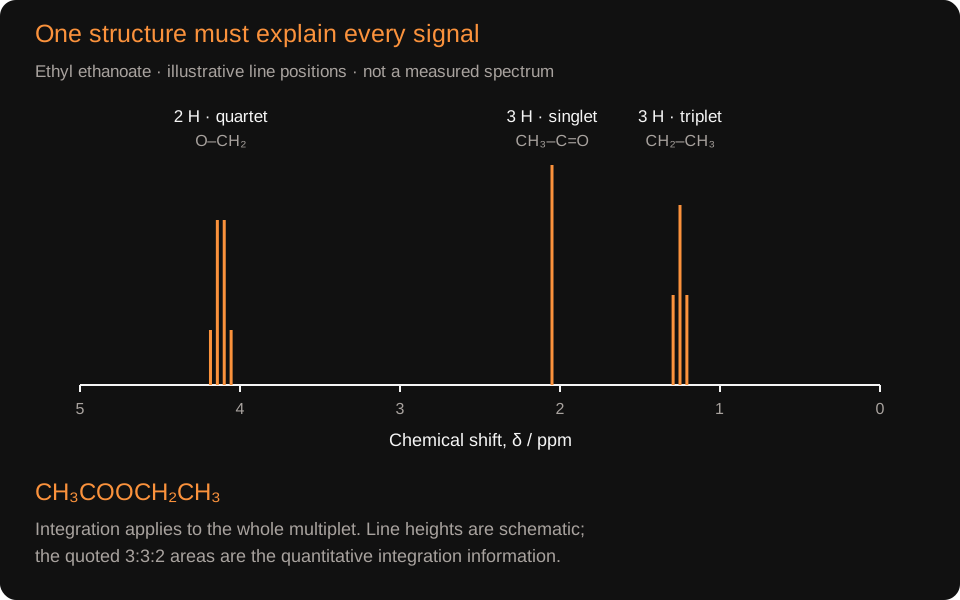
Swipe horizontally to view the whole diagram.
Worked example, stage 3: test the complete proposal
The connected structure is ethyl ethanoate, CH₃COOCH₂CH₃. It has C₄H₈O₂, one ester carbonyl, four carbon environments and three proton environments with integrals 3:3:2. The ethoxy CH₂/CH₃ pair accounts for quartet/triplet splitting and the acyl methyl gives the singlet.
Test the alternative methyl propanoate, CH₃CH₂COOCH₃. It has the same molecular formula and an ester group, but its OCH₃ would give a three-proton singlet downfield and its CH₂ next to C=O would be less downfield than an OCH₂. That is inconsistent with the stated two-proton quartet at 4.12 ppm.
Do not finish after recognising “an ester”. The full structure, including which side of the oxygen each carbon fragment occupies, must match the integration, splitting and shifts together. A sensible final check is to predict the spectrum back from your proposed structure.
Write an argument that links evidence to decisions
Present calculations in a traceable order, then state what each analytical observation supports. Use a short assignment table if helpful: signal, environment and reason. Connect fragments only after checking their formula contribution.
If two candidates still fit, say what further evidence would distinguish them rather than inventing a missing peak. If one fails, identify the contradiction explicitly, such as an extra expected carbon environment or a methyl singlet where a quartet is observed.
For level-of-response questions, a coherent structure determination requires connected reasoning, not a disconnected list of facts. The exact level descriptors belong to the particular mark scheme; a general “one sentence per mark” rule does not substitute for them.
Quick checks
Original Finesse questions. Reveal the indicative worked solutions after attempting each question; these are not official OCR A mark allocations.
Q1. A compound has empirical formula CH₂O and Mr 120. Find its molecular formula.Show answer
Empirical formula mass = 12 + 2 + 16 = 30. Factor = 120/30 = 4, so the molecular formula is C₄H₈O₄.
Q2. Why do C₄H₈O₂ and an ester IR band not uniquely identify ethyl ethanoate?Show answer
Several structural isomers share the formula and ester group. NMR environment counts, integrations, splitting and shifts are needed to establish which fragments lie on each side of the ester link.
Q3. Which feature in the worked dataset distinguishes an ethoxy group from a methoxy group?Show answer
A two-proton quartet at 4.12 ppm with a three-proton triplet partner supports OCH₂CH₃. A methoxy group would instead give an OCH₃ singlet integrating to three protons.
Q4. A proposed structure fits the formula but predicts five carbon environments when four are observed. What should you do?Show answer
Recheck symmetry, assignments and the proposal. Unless the supplied data justifies an overlap or missing signal, the mismatch is evidence against that structure; do not ignore it.
Q5. Explain why a final structure should be used to predict the data back again.Show answer
Back-prediction checks every atom, environment, integral, splitting pattern and functional group together. It can reveal a connectivity error that individual plausible fragments would not expose.
Sources
Sources and examiner guidance (reviewed 6 October 2026)
- OCR A H432 specification — version 3.1 — 6.3.2, printed pp. 62–63; outcomes and additional guidance, with relevant Module 1 practical skills.
- Chemrevise — OCR A 6.3.2 — Pages 1–8; secondary coverage cross-check. Lesson explanations, data and questions are original Finesse material.
- OCR H432/02 mark scheme — June 2025 — Q23(a–b); printed pp. 36–38. Question-specific evidence, not universal marking rules.
- OCR H432/02 examiner report — June 2025 — Q23(a–b); printed pp. 54–58. Read with the corresponding question context.
- OCR H432/02 question paper — June 2025 — Q23(a–b); context for the assessment references, not reproduced questions.
- OCR H032/H432 data sheet — Use the supplied IR and NMR ranges for assignments; illustrative shifts in these lessons are not reference measurements.
Finesse Tuition is not endorsed by AQA or Chemrevise. All explanations and examples here are our own.