
Build configurations through krypton and distinguish an orbital from a shell or a fixed electron orbit.
Shells contain sub-shells; sub-shells contain orbitals
An orbital is a region that can hold up to two electrons with opposite spins. It is not a circular path. Main shells n = 1, 2, 3 and 4 have maximum capacities 2, 8, 18 and 32. Their capacities do not imply each shell fills completely before the next begins.
An s sub-shell has one spherical orbital, p has three orbitals with dumbbell shapes in perpendicular orientations, and d has five orbitals. Capacities are 2, 6 and 10 electrons respectively; an f sub-shell has seven orbitals and capacity 14.
| Shell | Sub-shells | Maximum electrons |
|---|---|---|
| 1 | 1s | 2 |
| 2 | 2s, 2p | 8 |
| 3 | 3s, 3p, 3d | 18 |
| 4 | 4s, 4p, 4d, 4f | 32 |
Decode every part of an electron configuration
In 3p⁴, the 3 is the principal shell, p identifies the sub-shell, and 4 counts electrons across that whole sub-shell. It does not mean four p orbitals. A p sub-shell always contains three orbitals, each capable of holding two electrons. Shell, sub-shell, orbital and electron are different levels of description.
An orbital describes a spatial distribution for an electron, not a circular track travelled by a particle. An s orbital is spherical about the nucleus; each p orbital has two lobes. The two lobes are parts of the same orbital, not two orbitals or one electron in each. The three p orbitals differ in orientation.
| Notation | Meaning | Capacity check |
|---|---|---|
| 2s² | Two electrons in the shell-2 s sub-shell | One orbital × two electrons |
| 2p⁵ | Five electrons shared among three 2p orbitals | Maximum six |
| 3d¹⁰ | Ten electrons shared among five 3d orbitals | Maximum ten |
| [Ne]3s² | Ne core of ten electrons plus two | Twelve electrons altogether |
Fill lower energies first
For the atoms in this AS scope, use 1s → 2s → 2p → 3s → 3p → 4s → 3d → 4p, allowing up to two electrons per orbital. Orbitals of equal energy fill singly with parallel spins before pairing. Chromium and copper exceptions are outside the specified AS assessment of configurations.
Oxygen is 1s² 2s² 2p⁴. Its three 2p orbital boxes contain ↑↓, ↑, ↑, not two paired boxes and one empty box. Calcium is [Ar]4s²; bromine is [Ar]3d¹⁰4s²4p⁵; krypton ends 4p⁶. Count superscripts to verify Z.
In a box diagram, one box represents one orbital, not one entire p sub-shell. A double-headed arrow is not an electron; use separate up/down arrows to represent opposite spins.
Diagram placeholder
s and p orbitals; oxygen box diagram
Labels to include:
- Nucleus at centre of spherical s orbital
- Three p orbitals: px, py, pz, two lobes each
- 1s and 2s: ↑↓ in each box
- 2p: three boxes with ↑↓, ↑, ↑
The p orbitals have different orientations but the same energy in an isolated atom. The final paired electron in oxygen shares one p orbital; the other two p electrons remain unpaired.
Build configurations from an electron budget
For phosphorus, Z = 15, begin with 15 electrons. Fill 1s² (13 remain), 2s² (11 remain), 2p⁶ (5 remain), 3s² (3 remain), then 3p³. The completed configuration is 1s²2s²2p⁶3s²3p³. Adding the superscripts gives 15, which checks the bookkeeping.
For an atom with Z = 26, fill through [Ar] (18 electrons), then 4s² (20), then 3d⁶ (26). It is [Ar]3d⁶4s². Writing 3d before 4s in the final notation does not change which was filled first in this construction. Do not insist that the third shell must reach eighteen electrons before the fourth begins.
The sequence is a useful ground-state filling rule for the specified atoms, not a claim that orbital energy ordering can never change. Chromium and copper exceptions and transition-metal ion configurations are outside the configurations required in this OCR AS outcome; s- and p-block ions still need careful charge adjustment.
Use boxes to distinguish pairing from filling
Place one electron in each of the three equal-energy p orbitals before pairing. Nitrogen’s 2p³ therefore gives three unpaired electrons. Oxygen’s 2p⁴ gives one pair and two unpaired electrons. Fluorine’s 2p⁵ gives two pairs and one unpaired electron; neon’s 2p⁶ gives three pairs.
Use opposite spin arrows within each pair. Two parallel arrows in a single orbital violate the two-electron spin rule; putting two pairs into oxygen while leaving a p orbital empty fails the ground-state single-filling rule. Draw three boxes even if some are empty so the intended arrangement is unambiguous.
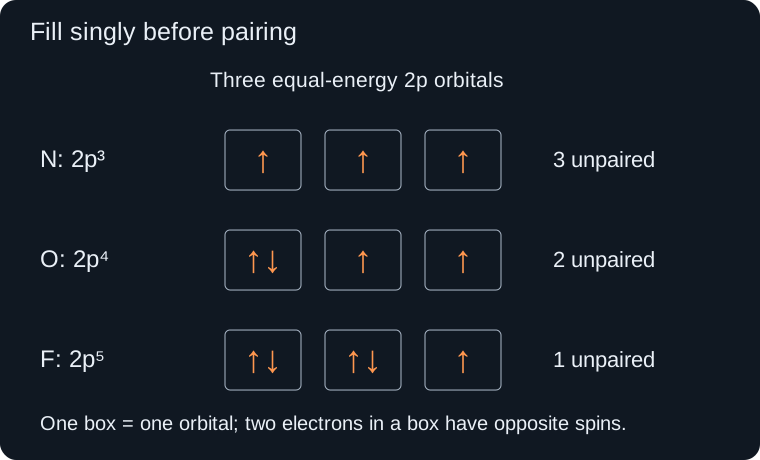
Swipe horizontally to view the whole diagram.
Adjust electron count for ion charge
For the s- and p-block ions in this scope, remove the outermost electrons to form cations and add electrons to form anions. Na is 1s²2s²2p⁶3s¹, so Na⁺ is 1s²2s²2p⁶. O²⁻ also has 1s²2s²2p⁶. Equal configurations do not mean equal nuclei or equal chemical identity.
Worked example: S²⁻ contains 16 + 2 = 18 electrons, so 1s²2s²2p⁶3s²3p⁶. The noble-gas shorthand [Ar] is useful, but write the full configuration when asked. The periodic table’s s, p and d blocks correspond to the sub-shell being filled; this helps check the final term.
Connect the configuration to period, group and block
For chlorine, [Ne]3s²3p⁵, the highest occupied principal shell is 3, so it is in Period 3. Its seven outer-shell electrons place it in Group 17; the sub-shell being filled is p, so it is a p-block element. “Seven electrons” alone is insufficient: the inner shells already contain ten more.
Elements in a main-group column repeat the same outer pattern with a different shell number: fluorine ends 2s²2p⁵ and chlorine ends 3s²3p⁵. Across Period 2, 2s fills and then 2p; across Period 3 the corresponding pattern is 3s then 3p. This repeated arrangement explains recurring chemical behaviour.
When asked for total p electrons, count every occupied p sub-shell. Chlorine has 2p⁶ plus 3p⁵, giving eleven p electrons, not five. Bromine has 2p⁶ + 3p⁶ + 4p⁵ = seventeen. Neither count includes s or d electrons.
Quick checks
Original Finesse questions. Reveal the indicative worked solutions after attempting each question; these are not official OCR A mark allocations.
Q1. Multiple choice: how many orbitals are in one p sub-shell? A: 1; B: 2; C: 3; D: 6.Show answer
C: three orbitals. Six is the maximum number of electrons, not the orbital count; each orbital holds up to two electrons.
Q2. Give the configuration of Mg²⁺.Show answer
Mg has Z = 12; Mg²⁺ has ten electrons: 1s²2s²2p⁶.
Q3. Why is calcium not [Ar]3d²?Show answer
The 4s sub-shell fills before 3d for calcium, so its ground-state configuration is [Ar]4s².
Q4. How many unpaired electrons are in nitrogen, 1s²2s²2p³?Show answer
Three: each p orbital is singly occupied before pairing.
Q5. Give the configuration of Cl⁻.Show answer
18 electrons: 1s²2s²2p⁶3s²3p⁶.
Q6. Application: write the full configuration of P³⁻, Z = 15, and say how many occupied p orbitals it contains.Show answer
It contains 18 electrons: 1s²2s²2p⁶3s²3p⁶. There are three occupied 2p orbitals and three occupied 3p orbitals, giving six occupied p orbitals and twelve p electrons.
Q7. Multiple choice: which describes ground-state oxygen 2p⁴? A two pairs and one empty orbital; B one pair and two singles; C four singly occupied p orbitals; D two parallel-spin electrons in each of two orbitals.Show answer
B. Three p orbitals fill singly before pairing and paired spins oppose. A pairs prematurely; C invents a fourth p orbital; D puts same-spin electrons into the same orbital.
Q8. An atom ends [Ne]3s²3p². Identify its electron count, period, group and block.Show answer
10 + 2 + 2 = 14 electrons, so it is silicon. Highest shell 3 gives Period 3; four outer electrons give Group 14; filling p gives p block.
Q9. Explain why Na⁺ and Ne have the same configuration but are not the same element.Show answer
Each has ten electrons and configuration 1s²2s²2p⁶. Na⁺ has eleven protons while Ne has ten; proton number determines element identity. Sodium has lost an electron, not a proton.
Sources
Sources and examiner guidance (reviewed 5 October 2026)
- OCR A H032 specification, version 2.0 — 2.2.1(a–d); AS outcomes and additional guidance. Reviewed 3 October 2026.
- Chemrevise — OCR A 2.2.1 Electronic Structure — Pages 1; coverage reference. Explanations and questions on this page are original.
- OCR H032/01 mark scheme — June 2025 — Q2; printed pages 8. Read with the question paper.
- OCR H032/01 examiner report — June 2025 — Q2; printed pages 7. Question-specific assessment guidance.
- OCR H032/01 question paper — June 2025 — Question context for the question numbers listed with the mark scheme and examiner report.
- OCR H032/02 June 2024 mark scheme — Q2(a)(i–ii); printed pp. 12. Reviewed 5 October 2026.
- OCR H032/02 June 2024 examiner report — Q2(a)(i–ii); printed pp. 12–13. Reviewed 5 October 2026.
- OCR H032/02 June 2024 question paper — Q2(a)(i–ii); corresponding question context. Reviewed 5 October 2026.
Finesse Tuition is not endorsed by AQA or Chemrevise. All explanations and examples here are our own.