
Separate the speed of reaching equilibrium from the composition at equilibrium, and predict responses to changing conditions.
Equal rates, constant concentrations
A dynamic equilibrium is established in a closed system when forward and reverse reactions continue at equal rates. Concentrations remain constant, but the concentrations of reactants and products need not be equal. “Dynamic” means reactions have not stopped. A homogeneous equilibrium has all reacting species in the same phase.
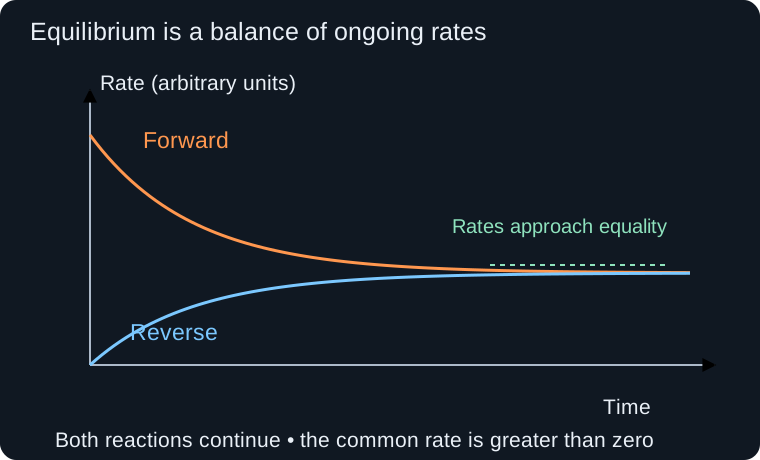
On a rate–time graph starting with reactants, the forward rate often falls and reverse rate rises until they meet. On a concentration–time graph, concentrations level off at possibly different heights. Do not confuse equality of rates with equality of concentrations.
Explain how the equal rates are reached
Imagine a closed vessel initially containing reactants only. At first there are no products to undergo the reverse reaction. Forward reaction creates products while using reactants; typically the forward rate decreases and the reverse rate increases. Eventually the two rates match. Individual particles keep reacting in both directions, but there is no net change in the amounts.
A concentration graph levels off at equilibrium. It does not require the reactant and product curves to meet. A rate graph instead shows the forward and reverse curves meeting at the same non-zero value. A graph where both rates become zero describes a stopped reaction, not the usual dynamic-equilibrium model.
The system must retain the reacting substances for this equilibrium model. Opening a vessel so that a gaseous product escapes can prevent the original equilibrium from being maintained. “Closed” does not mean temperature cannot be controlled by exchanging energy with the surroundings.
Swipe horizontally to view the whole diagram.
Apply Le Chatelier to the stated change
When conditions change, an equilibrium responds in the direction that opposes the imposed change. Increasing a reactant concentration favours its consumption; removing a product favours its replacement. This is a partial response, not a claim that the original concentrations are fully restored.
Increasing pressure by decreasing volume favours the side with fewer gas molecules; count gaseous coefficients only. If gaseous mole totals are equal, this pressure change does not shift position. A temperature increase favours the endothermic direction; a decrease favours the exothermic direction.
A catalyst accelerates both directions and allows equilibrium to be reached sooner without changing its position at fixed temperature. H032/01 June 2025 Q13 and Q23(a) assess this distinction and the meaning of dynamic equilibrium.
| Change | Response | Reason |
|---|---|---|
| Increase pressure by compression | More equilibrium NH₃ | Right side has fewer gas moles: 2 rather than 4 |
| Increase temperature | Less equilibrium NH₃ | Reverse direction is endothermic |
| Remove NH₃ | Net forward reaction | Replaces some removed product |
| Add catalyst | No composition change | Changes rates, not equilibrium constant |
Count gas particles and state how pressure was changed
For 2SO₂(g) + O₂(g) ⇌ 2SO₃(g), decreasing volume compresses the mixture. Both sides contain gases, but three stoichiometric moles on the left correspond to two on the right. The equilibrium shifts towards SO₃, reducing some of the imposed pressure increase. Say which side is favoured, not only “the side with fewer moles”.
For H₂(g) + I₂(g) ⇌ 2HI(g), each side contains two gas moles, so compression does not change equilibrium composition in the ideal model. Pressure may still change rates because gas concentrations change. Equal gas totals mean no position shift, not “no effect of any kind”.
An inert gas added at fixed volume raises total pressure but leaves the reacting gases’ concentrations unchanged in the ideal model, so no composition shift is predicted. This is a useful application of the concentration argument, not a new AS partial-pressure calculation. State “compression” when that is the change you mean.
Use the sign of the forward enthalpy change
For N₂O₄(g) ⇌ 2NO₂(g), the forward direction is endothermic. Heating therefore favours NO₂; cooling favours N₂O₄. If the equation is written the other way round, the forward sign reverses, but the physical prediction remains the same. Do not memorise “heating shifts left”.
Pressure and temperature can oppose each other. Heating this equilibrium favours two gas moles of NO₂, while compression favours one mole of N₂O₄. If both are changed together, a qualitative rule does not determine which effect dominates without further information.
Observe a reversible response
In a supervised equilibrium demonstration, use equal samples and change one condition. For the exothermic association 2NO₂(g) ⇌ N₂O₄(g), heating a sealed prepared tube makes the equilibrium mixture browner (more NO₂), while cooling makes it paler. These toxic gases require sealed teacher-prepared apparatus and appropriate controls.
For concentration, I₂(aq) + 2OH⁻(aq) ⇌ I⁻(aq) + IO⁻(aq) + H₂O(l) becomes paler as added hydroxide favours colourless products; removing OH⁻ by adding acid can restore brown iodine. Use small amounts under the centre’s risk assessment. A control sample helps distinguish chemical shifts from dilution alone.
Distinguish the imposed change from the later response
Adding more of a coloured reactant immediately changes its concentration and can change colour before the equilibrium has responded. The subsequent net reaction partially opposes that addition. It does not generally remove every extra molecule and restore all original concentrations.
For temperature demonstrations, use equal initial samples, one reference and controlled hot/cold baths. Allow time to reach the new temperature and compare under the same lighting. For concentration changes, consider dilution as well as the reagent’s chemical role; a paler solution alone does not establish the direction of an equilibrium shift.
A strong observation statement names the change, such as “the brown colour becomes more intense”. A supported inference then links it to a named species and direction. “Equilibrium moves” is an inference, not a directly visible observation.
Quick checks
Original Finesse questions. Reveal the indicative worked solutions after attempting each question; these are not official OCR A mark allocations.
Q1. Are reactant and product concentrations equal at equilibrium?Show answer
Not necessarily. They are constant; forward and reverse rates are equal.
Q2. For 2SO₂(g) + O₂(g) ⇌ 2SO₃(g), what does compression favour?Show answer
SO₃, because the product side has two gas moles versus three on the reactant side.
Q3. If the forward reaction is endothermic, what does heating favour?Show answer
The forward reaction and products, because that direction absorbs heat.
Q4. Why does adding a catalyst not increase equilibrium yield?Show answer
It changes the rates of both directions and not the equilibrium composition at the same temperature.
Q5. Why use a reference tube in a colour equilibrium experiment?Show answer
It provides an unchanged comparison; concentration, dilution, lighting and temperature can otherwise confuse colour judgements.
Q6. Multiple choice: which observation is compatible with dynamic equilibrium? A both reactions have stopped; B concentrations are constant but unequal; C reactants are exhausted; D forward rate is permanently greater.Show answer
B. Equal forward and reverse rates preserve concentrations, which need not be equal. A describes no ongoing reaction; C is not the stated reversible balance; D would cause a continuing net change.
Q7. For N₂O₄ ⇌ 2NO₂ with an endothermic forward reaction, predict separate effects of heating and compression.Show answer
Heating favours the endothermic forward reaction, increasing NO₂. Compression favours the side with fewer gas moles, N₂O₄. The effects oppose; a combined change needs more information to predict the net outcome.
Q8. Explain why “higher pressure always gives more product” is incorrect.Show answer
Compression favours whichever side has fewer gas moles, which may be the reactants. Equal gas coefficients give no composition shift in the ideal model. A pressure increase from inert gas at fixed volume is not equivalent to compression.
Q9. A student compares a heated brown equilibrium tube with a reference but shines a brighter light through one. Evaluate the conclusion.Show answer
Different illumination confounds the apparent colour comparison. Use identical tubes, equal initial samples, comparable optical paths and lighting, with temperature as the deliberate change. Link the observed colour to the known coloured species.
Sources
Sources and examiner guidance (reviewed 5 October 2026)
- OCR A H032 specification, version 2.0 — 3.2.3(a–g); AS outcomes and additional guidance. Reviewed 3 October 2026.
- Chemrevise — OCR A 3.2.3 equilibrium — Pages 1–3; coverage reference. Explanations and questions on this page are original.
- OCR H032/01 mark scheme — June 2025 — Q13, Q23(a,c); printed pages 8, 16, 18. Read with the question paper.
- OCR H032/01 examiner report — June 2025 — Q13, Q23(a,c); printed pages 12, 27, 29. Question-specific assessment guidance.
- OCR H032/01 question paper — June 2025 — Question context for the question numbers listed with the mark scheme and examiner report.
- OCR H032/01 June 2024 mark scheme — Q23(a)(i–ii); printed pp. 15. Reviewed 5 October 2026.
- OCR H032/01 June 2024 examiner report — Q23(a)(i–ii); printed pp. 25–26. Reviewed 5 October 2026.
- OCR H032/01 June 2024 question paper — Q23(a)(i–ii); corresponding question context. Reviewed 5 October 2026.
Finesse Tuition is not endorsed by AQA or Chemrevise. All explanations and examples here are our own.