
Use electronegativity and three-dimensional shape to predict dipoles, then explain boiling and solubility with the correct forces.
Bond polarity and molecular polarity are different
Electronegativity measures an atom’s ability to attract the bonding electron pair in a covalent bond. On the Pauling scale it generally rises across a period and falls down a group; fluorine is the most electronegative element. A difference pulls the pair towards one atom, giving δ− there and δ+ at the other end. These are partial, not full ionic, charges.
A molecule is polar if its bond dipoles do not cancel in three dimensions. Linear CO₂ and tetrahedral CCl₄ have cancelling dipoles; bent H₂O and CH₃Cl do not. Having polar bonds alone does not prove a polar molecule. Bonding spans degrees of ionic character, so an electronegativity difference is a guide rather than an absolute universal cutoff.
Add bond dipoles using the geometry
CO₂ has two polar C=O bonds. They point in opposite directions along a straight line and cancel, so the molecule is non-polar. Water also has polar bonds, but they meet at an angle; their effects do not cancel, giving an overall dipole. A drawing makes the difference clearer than the word “symmetrical” on its own.
CCl₄ has four identical polar bonds arranged tetrahedrally; their vector sum is zero. Replacing one Cl with H changes the dipole contributions, so CHCl₃ is polar even though the carbon still has tetrahedral geometry. Geometry and bond identities both matter.
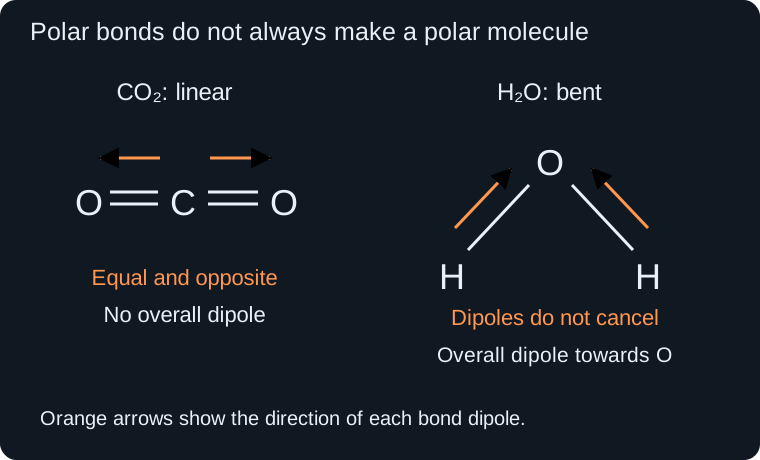
Swipe horizontally to view the whole diagram.
London forces, permanent dipoles and hydrogen bonds
London forces arise when fluctuations in electron density create instantaneous dipoles that induce dipoles nearby. They occur between all atoms and molecules. Larger, more polarisable electron clouds and greater intermolecular contact generally strengthen them. Polar molecules additionally have permanent dipole–dipole attractions. OCR groups these two types under van der Waals forces.
Hydrogen bonding involves H covalently bonded to N, O or F attracting a lone pair on N, O or F in a neighbouring molecule (or sometimes another part of the same molecule). In water, label Oδ−–Hδ+ and show a dotted attraction from Hδ+ to an oxygen lone pair on another molecule. H bonding is not an additional covalent O–H bond.
Compare similar-sized molecules to isolate the effect of hydrogen bonding. Do not claim a small hydrogen-bonding molecule must boil above every much larger molecule: overall London interactions also matter.
Choose the explanation that distinguishes the pair
Compare ethanol and dimethyl ether: both are C₂H₆O with the same electron count. Ethanol has an O–H donor and oxygen lone pairs, so its molecules can hydrogen bond to each other. The ether has oxygen lone pairs but no O–H/N–H/F–H donor, so it cannot make the same hydrogen-bond network in a pure sample. It still has London forces and permanent dipole attractions.
Now compare the ether with water as solvent. Its oxygen can accept a hydrogen bond from a water molecule, so “cannot hydrogen bond to itself” does not mean “cannot hydrogen bond with water”. Identify the donor and acceptor for the actual pair of molecules.
For pentane versus 2,2-dimethylpropane, both have the same formula and electron count, so a more-electrons argument cannot distinguish them. Pentane offers more intermolecular contact and generally stronger overall London attractions, giving the higher boiling point. For Cl₂ versus I₂, molecular size and polarisation instead provide the useful distinction.
| Pair | Useful distinction | Avoid |
|---|---|---|
| Ethanol / similar-sized ether | Hydrogen-bond donor present in alcohol | Pretending ether has no intermolecular forces |
| Pentane / branched C₅H₁₂ | Shape and surface contact | Claiming different electron counts |
| Cl₂ / I₂ | Polarisability of larger electron cloud | Breaking the X–X bond on boiling |
| Water / ice | Open hydrogen-bonded arrangement | Air trapped in gaps as the explanation |
Water’s unusual properties and molecular solubility
Water has a relatively high boiling point for such a small molecule because substantial energy is needed to overcome intermolecular hydrogen bonding. In ice the hydrogen-bonded open arrangement holds molecules farther apart on average than in liquid water, so ice is less dense. Each water molecule can participate as two H-bond donors and two acceptors in the ideal ice network.
A molecular solute dissolves favourably when new solvent–solute interactions compensate for interactions disrupted in both substances. Small alcohols can hydrogen bond to water and mix well; long hydrocarbon sections reduce water compatibility. Non-polar substances often dissolve better in non-polar solvents. Ionic solubility depends on lattice and hydration energetics, so avoid an “all polar things dissolve” rule.
Draw the hydrogen bond to the electron pair
Draw both covalent water molecules first. Put δ− on each O and δ+ on its H atoms. Show two oxygen lone pairs. The dotted intermolecular line must run from a hydrogen bonded to oxygen in one molecule to an oxygen lone pair in the neighbouring molecule. It must be visually different from the solid covalent O–H bonds.
Each water molecule can donate through two H atoms and accept at two lone pairs in the ideal ice network. The open arrangement holds molecules farther apart on average than in liquid water, reducing density. Do not explain this using stretched covalent bonds, air in the gaps or weaker London forces.
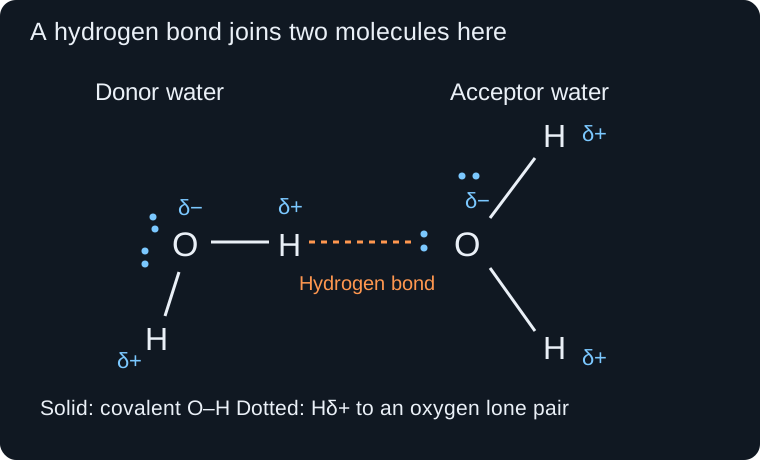
Swipe horizontally to view the whole diagram.
Quick checks
Original Finesse questions. Reveal the indicative worked solutions after attempting each question; these are not official OCR A mark allocations.
Q1. Why is CCl₄ non-polar?Show answer
Its four identical polar C–Cl bonds are arranged tetrahedrally so their dipoles cancel.
Q2. Why does iodine have a higher boiling point than chlorine?Show answer
I₂ has more electrons and a more polarisable cloud, giving stronger London forces; more energy is needed to separate its molecules.
Q3. Can pure ethane hydrogen bond?Show answer
No. Its H atoms are bonded to carbon, not N, O or F. It has London forces.
Q4. Why does ice float?Show answer
Its open hydrogen-bonded structure has a lower density than liquid water.
Q5. Does water boil by breaking the O–H covalent bonds in each molecule?Show answer
No. Boiling mainly overcomes attractions between molecules; the vapour still contains H₂O molecules.
Q6. Multiple choice: why is CO₂ non-polar? A C=O bonds are non-polar; B its two bond dipoles cancel; C it has no electrons; D all carbon compounds are non-polar.Show answer
B. C=O bonds are polar, but their equal opposed dipoles cancel in the linear molecule. A confuses bond and molecular polarity; C and D are false.
Q7. Can CH₃OCH₃ form hydrogen bonds with water? Explain without claiming pure ether hydrogen-bonds to itself.Show answer
Yes. Oxygen lone pairs in the ether accept hydrogen bonds from O–H groups of water. The ether has no suitable donor, so pure ether molecules cannot form that same donor–acceptor network with one another.
Q8. Extended response: compare the melting and conductivity of NaCl and iodine, then explain why water has unusual boiling and freezing behaviour.Show answer
NaCl has a giant lattice of oppositely charged ions; strong attractions require substantial energy to overcome. Its fixed ions prevent solid conduction but mobile ions conduct in the melt.
Iodine contains I₂ molecules held by London forces; melting separates molecules without breaking I–I bonds. Ordinary iodine samples lack freely mobile ions or electrons for conduction.
Water has intermolecular hydrogen bonding, requiring comparatively high energy to separate its small molecules. In ice an open hydrogen-bond network holds molecules farther apart than in liquid water, lowering density. Connect the correct particles, interactions and mobility to each property; these are indicative reasoning points, not official marks.
Sources
Sources and examiner guidance (reviewed 5 October 2026)
- OCR A H032 specification, version 2.0 — 2.2.2(a–o); AS outcomes and additional guidance. Reviewed 3 October 2026.
- Chemrevise — OCR A 2.2.2 Bonding and Structure — Pages 1–7; coverage reference. Explanations and questions on this page are original.
- OCR H032/02 mark scheme — June 2025 — Q5(a–b); printed pages 20–21. Read with the question paper.
- OCR H032/02 examiner report — June 2025 — Q5(a–b); printed pages 25–26. Question-specific assessment guidance.
- OCR H032/02 question paper — June 2025 — Question context for the question numbers listed with the mark scheme and examiner report.
- OCR H032/02 June 2024 mark scheme — Q1(a–b); printed pp. 9–10. Reviewed 5 October 2026.
- OCR H032/02 June 2024 examiner report — Q1(a–b); printed pp. 5–8. Reviewed 5 October 2026.
- OCR H032/02 June 2024 question paper — Q1(a–b); corresponding question context. Reviewed 5 October 2026.
Finesse Tuition is not endorsed by AQA or Chemrevise. All explanations and examples here are our own.