
Interpret singly charged isotope peaks and calculate weighted relative masses without confusing them with molar masses.
Carbon-12 is the reference
Relative isotopic mass is the mass of an atom of an isotope compared with one twelfth of the mass of a carbon-12 atom. Relative atomic mass, Ar, uses the weighted mean mass of atoms of an element relative to the same reference. Both are ratios and have no unit.
Mass number is an integer particle count. Relative isotopic mass is a measured mass ratio and need not be exactly an integer. Use the isotope masses supplied in a question. Relative molecular mass adds the Ar values in a molecule; for a giant ionic substance use relative formula mass instead.
Relative mass is a ratio, not a weighed amount
Choosing one twelfth of a carbon-12 atom as the reference gives a common scale for atoms and molecules. “Relative” means divide by that reference mass. The mass units cancel. A carbon-12 atom therefore has relative isotopic mass exactly 12 by definition, whereas its mass number is 12 because it contains six protons and six neutrons: identical numbers arise from different definitions.
Relative molecular mass compares the average mass of a molecule with that same reference. Relative formula mass applies the atom-ratio calculation to a formula unit when there is no discrete molecule, for example NaCl or SiO₂ in a giant structure. Neither quantity has g mol⁻¹ as its unit. Molar mass is a different quantity: mass divided by amount of substance.
| Quantity | What it describes | Example |
|---|---|---|
| Mass number | Nuclear particle count | A = 24 |
| Relative atomic mass | Weighted atomic mass ratio | Ar(Mg) ≈ 24.3, no unit |
| Relative formula mass | Sum of Ar values in a formula unit | NaCl: 58.5, no unit |
| Molar mass | Mass of one mole of specified entities | NaCl: 58.5 g mol⁻¹ |
Work from abundance, not the midpoint
A mass spectrum plots relative abundance against m/z. For the singly charged isotope ions in this part of OCR AS, z = 1, so the peaks identify the isotopic masses numerically. Instrument design and time-of-flight calculations are not required here.
Illustrative data: an element has isotopes of mass 10.0 and 11.0 with abundances 20.0% and 80.0%. Ar = (10.0 × 20.0 + 11.0 × 80.0)/100 = 10.8. The answer lies nearer 11 because that isotope is more abundant. If relative peak heights total 50 rather than 100, divide by 50.
Reverse example: isotopes 63 and 65 have mean 63.6. Let fraction f be isotope 63: 63f + 65(1 − f) = 63.6. Therefore 2f = 1.4 and f = 0.700: 70.0% of isotope 63, 30.0% of isotope 65.
Read a spectrum, then calculate the weighted mean
The illustrated spectrum uses invented singly charged isotope ions at m/z 20, 21 and 22 with relative intensities 90, 5 and 5. Multiply each mass by its own intensity: 20 × 90 = 1800; 21 × 5 = 105; 22 × 5 = 110. Add 2015 and divide by total intensity 100 to obtain Ar = 20.15. The result lies close to the dominant isotope at 20.
Peak height is proportional to abundance for this simple interpretation. A peak normalised to 100 is the reference tallest peak; that does not necessarily mean 100% of the atoms. With heights 100 and 25 at masses 50 and 52, divide by 125: Ar = (5000 + 1300)/125 = 50.4. Scaling every height by the same factor leaves the mean unchanged.
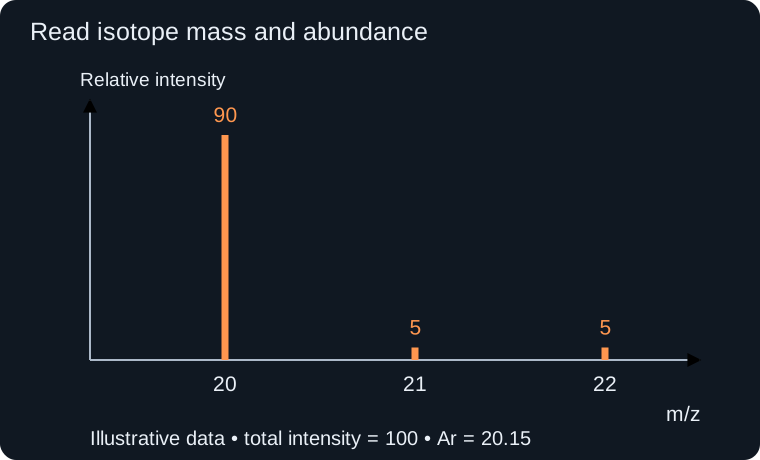
Swipe horizontally to view the whole diagram.
Find an unknown abundance without guessing
Suppose three isotope masses are 24, 25 and 26. The middle isotope has abundance 10.0% and Ar = 24.50. Let the percentage of mass-24 atoms be x; mass-26 abundance must then be 90.0 − x. The three percentages must sum to 100, not 110.
Write 24x + 25(10.0) + 26(90.0 − x) = 24.50 × 100. Expanding gives 2590 − 2x = 2450, so x = 70.0. The mixture is 70.0%, 10.0%, 20.0%. Substitution gives (1680 + 250 + 520)/100 = 24.50, verifying both the mean and the total.
Use a reasonableness check before accepting any result: percentages must be between 0 and 100 and a weighted mean must lie between the smallest and largest isotope masses. A negative percentage usually signals an algebra or data-pairing error.
Add every atom in the formula
For CO₂, Mr = 12.0 + 2(16.0) = 44.0. For Mg(NO₃)₂, relative formula mass = 24.3 + 2[14.0 + 3(16.0)] = 148.3. Brackets multiply the whole group. A molar mass has the same numerical value in g mol⁻¹ but describes mass per mole, not a dimensionless ratio.
Quick checks
Original Finesse questions. Reveal the indicative worked solutions after attempting each question; these are not official OCR A mark allocations.
Q1. Isotopes of masses 6 and 7 have abundances 10% and 90%. Find Ar.Show answer
Ar = (6 × 10 + 7 × 90)/100 = 6.9.
Q2. Peak heights at masses 20 and 22 are 3 and 1. Find the mean.Show answer
(20 × 3 + 22 × 1)/(3 + 1) = 20.5. Do not divide relative heights by 100.
Q3. Why does Ar have no unit?Show answer
It is a mass divided by a reference mass; the units cancel.
Q4. Find the relative formula mass of Ca(OH)₂ using Ca = 40.1, O = 16.0, H = 1.0.Show answer
40.1 + 2(16.0 + 1.0) = 74.1.
Q5. Two isotopes of masses 50 and 52 give mean 50.4. Find the lighter isotope percentage.Show answer
50f + 52(1 − f) = 50.4; f = 0.80, so 80%.
Q6. Application: singly charged isotope peaks at m/z 40, 42 and 44 have relative heights 8, 1 and 1. Calculate Ar.Show answer
Weighted total = 40(8) + 42 + 44 = 406. Total intensity = 10. Ar = 40.6, with no unit. Dividing by 100 would be wrong because these heights are not percentages.
Q7. Multiple choice: mass-10 and mass-11 isotopes give Ar = 10.8. What fraction is mass 10? A: 0.8; B: 0.2; C: 0.5; D: 1.8.Show answer
B. Let f represent mass 10: 10f + 11(1 − f) = 10.8, so f = 0.2. A swaps the isotope labels; C ignores the mean’s position; D cannot be a fraction.
Q8. Find the relative formula mass of Al₂(SO₄)₃ using Al 27.0, S 32.1 and O 16.0. Explain why this is not a molecular mass.Show answer
2(27.0) + 3[32.1 + 4(16.0)] = 342.3. The compound has a giant ionic structure; its formula specifies an ion ratio rather than one discrete molecule. Its molar mass is 342.3 g mol⁻¹.
Sources
Sources and examiner guidance (reviewed 5 October 2026)
- OCR A H032 specification, version 2.0 — 2.1.1(a–e); AS outcomes and additional guidance. Reviewed 3 October 2026.
- Chemrevise — OCR A 2.1.1 2.1.2 Atomic structure — Pages 1–2; coverage reference. Explanations and questions on this page are original.
- OCR H032/01 mark scheme — June 2025 — Q21(a–b); printed pages 9. Read with the question paper.
- OCR H032/01 examiner report — June 2025 — Q21(a–b); printed pages 18–19. Question-specific assessment guidance.
- OCR H032/01 question paper — June 2025 — Question context for the question numbers listed with the mark scheme and examiner report.
- OCR H032/01 June 2024 mark scheme — Q21(a); printed pp. 10. Reviewed 5 October 2026.
- OCR H032/01 June 2024 examiner report — Q21(a); printed pp. 18. Reviewed 5 October 2026.
- OCR H032/01 June 2024 question paper — Q21(a); corresponding question context. Reviewed 5 October 2026.
Finesse Tuition is not endorsed by AQA or Chemrevise. All explanations and examples here are our own.