Use three-dimensional connectivity to identify enantiomers and explain when a reaction produces a racemic mixture.
Compare whole groups, not just the first atom
A common chiral centre is a tetrahedral carbon bonded to four different groups. Two arrangements that are non-superimposable mirror images are enantiomers. A two-dimensional formula may hide this difference, so wedge-and-dash bonds are needed when the spatial arrangement matters.
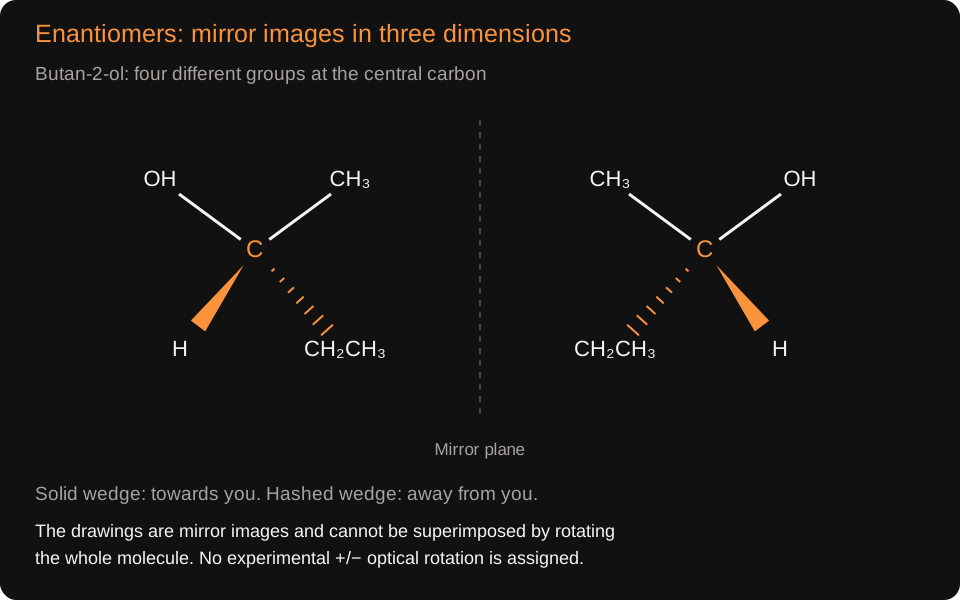
Compare each complete substituent. In CH₃CH(OH)CH₂CH₃, the central carbon has H, OH, CH₃ and CH₂CH₃: the two carbon-based groups are different even though both begin with carbon. In CH₃CH(OH)CH₃, the two methyl groups are identical, so that carbon is not chiral.
For alanine, the α-carbon carries NH₂, COOH, CH₃ and H and is chiral. Glycine has two H atoms at that carbon and is achiral. Do not use “all amino acids are optically active” as a rule.
Draw a tetrahedron with an explicit viewing convention
Draw two bonds in the plane of the page, one solid wedge towards the viewer and one hashed wedge away. Keep the same four substituent labels when drawing the mirror image. The mirror reverses their spatial arrangement, not their chemical identities.
Swapping two groups at a single tetrahedral centre reverses its configuration. Rotating the entire molecule does not. To decide whether two drawings show different enantiomers, mentally rotate the whole tetrahedron rather than moving one substituent independently.
With several potential stereocentres, inspect each carbon separately. Counting 2ⁿ gives only a possible upper limit for n centres; symmetry can reduce the number. That counting extension should not replace direct recognition of the chiral centres asked for in the OCR question.
Swipe horizontally to view the whole diagram.
A racemic mixture can contain chiral molecules
Pure enantiomers rotate plane-polarised light by equal magnitudes in opposite directions under identical conditions. A 1:1 mixture is racemic and has no net optical rotation because the effects cancel. This does not make the individual molecules achiral.
Optical activity is an experimental property of a sample; chirality describes molecular structure. A sample containing a chiral molecule is not necessarily optically active if equal amounts of both enantiomers are present.
The direction of rotation cannot be deduced merely by looking at whether OH is on the left or right of a page drawing. Do not invent a plus/minus assignment without experimental or supplied information.
Worked example: explain the new centre after addition
HCN addition to ethanal gives CH₃CH(OH)CN. The carbonyl carbon was planar before attack; afterwards it is tetrahedral and carries four different groups, H, CH₃, OH and CN. In an achiral environment attack from either face leads to a racemic mixture.
HCN addition to propanone gives (CH₃)₂C(OH)CN. It is also tetrahedral, but its two methyl groups are identical, so that carbon is not a chiral centre. The same reaction type therefore does not guarantee the same stereochemical outcome.
For a unfamiliar molecule, mark candidate tetrahedral carbons, list their four groups, reject duplicates, then consider any supplied symmetry or reaction conditions. This procedure is more reliable than looking only for an OH or NH₂ group.
Quick checks
Original Finesse questions. Reveal the indicative worked solutions after attempting each question; these are not official OCR A mark allocations.
Q1. Is the central carbon of 2-aminobutanoic acid chiral? Explain.Show answer
Yes. It is bonded to NH₂, COOH, H and CH₂CH₃, four different groups.
Q2. Why is glycine achiral at its α-carbon?Show answer
That carbon has two identical H substituents, so it does not have four different groups.
Q3. A racemic mixture shows zero optical rotation. Are its molecules necessarily achiral?Show answer
No. It contains equal amounts of two enantiomers whose opposite rotations cancel.
Q4. Does rotating a wedge-and-dash drawing turn one enantiomer into the other?Show answer
No. A whole-molecule rotation preserves configuration. Exchanging two substituent positions at a single tetrahedral centre changes it.
Q5. Predict whether reducing propanal creates a chiral centre at its carbonyl carbon.Show answer
No. Propan-1-ol has CH₂OH at that position, so the carbon has two H atoms. Planar attack alone is insufficient; the product must have four different groups.
Sources
Sources and examiner guidance (reviewed 6 October 2026)
- OCR A H432 specification — version 3.1 — 6.2.2, printed pp. 58–59; outcomes and additional guidance, with relevant Module 1 practical skills.
- Chemrevise — OCR A 6.2.2 — Pages 1–3; secondary coverage cross-check. Lesson explanations, data and questions are original Finesse material.
- OCR H432/02 mark scheme — June 2025 — Q22(a)(ii), Q21(d); printed pp. 30–31,34. Question-specific evidence, not universal marking rules.
- OCR H432/02 examiner report — June 2025 — Q22(a)(ii), Q21(d); printed pp. 46,50. Read with the corresponding question context.
- OCR H432/02 question paper — June 2025 — Q22(a)(ii), Q21(d); context for the assessment references, not reproduced questions.
Finesse Tuition is not endorsed by AQA or Chemrevise. All explanations and examples here are our own.