
Explain the shape of a neutralisation curve and choose an indicator by its transition range rather than by a memorised colour.
Distinguish equivalence, neutrality and endpoint
Equivalence occurs when acid and base have reacted in their stoichiometric ratio. It does not always occur at pH 7. The endpoint is the observed indicator change or instrumental criterion used to estimate equivalence. A useful indicator changes within the steep part of the curve so a small volume change gives a clear endpoint.
At 25 °C a strong monobasic acid–strong base equivalence is approximately neutral. A weak acid–strong base equivalence is alkaline because A⁻ reacts with water to form some HA and OH⁻. A strong acid–weak base equivalence is acidic because the conjugate acid of the weak base donates protons.
| Pair | Equivalence region | Indicator implication |
|---|---|---|
| Strong acid / strong base | Large steep rise across about pH 7 | Several transition ranges can fit |
| Weak acid / strong base | Buffer region; equivalence above pH 7 | Choose a range in the alkaline steep section |
| Strong acid / weak base | Equivalence below pH 7 | Choose a range in the acidic steep section |
| Weak acid / weak base | No sharp vertical section | No suitable visual indicator |
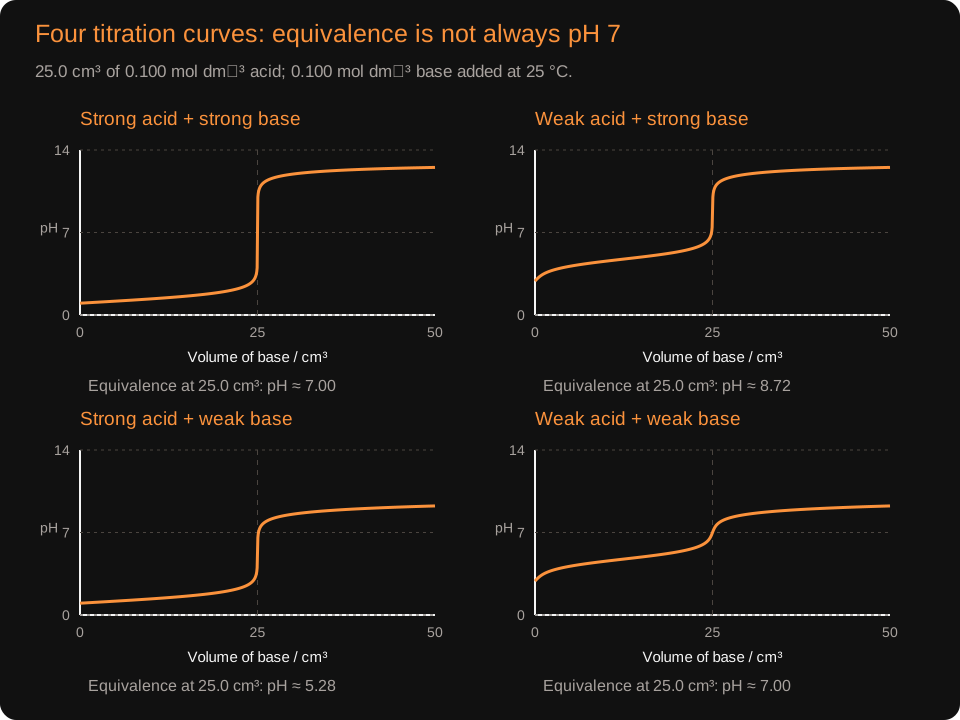
Swipe horizontally to view the whole diagram.
Read the chemistry at successive points
A weak acid titrated with a strong base begins at the pH set by Ka and initial concentration. Before equivalence, neutralisation creates a buffer. At half-equivalence, equal amounts of HA and A⁻ make [H⁺] ≈ Ka, so pH ≈ pKa. This is an approximate equilibrium relationship, not a claim that the solution is neutral.
At equivalence the weak acid has been converted mainly to its conjugate base, and a buffer formula requiring substantial remaining HA is no longer appropriate. Well beyond equivalence, excess strong alkali controls the pH: calculate excess OH⁻ moles divided by total volume, then use Kw.
For an original 25.0 cm³ sample of 0.100 mol dm⁻³ HA titrated with 0.100 mol dm⁻³ NaOH, equivalence is 25.0 cm³ and half-equivalence 12.5 cm³. If Ka = 1.80 × 10⁻⁵, pH at half-equivalence is about 4.74. At 30.0 cm³ added base, excess OH⁻ is 0.000500 mol in 0.0550 dm³; at 25 °C pH = 11.96.
Why the indicator changes colour
An indicator can be represented as a weak acid HIn with differently coloured HIn and In⁻ forms: HIn ⇌ H⁺ + In⁻. Added acid increases [H⁺] and favours HIn; added alkali removes H⁺ and favours In⁻. Its visible transition covers a pH range rather than one exact pH.
Suppose supplied data show a steep region from pH 7.8 to 10.6. An indicator with range 8.2–10.0 is suitable, while one changing at pH 3.1–4.4 is not. Justifying with the supplied curve is stronger than saying “phenolphthalein is always used for acids”. Use only a few drops so the indicator does not materially change the solution composition.
Measure a curve carefully: PAG11 skills
Calibrate the pH meter with suitable standard buffers according to its instructions, preferably bracketing the range of interest. Rinse the electrode with deionised water between solutions and gently blot excess water; do not rub the delicate glass bulb. Immerse appropriately, stir consistently and wait for a stable reading.
Pipette a known acid volume into the vessel and record pH after measured additions of base from a burette. Use smaller additions near the steep region, allowing mixing and stabilisation each time. Plot pH vertically against cumulative volume horizontally. Temperature affects both chemical equilibria and electrode response, so keep it controlled and report it.
Large additions can skip the sharp change and give a poor equivalence estimate. A dirty or poorly calibrated electrode can bias all pH readings; repeating many readings will not automatically remove that bias. The best improvement names the cause and explains how the change addresses it.
Quick checks
Original Finesse questions. Reveal the indicative worked solutions after attempting each question; these are not official OCR A mark allocations.
Q1. Does half-equivalence mean half the final pH?Show answer
No. It means half the stoichiometric equivalence volume has been added. For a weak monobasic acid–strong base titration, n(HA) ≈ n(A⁻) there, so pH ≈ pKa.
Q2. Why is weak acid–strong base equivalence alkaline?Show answer
The salt contains the conjugate base A⁻. It accepts a proton from water: A⁻ + H₂O ⇌ HA + OH⁻. The resulting excess hydroxide makes pH greater than neutral pH under those conditions.
Q3. A steep titration region spans pH 4.0–6.5. Choose between indicators with ranges 3.1–4.4 and 4.4–6.2.Show answer
The 4.4–6.2 range lies within the steep region and is the better choice. It changes across a small added-volume interval near equivalence; justify using the supplied ranges.
Q4. Explain why no ordinary indicator suits a weak acid–weak base titration.Show answer
There is no sufficiently steep pH jump at equivalence. The indicator would change gradually over too large a volume interval, making a sharp reliable visual endpoint unavailable.
Q5. A learner records pH only after each 5.0 cm³ addition near equivalence. Improve the method.Show answer
Use much smaller measured additions in the rapid-change region, mix and wait for stable pH. This resolves the curve instead of jumping across it. Calibration and temperature control address different possible errors and are still needed.
Sources
Sources and examiner guidance (reviewed 6 October 2026)
- OCR A H432 specification — version 3.1 — 5.1.3, printed pp. 45–46; outcomes and additional guidance, with relevant Module 1 practical skills.
- Chemrevise — OCR A 5.1.3 — Pages 1–8; secondary coverage cross-check. Lesson explanations, data and questions are original Finesse material.
- OCR H432/01 mark scheme — June 2025 — Q19(a–c); printed pp. 22–25. Question-specific evidence, not universal marking rules.
- OCR H432/01 examiner report — June 2025 — Q19(a–c); printed pp. 38–41. Read with the corresponding question context.
- OCR H432/01 question paper — June 2025 — Q19(a–c); context for the assessment references, not reproduced questions.
Finesse Tuition is not endorsed by AQA or Chemrevise. All explanations and examples here are our own.